


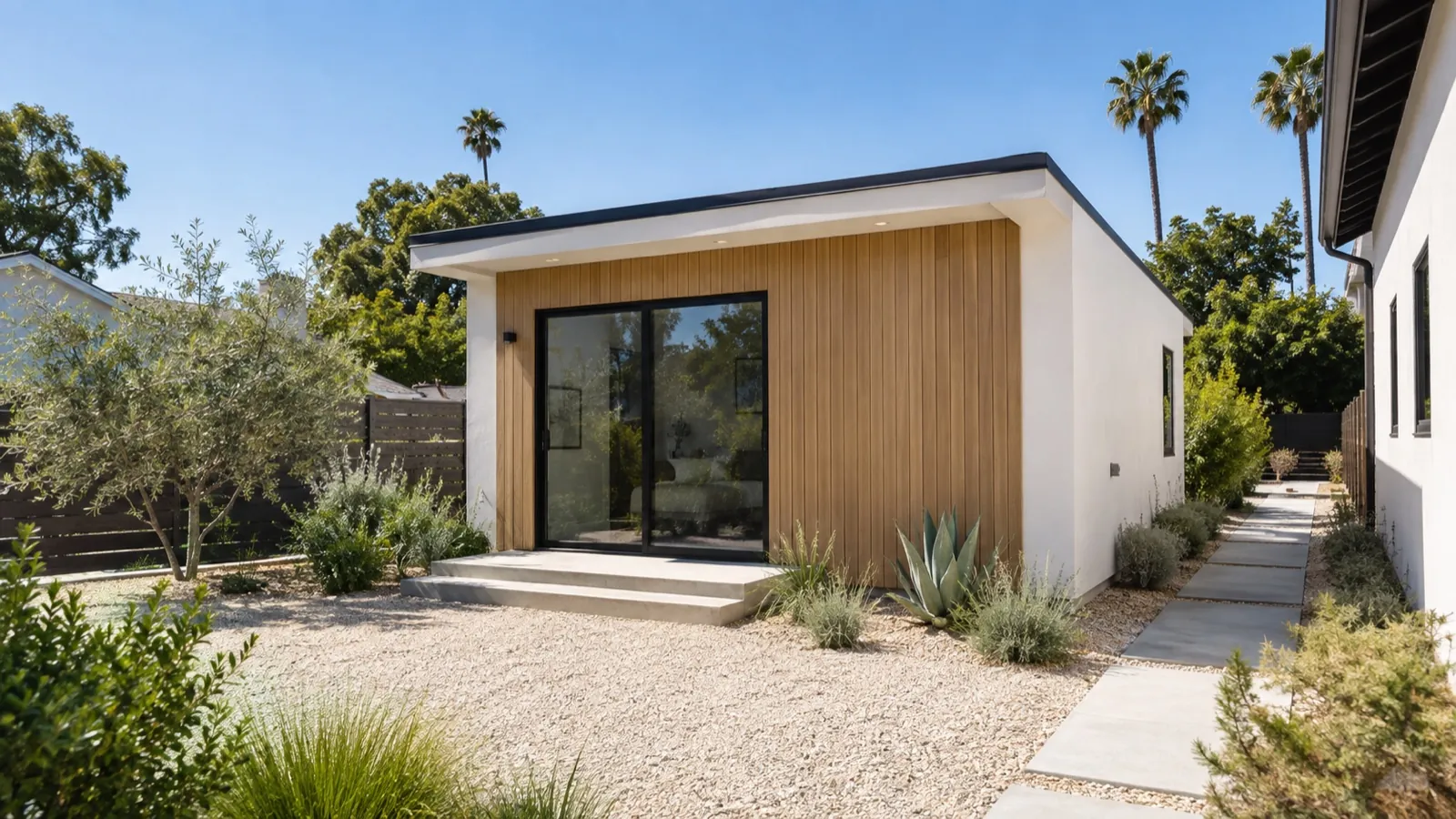
In Manhattan Beach or Hermosa Beach, many houses sit on narrow lots and are built upward. In Hollywood Riviera, especially on the side with a Torrance address, the lots are larger. In the episode, Dina Silveira points to that difference as one of the neighborhood's opportunities: room for an ADU.
"In Brazil we call it a 'puxadinho.' Except here everything is regulated, it's very strict." — Jason Lanzarini, in the episode
What an ADU is and what a junior ADU is
An ADU (Accessory Dwelling Unit) is a complete housing unit (bedroom, bathroom and kitchen) built on the same lot as a main house. It can be:
- Detached (detached): a separate small house in the backyard;
- Attached (attached): connected to the main house, with its own entrance;
- Conversion: using a garage or another existing structure, or built over the garage.
A junior ADU (JADU), in turn, is a unit of up to 500 square feet (about 46 m²) created inside the house itself, from a bedroom or part of the home. It's the option for people without a backyard, and Dina mentions it precisely for homes with little land.
One of her recommendations for anyone building in the backyard: give it a private entrance. With independent access, the unit works better as a rental and offers more flexibility for future use.
State law is on the owner's side
Since 2020, a series of state laws (including AB 68, AB 881 and SB 13) has required California cities to approve ADUs and JADUs on residential lots that meet objective requirements, without the city being able to deny them on subjective grounds. Later laws expanded that right. Among the general rules:
- On a single-family lot, you can have one ADU and one JADU in addition to the main house, subject to the law's conditions;
- The city cannot require side and rear setbacks greater than 4 feet (about 1.2 m) for the ADU;
- There is a minimum size the city must accept (units of up to 800 sq ft under standard conditions), even when local floor-area rules would say otherwise;
- Permit review has a legal deadline, and parking requirements have been sharply restricted.
Details such as maximum height, size above the minimum and fees vary from city to city. In Hollywood Riviera, which has stretches in the coastal zone, a coastal development permit may also be required. That's why the first step is always to consult the Torrance planning division with the address in hand.
Three common misconceptions
1. "I built the ADU, so I can sell it separately." In most cities, no. The ADU is part of the same lot and is sold together with the house. A 2023 state law (AB 1033) allows cities to authorize the sale of ADUs as condominium units, but it only applies where the city has chosen to adopt it. Anyone counting on that option needs to confirm the local rule first.
2. "With a big lot, I can split it." SB 9, in effect since 2022, allows in many cases a single-family lot to be split in two (each part at least 1,200 sq ft) and up to two units built on each. But there are conditions: the lot cannot be in certain protected or hazard areas, and the applicant must declare they will live in the property for three years. It's not an automatic split: it's an application with requirements. Jason raises this question in the episode, and the answer depends on the specific lot.
3. "If the law guarantees it, infrastructure doesn't matter." Dina rightly notes that sewer, water and electrical capacity matter. State law limits the fees cities can charge for small ADUs, but utility connections, any upgrades and school fees (charged on larger units) go into the budget. A new ADU is also new construction: it must meet California's energy code, which, depending on the project, includes solar panels.
What families are building for
The episode cites the uses that come up most in the South Bay:
- Long-term rental income, which helps cover the mortgage payment (short-term rental rules are another story, covered in a separate article);
- Housing for parents or relatives who stay for long periods, with privacy for both sides;
- Multigenerational homes: Dina says it has become a trend in Los Angeles to buy lots (sometimes with a house to tear down) and build housing for the whole family on the same lot, something the old rules didn't allow.
"The lots are bigger, and you'll have that possibility. You can also build over the garage." — Dina Silveira, in the episode
The backdrop is California's housing shortage: the state began encouraging ADUs, duplexes and small construction precisely to increase supply where infrastructure already exists.
Before buying with an ADU in mind
- Ask your agent for the lot size and site plan, and check whether the property is in the coastal zone.
- Ask the city about setbacks, height and fees before making an offer, or during the contract's investigation period.
- Get an estimate from an architect or a specialized company; there are professionals in the area who serve clients in Portuguese.
- If the ADU is for income, confirm that your financing and insurance cover that use.
This article is for information only and does not replace review by an architect, the city or an attorney. California ADU laws change often; confirm the current rule for the specific address.
Sources and verification
- California Department of Housing and Community Development (HCD) — ADU Handbook and state ADU and JADU legislation (AB 68, AB 881 and SB 13, of 2019, in effect since 2020; later updates).
- JADU: unit of up to 500 sq ft contained within the single-family residence (state law definition).
- AB 1033 (2023) — allows cities to authorize the separate sale of ADUs as condominiums; application depends on local adoption.
- SB 9 (2021, in effect since January 1, 2022) — urban lot split (lots of at least 1,200 sq ft) and up to two units per lot; HCD SB 9 Fact Sheet.
- California Energy Code (Title 24, Part 6) — energy efficiency and solar requirements for new residential construction.
- Transcript and chapters of episode 13 of the Cadê Moradia podcast (May 2026), with Dina Silveira and Jason Lanzarini.
Watch this part of the episode:
ADUs and expansion potential on the lots — starting at 12:00 · CADÊ BRAZIL
This article is a reference edition of episode 13 of the podcast and is subject to edits and editorial additions. For the full conversation, watch the episode. — Updated on 16/09/2026.