



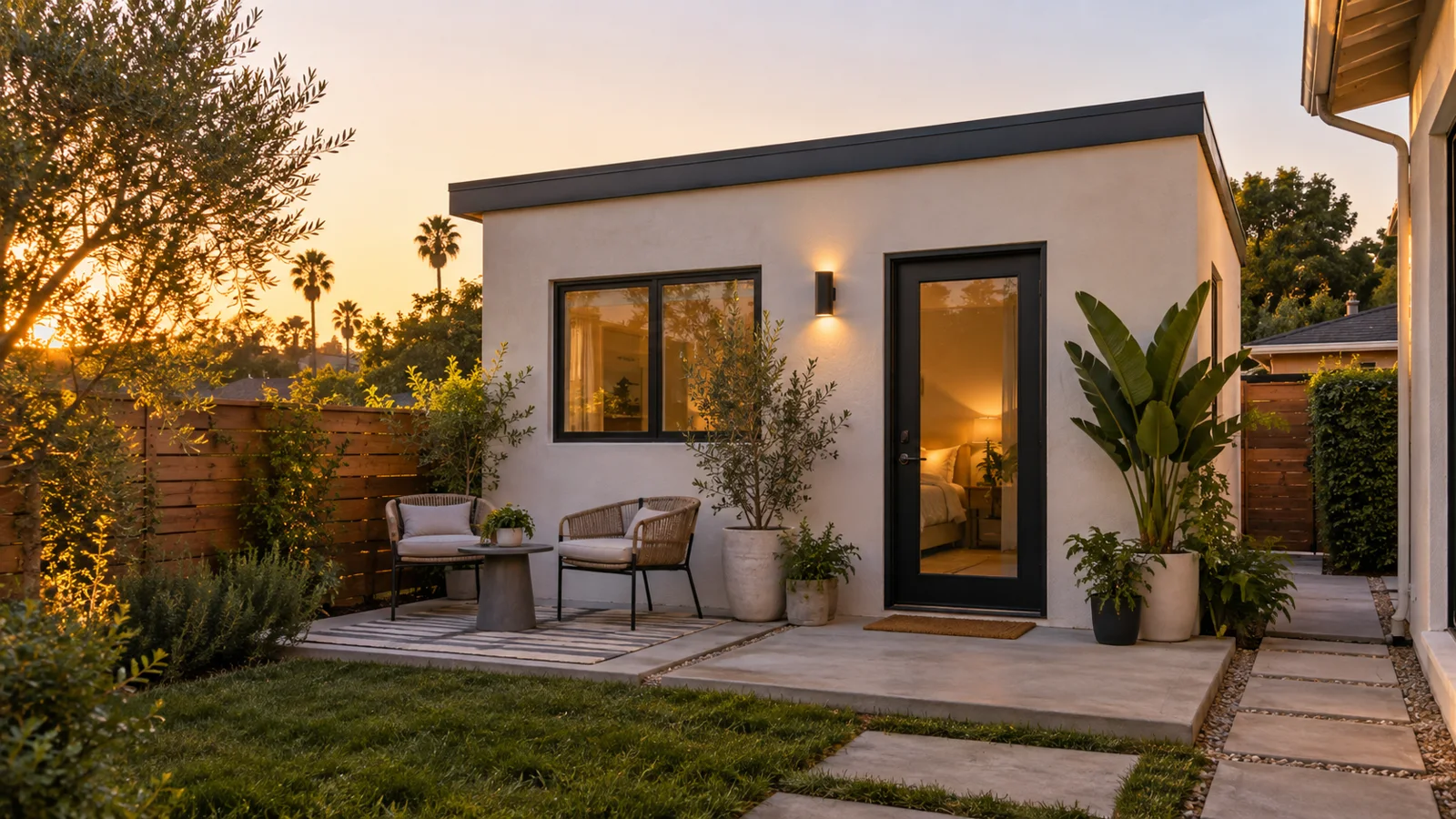
"If you own land today and you don't have an ADU, you're leaving money on the table." The line, said in the episode by one of the show's realtors, sums up the enthusiasm for the extra unit in the backyard. Builder Rafael Pozas, the guest, brings numbers from his own experience — and this article puts those numbers in context, because income and added value depend on a series of conditions.
How much value it adds
Rafael estimates that, from what he sees in the market and in conversations with agents, a house with an ADU carries a premium of about $150,000 over an equivalent house without the unit — and that, depending on the location, it can be more. A $1 million house would go, by that math, to $1.15 million.
The reason, for him, is flexibility: the ADU works for income, for hosting family, for the adult child who separated and came back, for someone saving up for college. But the real increase depends on the unit being permitted, on the quality of the construction, on demand in the area and on the appraisal (appraisal) done at sale or at financing. Rafael recalls that, early on, appraisers treated the ADU almost like a garage: the owner spent $200,000 and the unit was appraised at $50,000 or $70,000. Today, he says, the market is more mature.
How much it brings in
The client examples Rafael cites, as of the April 2026 recording:
- an ADU of 500 square feet (one bedroom, bathroom and living room) renting for $2,800 in Huntington Beach;
- a unit of about 524 square feet in Fullerton, in the same range;
- a unit above the garage, also in Fullerton, for about $2,000.
The demand is there, one of the realtors notes: anyone advertising a room for rent gets calls nonstop, from young couples to mothers with a child. Rafael says he once visited, in Santa Ana, a five-bedroom house where five strangers each paid $800 and shared the kitchen. Students, he says, consider an ADU first-class housing: privacy instead of a shared room.
The question Rafael asks anyone building to rent isn't "how many bedrooms," but "for whom": nurses near a hospital, students near a college, families near a school. The design comes out of the audience.
The math you have to do
Gross rent is not profit. Before deciding, into the calculation go:
- the total cost of the work, with the lot, utility connections and permits (see this series' article on costs);
- the interest on the financing used to build;
- the property tax: new construction is reassessed and adds value to the assessment base;
- insurance, maintenance and vacancy;
- the income tax on the rent;
- tenancy rules: in many California cities there are limits on increases and protections against no-fault eviction.
What you can't do: short-term rentals
Brazilians in particular ask whether they can put the ADU on Airbnb. Rafael's answer is no. State law allows cities to require ADUs to be rented for more than 30 days, and units created under SB 9 cannot be rented for 30 days or less. The legislation's goal is permanent housing — and, ADU aside, short-term rental is already restricted in much of the state's cities.
On the other hand, since 2024 the law (AB 976) bars cities from requiring the owner to live on the property in order to have an ADU. It is possible to rent out the main house and the unit at the same time — with the exception of the Junior ADU, where the owner-occupancy requirement can be applied.
How to finance it
Rafael says his business took off during the pandemic. With interest near 3%, owners refinanced the mortgage, pulled out part of their accumulated equity (cash-out refinance), something like $200,000, and built a second unit to rent. With higher rates, that route lost steam: trading a cheap mortgage for an expensive one rarely pays.
The routes cited and used today include:
- A construction loan (construction loan) or renovation financing that considers the property's value after the work — Rafael notes that today it is already possible to borrow based on the future appraisal, counting the ADU;
- a home equity line of credit (HELOC), without touching the main mortgage;
- your own funds, in part or in full.
For anyone buying a house that already has an ADU, there is a relevant change: under Fannie Maerules, the ADU's rent can be used to qualify the buyer for the mortgage, capped at 30% of the total income considered, on a one-unit property used as a primary residence. That's what one of the realtors mentions in the episode: the unit's income can help get a larger mortgage approved.
The multigenerational house
The ADU also changes roles over a lifetime. Rafael and the realtors talk about the multigenerational property: the parents live in the unit while the main house is remodeled; the adult child uses the ADU; and, in retirement, the owners move into the smaller unit and rent out the big house. Rafael also suggests that someone about to sell who hasn't built can get the plans approved and sell the house with the permit in hand, which makes it more attractive to a buyer.
This text is for informational purposes and is not a recommendation on investment, financing or tax planning. The rent and appreciation figures cited are the guest's benchmarks at the time of recording and vary widely by property and area; consult an agent, a lender and an accountant before deciding.
Sources and verification
- Government Code, section 66315 — authorization for cities to require ADU leases longer than 30 days; AB 976 (2023) — permanent ban on owner-occupancy requirements for ADUs.
- SB 9 (2021) — ban on rentals of 30 days or less for units created under the law.
- Fannie Mae Selling Guide — use of ADU rental income in qualifying, capped at 30% of qualifying income, on a one-unit property as a primary residence.
- Transcript of episode 9 of the Cadê Moradia podcast (April 2026), with the show's realtors and builder Rafael Pozas.
This topic comes from the full episode — watch it:
CADÊ BRAZIL
This article is a reference edition of episode 9 of the podcast and is subject to edits and editorial additions. For the full conversation, watch the episode. — Updated on 17/09/2026.