
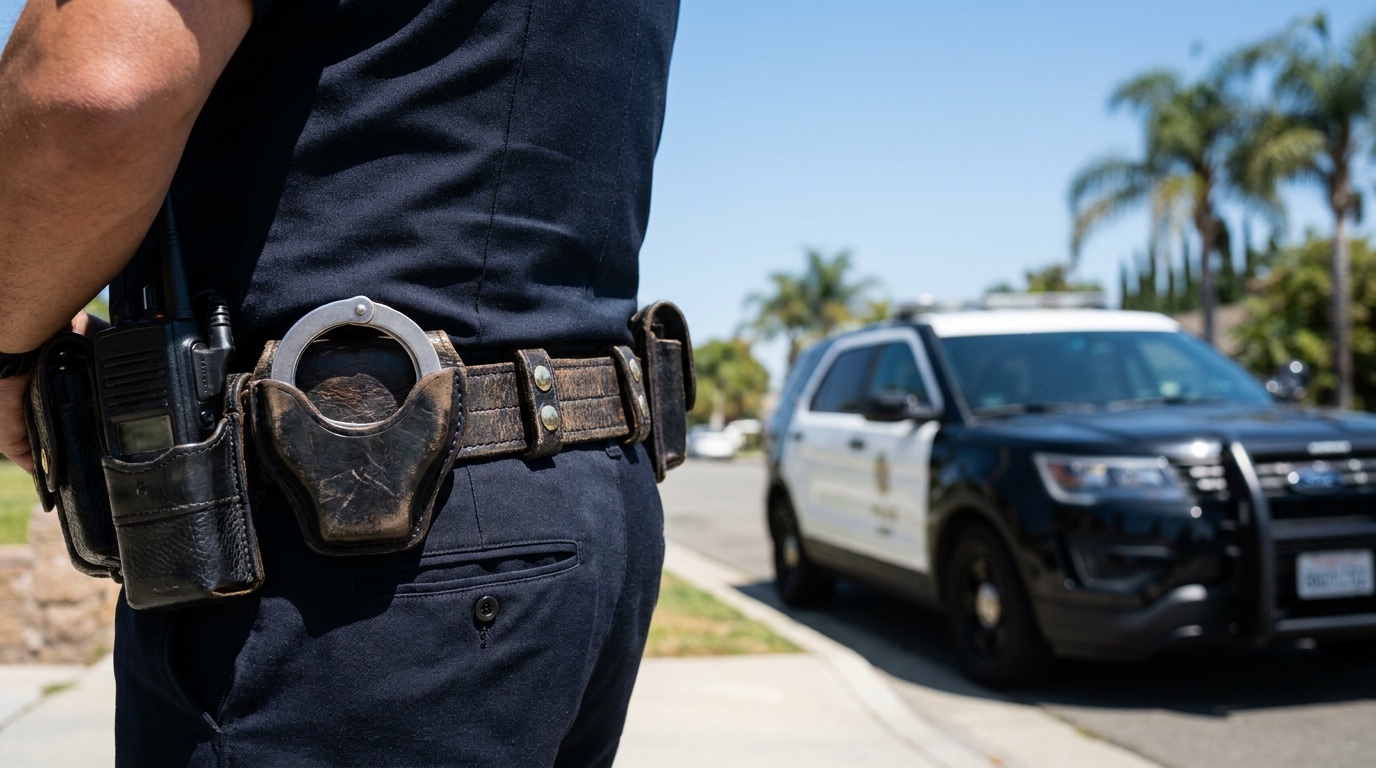
In an earlier episode, the conversation was about how to position the handcuff when taking someone into custody and when switching cuffs — the keyhole has to face a direction that lets you reach the lock without flipping the suspect upside down. The subject came back through the comments, with a detail that caught hosts Eliel Teixeira and Edwin Wu off guard: there's a handcuff with a keyhole on both sides of the frame. It's American, it's in the catalog — and even so, neither of them would use it.
The tip came from São Paulo
It was Ricardo Moreira, from the São Paulo State Department of Public Security, a card-carrying follower of the show, who brought it up. He said he owns several Brazilian wrist and leg cuffs, but his favorite is the ASP — an American brand — and one of the reasons, among other features, is exactly the keyhole on both sides of the frame.
The detail that made Eliel and Edwin stop: neither had seen that configuration on duty. Never held one, never heard of a handcuff with key access — to lock and unlock — on both sides. It took a trip to the ASP website to confirm the product actually exists. It's the reverse of the usual situation: the American novelty arrived by the hand of a Brazilian colleague.
In their day-to-day, in California, what circulates is Smith & Wesson and Peerless — both with access on one side only.
It's not a manufacturing limit: it's doctrine
The first hypothesis floated in the conversation was mechanical — maybe making both sides had some design cost, some weak point. That's not it. It can be manufactured — ASP manufactures it. American police don't use it because they don't want to.
The reason is doctrinal and fits in one sentence: the harder it is for the person in custody to reach the keyhole, the better. That's why a correctly applied handcuff ends up with the keyhole facing up and away from the hands of the person cuffed. The side left facing their body is smooth frame — nothing to work with there, not with fingertips, not with a paperclip, not with whatever they might have hidden.
With a keyhole on both sides, that blind side disappears. No matter how the cuff was applied, there will always be an accessible lock on the side they can work with. The convenience — never having to hunt for the right side to insert the key — belongs to the officer, who's with the suspect for just a few minutes. The risk belongs to custody staff, who are with them for hours.
"For me, having a keyhole on both sides wouldn't make anything easier. It's a novelty I didn't know existed — but even so, I wouldn't use it."
The math police equipment always runs
It's the classic trade-off: the accessory that saves the officer two seconds almost always opens a window for whoever's on the other side of the cuffs. The keyhole orientation is taught exactly because the time a cuffed person spends without someone watching over them — in the back seat, in the holding cell, waiting to be processed — is the time they have to try something. Removing an obstacle from that design for free, in exchange for convenience, doesn't add up.
The usual caveat applies: this is the doctrine as read in California, and by the department each of them works for. Handcuff specifications, approved brands and custody procedures change from state to state and agency to agency — in Brazil, in fact, Ricardo's preference shows the math can come out differently.
And here's the honest record: Eliel and Edwin admitted on air that they learned something new from a comment. That's exactly what the comment section is for. Thank you, Ricardo Moreira.
Who's talking here: Eliel Teixeira and Edwin Wu are active-duty police officers in the Los Angeles, California area — Brazilian by birth, American citizens, with long careers in law enforcement. On Palavrão Tático, they talk cop-to-cop and to enthusiasts, with no translation into civilian language.
Note: everything described here applies to California rules — and, on several points, to each one's specific department. In other U.S. states (Florida, Texas, New York…) the rules can be quite different.
Watch this part of the episode:
Equipment Review: ASP handcuffs with keyholes on both sides — advantage or risk? — starting at 27:10 · Palavrão Tático
This article is a reference edition of episode 42 of Palavrão Tático and is subject to edits and editorial additions. For the full conversation, watch the episode. — Updated on 09/08/2026.