

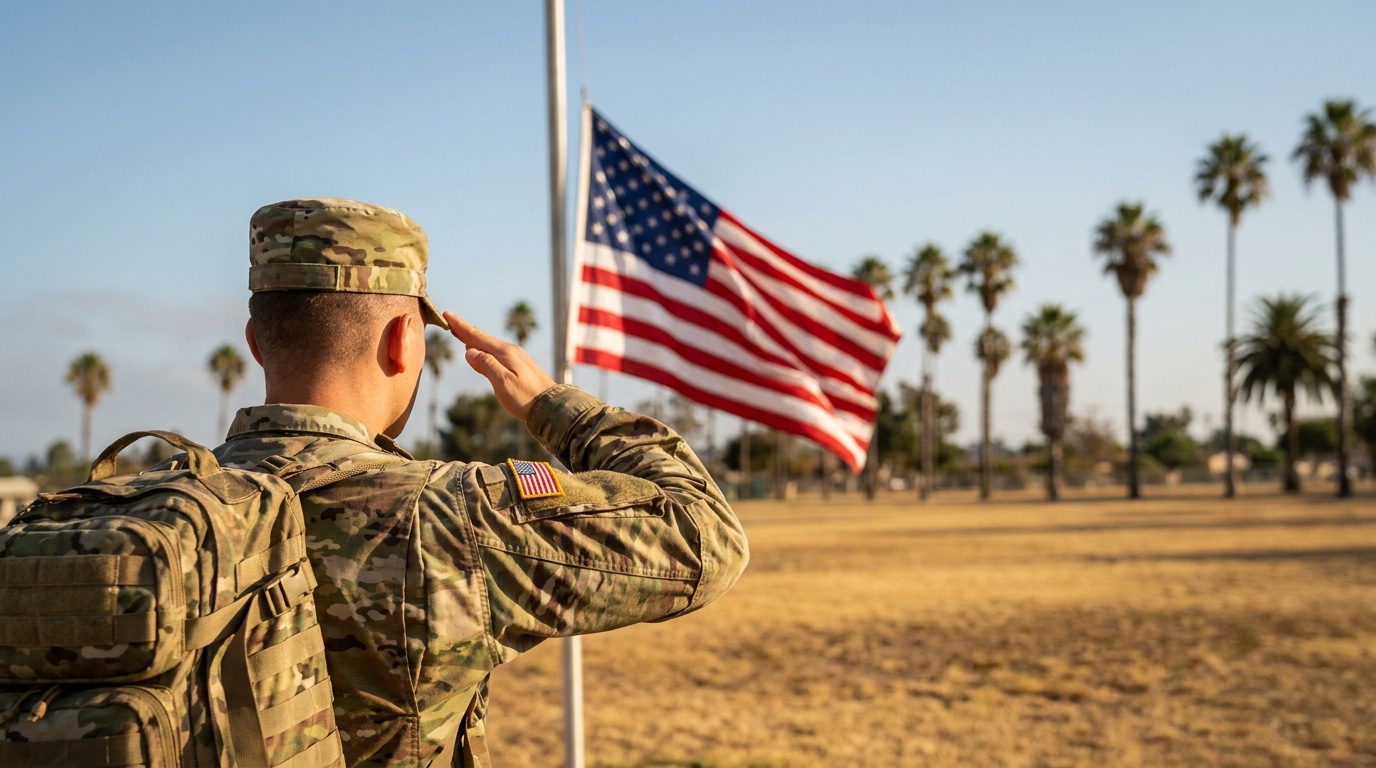
In Brazil, you "render" a salute. You don't "strike" one. And that single verb became the topic of an entire week of comments on Palavrão Tático, while the episode's real subject — the role of the FEB (Brazilian Expeditionary Force) in World War II — went unnoticed.
The "Crime of the Century" Was a Verb
Eliel Teixeira was on assignment with the U.S. Armed Forces, off the grid, when the clip went viral. Edwin Wu was left to handle the backlash alone, replying comment by comment: no, neither of them is a Brazilian service member; no, the podcast isn't recorded in Brazil; yes, they work in California, and the only Brazilian thing about it is the language.
Part of the criticism came with an explanation, and it's a fair one: beyond being flat-out wrong in Brazilian military vocabulary, in the Brazilian Army, saying "bater continência" (literally "to strike a salute") used to earn you push-ups. The verb is burned into the memory of anyone who served. On the other side, there was also a crowd insisting that "prestar" is a universal military term — which doesn't hold up: prestar is a Portuguese-language verb. In English, you don't "render" anything in that sense: salute is already the verb, and the formal phrase is render salute.
"I apologize to my fellow service members in Brazil for using the wrong verb. That one's on me."
A Civilian in Brazil, a Service Member in the United States
The point that got lost in all the pile-on isn't about grammar — it's about rank. Someone who serves in the U.S. Armed Forces and never served in Brazil is, by Brazilian military standards, a civilian. The criticism would be entirely fair if aimed at an active-duty service member in Brazil, who genuinely has no excuse for the wrong verb. For someone who never wore that olive-green uniform, it's a vocabulary slip, not a doctrine violation.
And there's a side effect that anyone making Portuguese-language content outside Brazil knows well: because the conversation is in Portuguese, the audience assumes Brazil. They assume Military Police, a Brazilian barracks, everything Brazilian — and whatever is actually said about American reality arrives distorted on the other end.
The FEB Got Left Out of the Conversation
The original video's context was something else entirely, and a good one: praising the FEB's role in Italy, pointing out that the pracinhas (Brazilian WWII infantrymen) still don't get the credit they deserve even in Brazil, and correcting a historical misunderstanding. The FEB did not operate "under" the U.S. 10th Mountain Division. Both were divisions, fighting side by side, subordinate to the same higher American command in the Italian theater.
That clarification sparked a heated exchange with Ricardo Henriques, director of one of the associations that preserve the FEB's memory — ANFIFEB — a discussion that ended in agreement (and friendship) once it became clear the clip had cut out the very word "alongside." The Tribute to the FEB page even reposted the video. None of that made it onto the timeline. The verb did.
The Clip Strips the Context — and Context Is the Story
That's the nature of the format. A social media clip exists to hook, not to explain — and the algorithm rewards exactly the line that starts a fight. Anyone who doesn't watch the full episode sees a fragment with no before and no after — and argues with a version of the speaker who never existed.
"Reading the comments, I can see the scale of Brazil's problem. Nobody heard anything he actually said, just the part where he 'struck' a salute."
The comment is from Israel Olímpio, a U.S. Navy veteran, and it sums up the final irony: had the episode gone out with no error at all, the tribute to the FEB would have earned less engagement than the wrong verb did. The mistake drew a crowd. The pracinhas' story didn't.
Who's talking here: Eliel Teixeira and Edwin Wu are active-duty police officers in the Los Angeles, California area — Brazilian-born, American citizens, with long careers in law enforcement. On Palavrão Tático, they talk cop-to-cop, for officers and enthusiasts, with no translation into civilian language.
Heads up: everything described here applies to California rules — and, on several points, to each host's specific department. In other U.S. states (Florida, Texas, New York…) the rules can be very different.
Watch this part of the episode:
Strike or Render? Explaining the Terminology Difference Between Brazil and the U.S. — starting at 1:45 · Palavrão Tático
This article is a reference edition of episode 42 of Palavrão Tático and is subject to edits and editorial additions. For the full conversation, watch the episode. — Updated on 17/08/2026.