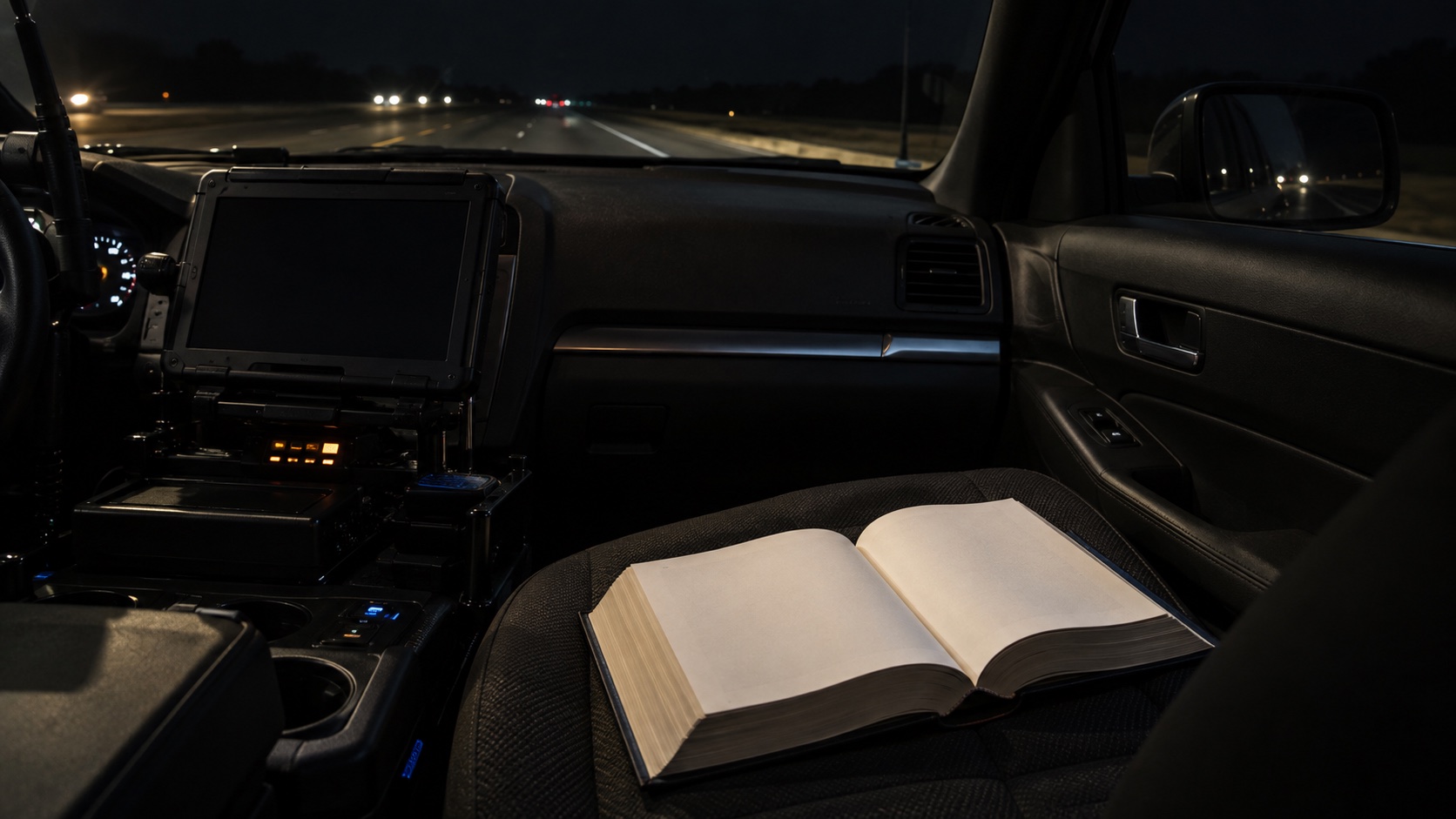


It's one of the topics that draws the most comments from Brazilian cops on the channel: what happens when an officer crashes the patrol car? The stories from Brazil vary — some describe colleagues passing the hat to pay for the repair, some agencies use a rental company with insurance, and the most common: a board decides whether the officer was “at fault”; if he was, he pays out of pocket or it comes off his paycheck. In California, the process is a different animal — and it's worth telling a real case, from early in a career, to show how it works.
The accident
Leaving the station to respond to a request for backup, pulling from a side street onto an avenue: a cab driver up ahead saw the patrol car in his mirror and hit the brakes. No time to react — the unit tapped the rear of the cab. Visible physical damage: none. But rear-ending someone here means automatic fault for whoever hit.
The investigation — in writing, with the right to a defense
Every accident involving a patrol car opens an administrative investigation: what happened, whether any rule was broken, whether procedure was followed. In this case, the report went all the way up to the chief of police with two formal allegations. The first — contributing to the accident, driving without due care — was ruled sustained (he hit the cab, that's a fact). The second — leaving the scene before the reporting unit arrived — was ruled unfounded: the cab driver had a customer to pick up, and forcing him to stay would have harmed a citizen; they agreed to file the report at the station afterward.
Final penalty: a verbal counseling. Extra training? No. Disciplinary record? No. And the entry comes off the officer's file in 6 months.
Who pays the bill
The repair — and any civil fallout, had the cab driver claimed injury and sued — comes out of the city's insurance. The officer doesn't pay a dime out of pocket… as long as he didn't act with negligence. Negligence changes everything: then the city can fire him and come after the money.
Lying is the one unforgivable sin
One detail that explains a lot about police culture here: in that entire investigation, lying would have been infinitely worse than the accident itself. An officer caught lying lands on the Brady list — the registry of officers whose word no longer holds up in court. Anyone on it can no longer sustain an arrest or give testimony: even without a firing, the career is over.
And the torn gear?
Uniforms and equipment damaged on duty follow the same spirit: in a foot pursuit in Inglewood that ended on the asphalt — pants torn, shirt torn, leather belt ruined — all it took was bringing the items to the supply room and walking out with a voucher for the uniform store. A complete new set, about US$ 300, no argument. On top of that, every officer gets an annual allowance (in the range of US$ 1,500 to 2,000) for uniform and equipment.
Who's talking here: Eliel Teixeira and Edwin Wu are active-duty police officers in the Los Angeles area, California — Brazilian-born, American citizens, with long careers in law enforcement. On Palavrão Tático, they talk cop to cop, for officers and enthusiasts, with no translation into civilian language.
Heads up: everything described here applies to California rules — and, on several points, to each host's specific department. In other U.S. states (Florida, Texas, New York…) the rules can be quite different.
Watch this part of the episode:
I crashed the patrol car: who foots the bill in Brazil and in the U.S.? — starting at 30:30 · Palavrão Tático
This article is a reference edition of episode 40 of Palavrão Tático and is subject to edits and editorial additions. For the full conversation, watch the episode. — Updated on 06/08/2026.