



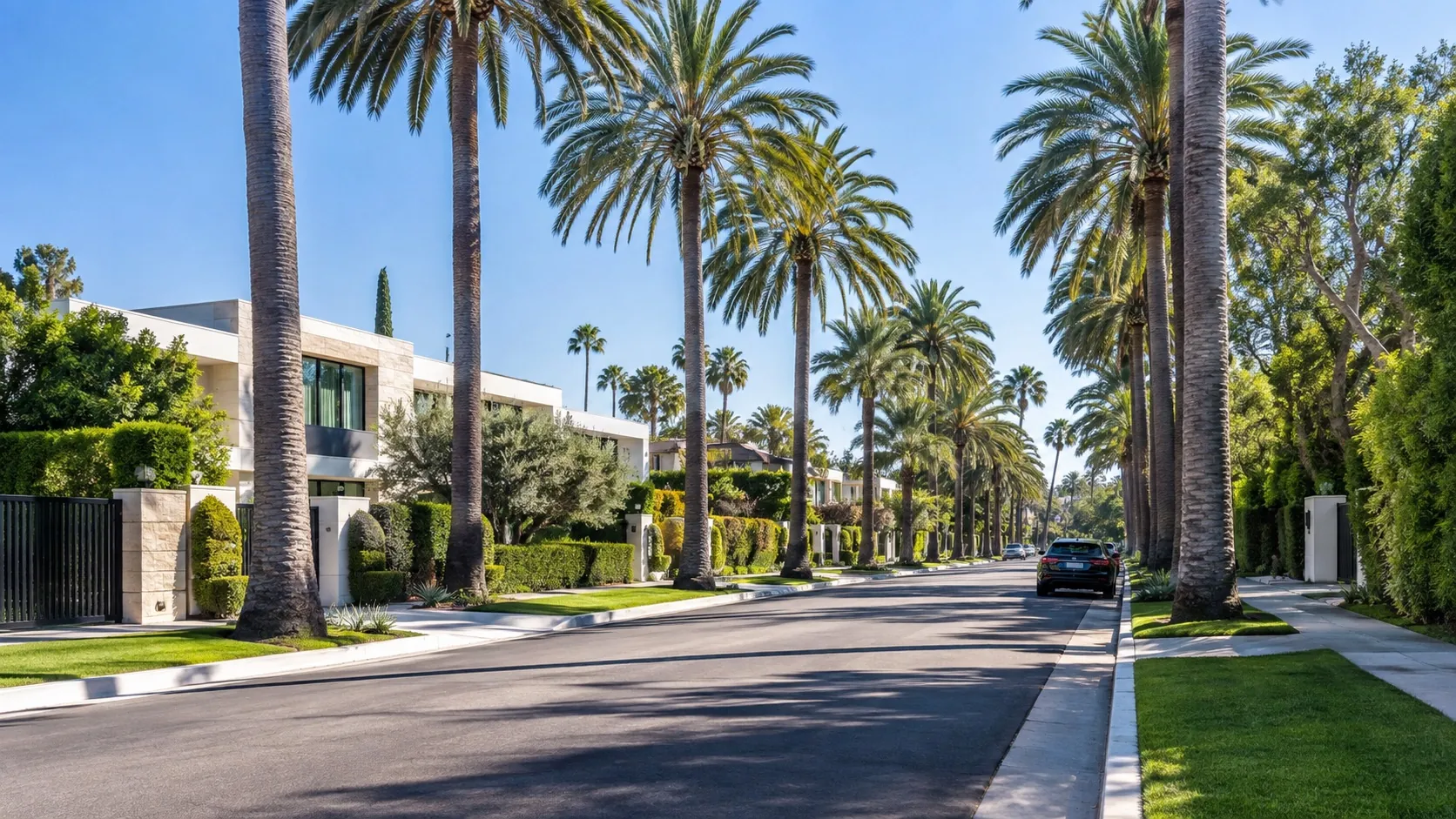
After touring cities with a more family-oriented profile, the episode makes its obligatory stop: Beverly Hills. The interest here isn't just curiosity — the city works as the yardstick for the region's luxury market, and the conversation brings numbers that break a common assumption.
The address as the product
The city is, in the words used on the show, world-famous, with ZIP code 90210 turned into a brand by decades of television and film. That has a practical consequence: demand isn't local or even regional — it comes from international buyers, celebrities and major business owners. It's that broad base that leads realtors to say the price there "always holds."
"When you pay to live in Beverly Hills, you're not paying for the square footage of the house. You're paying for the lifestyle and the prestige." — from the episode
The ranges cited on the episode
- Top tier: properties that run into the tens of millions of dollars — the episode mentions $50 million and notes that, up there, the sky's the limit.
- Good houses, below the top tier: starting around $2.5 to $3 million.
- Condos and studios: there are options starting around the $1 million mark, though few, generally on the east or south side of the city.
That last point is usually what surprises people. The image of Beverly Hills is the gated mansion, but the city does have residential buildings — and that's how people get the address without the mansion budget. Market prices change fast; the figures above reflect the realtors' read as of March 2026 and should be verified as of your search date.
Why the west side costs more
The conversation picks up a pattern already noted in other cities — the farther west, the more expensive — and, in Beverly Hills, finds a geographic explanation: it's toward the hills that the big properties sit. The realtors raise an interesting theory about where the pattern started: the wealthy settled that side before the city we know today even existed — and the market has priced it that way ever since.
Privacy instead of walls
An architectural detail noted on the show helps explain the city: the highest-value properties are barely visible from the street, but the barrier is rarely the tall wall Brazilians are used to. It's dense landscaping, hedges and gates — privacy built with landscaping instead of concrete. For someone arriving from Brazil, it's a visible cultural difference: same goal, solved a different way.
Costs that come with the address
- Property tax calculated on the purchase price — on a multimillion-dollar home, it's the biggest recurring expense.
- Insurance, which in California varies a lot depending on wildfire risk exposure and rebuild value.
- Maintenance and landscaping for a large lot.
- HOA dues, in the case of buildings, which on high-end properties include services and tend to run high.
Sources and verification
- City of Beverly Hills — municipal information about the city and its residential profile.
- Los Angeles County Assessor — property tax basis calculated from the purchase price.
- Price ranges cited ($2.5 to $3 million for houses, starting around $1 million for condos, top tier in the tens of millions) and buyer-profile read: realtors' assessment on the episode (March 2026).
- Transcript of episode 6 of the Cadê Moradia podcast.
Watch this part of the episode:
Beverly Hills: the market of LA's most famous city (approximate excerpt) — starting at 34:34 · CADÊ BRAZIL
This article is a reference edition of episode 6 of the podcast and is subject to edits and editorial additions. For the full conversation, watch the episode. — Updated on 18/09/2026.