
Until a few years ago, anyone who was the victim of a crime in São Paulo knew the drill: go to the precinct, wait in line at the front desk and tell the story to a clerk. In the second part of the conversation with Maurício de Thomazi, a chief of the São Paulo Civil Police, Palavrão Tático got into the subject that changed that drill the most: the Delegacia Eletrônica, the state's online police station. And on this side, the hosts explained how the same shift happened in the Los Angeles area — only starting from the opposite end.
From the front desk to the website
The Civil Police, the guest explained, has a long tradition of front-desk service. Someone gets robbed, has their house broken into, gets into a fight with the neighbor: they call for a patrol car, which may even respond to the scene, but in the end the instruction used to be the same — either the unit takes the person in, or they go to the precinct on their own to file the boletim de ocorrência, the police report, which then goes to someone for review.
Online reporting already existed, but it was narrow. Before the pandemic, according to the chief, there were about 12 to 14 incident types that could be filed online: vehicle theft, lost or missing documents and license plates, defamation-type offenses, threats — "half a dozen things."
The pandemic as the turning point
With everything shut down in 2020, the Civil Police realized it could — and had to — expand the service. The Delegacia Eletrônica started accepting remote reports for practically any type of incident. It sounds like just "adding more options to the website," but the guest described a full overhaul behind it:
- New manuals and protocols for each type of report;
- More officers assigned to reviewing the reports that come in online;
- A system that talks to the other institutions — the Military Police, the Municipal Civil Guard (GCM), the courts and the prosecutor's office;
- Retraining for the people doing triage, because the report formats changed;
- A different way of communicating with the public, explaining that some reports go to the precinct, others to a specialized unit and others wait for the victim to come forward.
"You had to rethink everything," he summed up. As he sees it, it was an institutional lesson: the police understood they needed a stronger digital presence in people's lives.
The numbers: 3.2 million reports in one year
The size of the change shows in the numbers the chief brought. According to him, in 2025 the Delegacia Eletrônica logged about 3.2 million police reports — close to 72% of all reports filed in the state that year, which by his count totaled between 3.6 and 3.8 million (the two figures don't add up exactly, so treat them as an order of magnitude). That's millions of reports that didn't tie up an officer at the front desk.
Some things still require an in-person report. The guest listed homicide (there's a body and a crime scene to preserve), rape, kidnapping for ransom and internal affairs cases, which have their own channel. "There are very few things you can't do," he said.
The hosts reacted right away: on this point, São Paulo is ahead of a lot of American agencies.
In California, the police always went to the citizen
The comparison explains why. Policing in the United States has always been designed as a service to the taxpayer: there's no culture of bringing the victim to the station to make the report official. The officer drives to the crime scene — or wherever is most convenient for the person reporting — and takes the police report right there, face to face. That's the personalized service the American public expects: the police come to serve them, not the other way around.
The large departments in the region also offer online reporting for non-emergency incidents, generally with no known suspect — the Los Angeles Police Department (LAPD) and the Los Angeles County Sheriff's Department (LASD) provide that option on their websites, for cases like petty theft, vandalism or lost property. Emergencies and crimes in progress are still 911, always.
After the pandemic, people don't even want the patrol car to come
What changed, the hosts said, was the public's mindset. The pandemic got people used to handling everything on a screen — groceries through Instacart, food through DoorDash, banking on the phone. And that expectation reached the police.
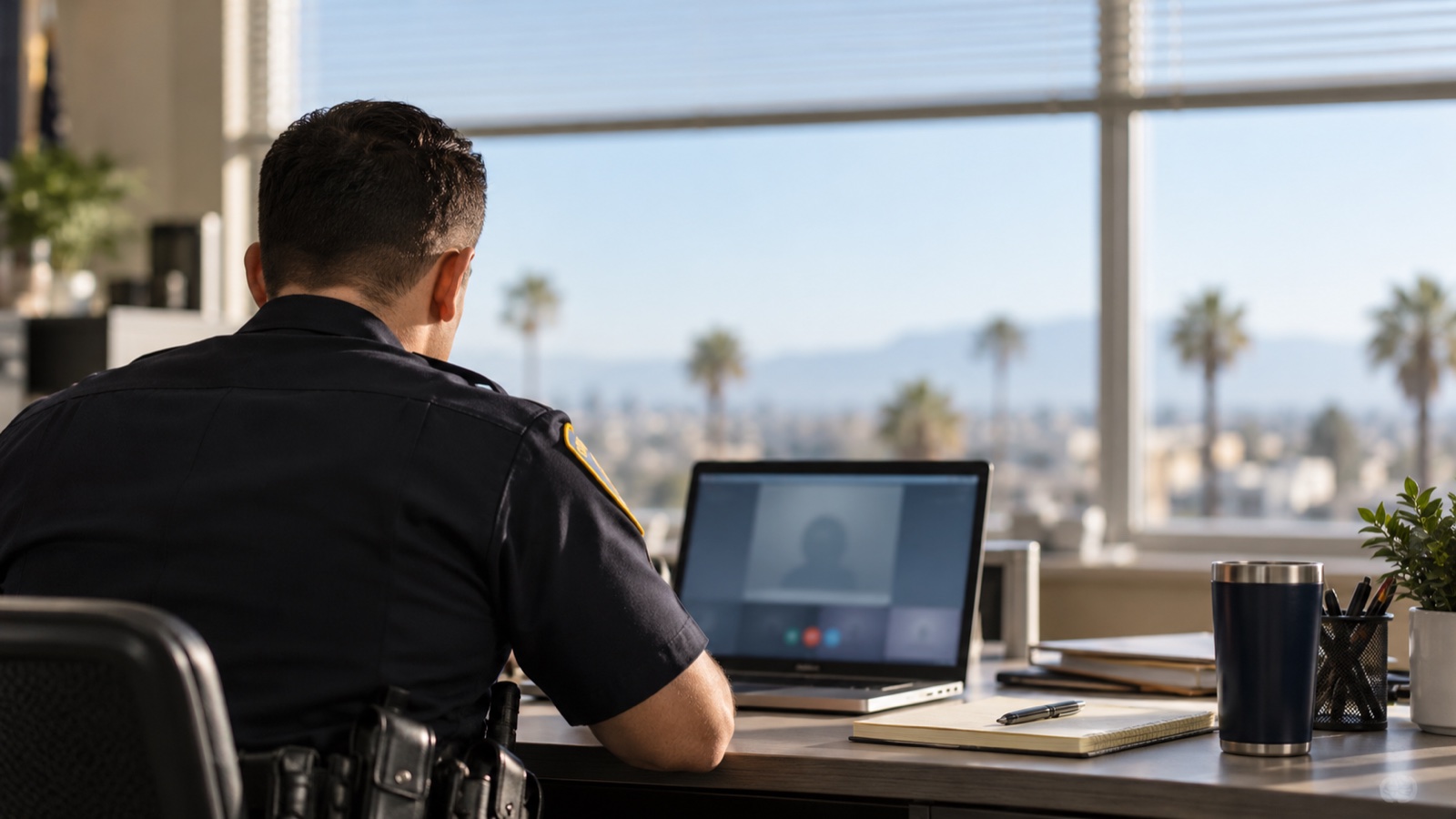
That's why, at one of their agencies, reporting gained another option: the person calls, books a time slot and, at the scheduled time, joins a Zoom-like video-call platform. On the other end, an officer asks the questions and completes the report. The team still offers to send a unit — and often hears there's no need. "I don't want to have to get dressed. Just send me the link and I'll log on at that time."
The chief added a criminology reading: the citizen's "existential profile" has changed, now used to accessing services and paying for things online. Money that used to be in the wallet is now on the phone. And that changes crime — a topic the conversation moved straight into, which we cover in the story about scams run by criminals in another state, from this same episode.
What changes for those on the front line
Two models, two starting points: São Paulo went from the front desk to the internet; California went from the citizen's doorstep to the internet. In both cases, the practical effect is similar. Filing a report no longer eats up a patrol unit or an on-duty officer for every simple incident, and the human work shifts to triage — deciding what goes to investigations, what goes to a specialized unit, what just needs to be on record. The people doing this need specific training, and the system needs to talk to the other agencies, or the online report becomes just a file sitting in a drawer.
Public expectations are different too. Before, the model was 190 or 911 and a patrol car at the door. Today, for anything that isn't urgent, it's the police website, a scheduled time and service on screen.
What the two of them think about it
In the episode, Eliel Teixeira and Edwin Wu talk about how remote reporting became part of the routine in the Los Angeles area after the pandemic and about the change in behavior of the public they serve. The comparison with the São Paulo Delegacia Eletrônica numbers brought by the guest is one of the highlights of the conversation.
Sources and verification
São Paulo State Department of Public Security (Secretaria da Segurança Pública), Delegacia Eletrônica (list of incident types that can be reported online). Los Angeles Police Department and Los Angeles County Sheriff's Department, online reporting pages for non-emergency cases. The 2025 figures (3.2 million reports and about 72% of the total), the number of incident types available before the pandemic and the description of the internal overhaul come from the guest, in the episode. The scheduled video-call reporting was described by the hosts based on the routine at one of their agencies.
Who's speaking here: Eliel Teixeira and Edwin Wu are active-duty police officers in the Los Angeles area, California — Brazilian-born, American citizens, with long careers in law enforcement. In this episode, produced in partnership with Criminocast, they welcome back Maurício de Thomazi, a chief with the São Paulo State Civil Police, professor of criminology and criminal procedure, and host of Criminocast.
Note: what is described here about American policing applies to California rules — and, in several points, to each host's specific department. In other U.S. states the rules differ. What is described about Brazil applies to the São Paulo Civil Police; each Brazilian police force has its own organic law and internal rules.
This article is a reference edition of episode 50 of Palavrão Tático and is subject to edits and editorial additions. For the full conversation, watch the episode. — Updated on 22/10/2026.