



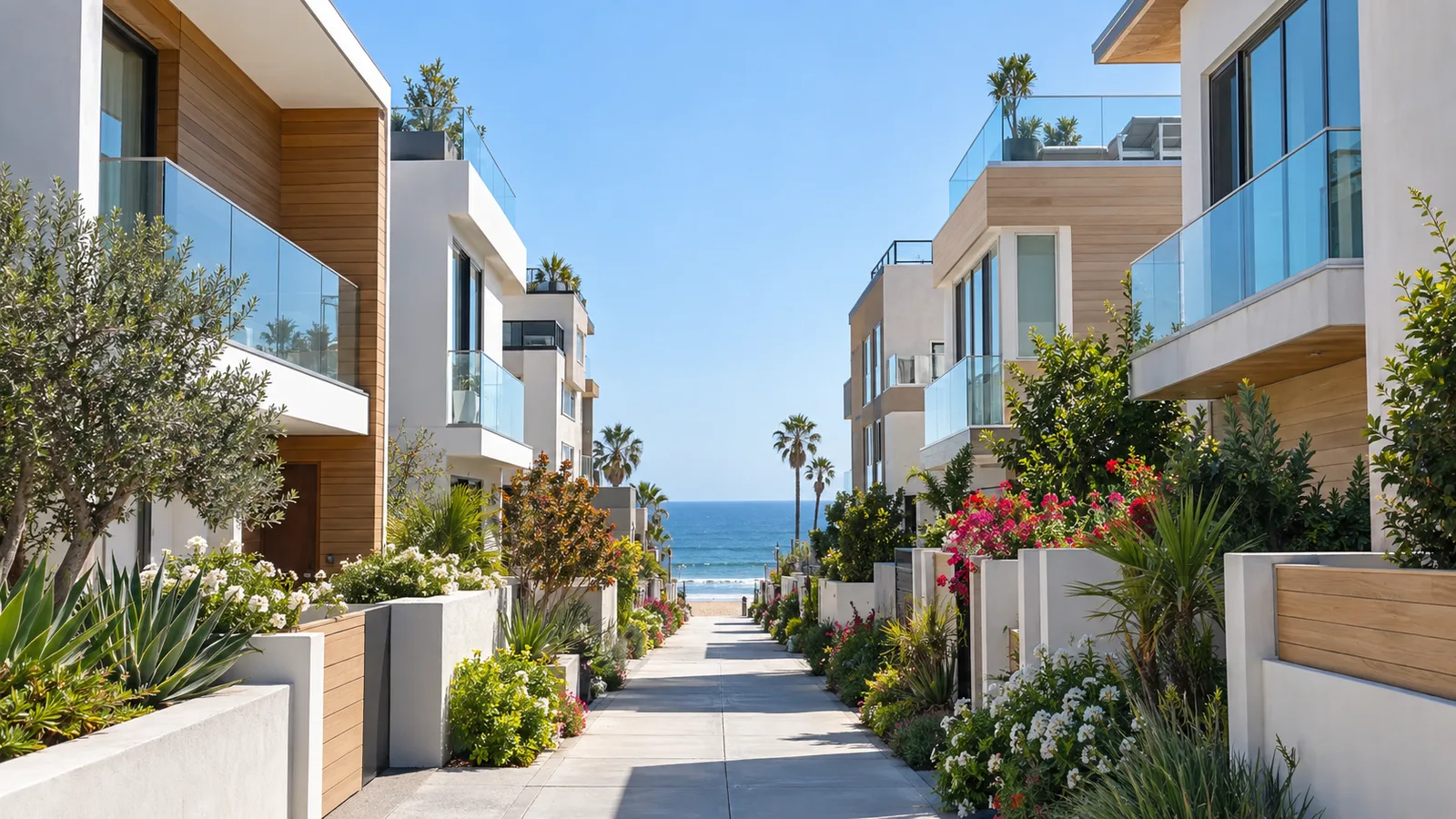
The first drive through the streets of Hermosa Beach usually gets the same reaction from people arriving from Brazil. Dina Silveira recalls hers in the episode: "My God!" The houses sit right next to each other, rise two or three stories and almost never have a backyard. It isn't careless urban planning — it's the format the city found for living close to the ocean on very small lots.
Americans call this type of house tall and skinny. Understanding its logic before touring properties avoids frustration and helps compare what each address delivers.
Small lot, vertical house
Hermosa Beach is known for its narrow lots. The solution was to build up: the garage on the ground floor and two or three living levels above it, with few interior walls to make the most of the space. Instead of a backyard, the outdoor space is usually the rooftop deck, often with an ocean view.
"Hermosa Beach is famous for having small lots. So it's very rare to see a house with a backyard." — Dina Silveira, in the episode
Height, on the other hand, has a ceiling. The city's zoning code limits building height — the general cap is 30 feet, about 9 meters — which is why you hardly see tall buildings along the shore. The rules for remodeling and expanding on the coast have their own article in this series.
According to Dina, there are areas of Hermosa with wider lots, where a bigger house and even a backyard fit. But they are farther from the sand, and the price rises along with the lot.
Townhouse, attached home and duplex: the terms you'll see in listings
In the episode, Jason Lanzarini and Dina also talk about townhouses — attached units, where two, three or more homes share the same lot or side walls. Dina notes that this format is more common in neighboring Redondo Beach; in Hermosa, tall, narrow houses dominate. When searching, it helps to know the terms:
- Single-family residence (SFR): a detached house on its own lot — even if narrow.
- Townhouse: a multi-story unit, usually with shared walls and often with a homeowners association (HOA) and monthly fee.
- Condo: a unit individually owned, with common areas managed by an HOA.
- Duplex/triplex: one lot with two or three independent units.
Walk streets: the front door on a car-free street
Hermosa's most distinctive setting is its walk streets: pedestrian-only lanes that run down from Hermosa Avenue to the Strand, the beachfront path. The houses on both sides face this flower-lined walkway, like a little village.
And the car? It stays in the back. Jason asks where residents park, and Dina explains: the garages open onto the alley, a service lane behind the houses, narrow, often one-way, used only to reach the garages. Visitors park on the street, farther inland, and walk down.
For buyers, this layout has practical consequences: moving and furniture deliveries require planning (the truck can't reach the door), guest parking is hard to find and the garage is often the home's only parking space. On the other hand, the car-free frontage is exactly what gives these addresses their charm — and their price.
Can you build an ADU?
California law encourages building ADUs (Accessory Dwelling Units), additional housing units on the same lot that can be rented out or house family members. Jason compares an ADU to a studio on the property. Dina notes that, under a recent rule, in some cities the unit can even be sold separately, with its own address and owner — something that depends on the city having adopted that option (how the state law works is covered in its own article in this newspaper).
In Hermosa, however, the shape of the houses gets in the way. An ADU over the garage, common in other cities, assumes a garage separate from the house. Here, in most cases, the house itself was already built on top of the garage, like a small two- or three-story building, and the lot has no room to spare.
"It's not for every address. If you intend to build an ADU, even in the future, it's important to talk to a specialist realtor who can show you areas with more options." — Dina Silveira, in the episode
The closer to the sand, the lower the chances. Farther inland, lots that can accommodate the addition occasionally come up — but that takes property-by-property research, with the zoning and coastal restrictions in hand.
The price of living by the ocean: salt air
Dina makes a point of saying this isn't a Hermosa problem but one shared by any beach city: humidity and sea salt encourage mold, leaks and termites, and the structure of American houses, largely made of wood, feels it. That's why preventive maintenance needs to be in the budget from the start, and the pre-purchase inspection becomes even more important — what to look for in that report is covered in its own article in this newspaper.
The same care applies to renters. Dina recommends keeping the house ventilated, opening windows and controlling indoor humidity, because mold affects the health of whoever lives there, whether the property is yours or not.
Checklist for touring a beach house in Hermosa
- Count the parking spaces. The alley garage is often all there is; ask about street parking permits.
- Go up to the rooftop. It's the house's "backyard": check the waterproofing, the railings and any signs of leaks on the floors below.
- Look at the stairs. Three stories is great at 30; think about who will be living there 15 years from now.
- Ask for the permit history. An enclosed deck, an added floor or a converted room must have been approved by the city.
- Don't count on an ADU without a study. If the extra unit is part of the plan, check feasibility before making an offer.
- Inspect with the salt air in mind. Humidity, mold and termites are the weak spot of beach houses.
Sources and verification
- City of Hermosa Beach — PLAN Hermosa: description of the walk streets between Hermosa Avenue and the Strand.
- Hermosa Beach zoning code — general 30-foot height limit for residential construction, with occasional exceptions reviewed by the Planning Commission.
- California Government Code, sections 66314 et seq. (state ADU law) and AB 1033 (2023), which allows cities to authorize the separate sale of ADUs.
- Transcript and chapters of episode 12 of the Cadê Moradia podcast (May 2026), with Dina Silveira and Jason Lanzarini.
Watch this part of the episode:
House Styles: What the famous "Tall and Skinny" houses are. — starting at 6:12 · CADÊ BRAZIL
This article is a reference edition of episode 12 of the podcast and is subject to edits and editorial additions. For the full conversation, watch the episode. — Updated on 17/09/2026.