
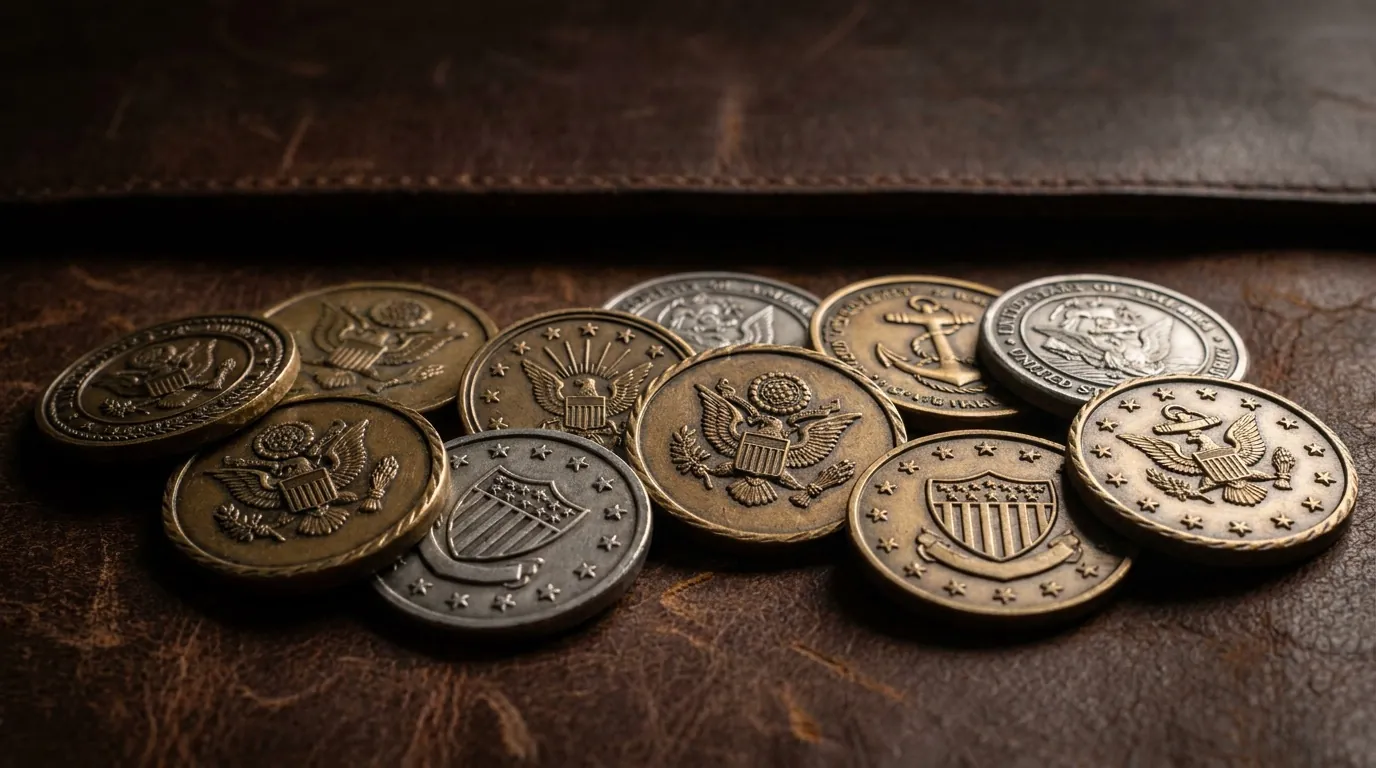
In the American police and military world there is a tradition that sums up entire careers in small pieces of metal: challenge coins — commemorative coins for units, projects and missions. A certificate is an institutional document; the coin is something else: a personal gift, from one person to another, usually marking a job done side by side.
And there is the folklore: among classmates, if someone slaps their coin on the bar, whoever does not have theirs in their pocket buys the round.
A collection that tells stories
Every coin opens a door. The one from the K9 unit of the Amtrak police — shaped like a dog's paw — is a reminder of a detail that surprises even Brazilians who have been in America for years: the rail company that crosses the entire country is private and has its own police force, with arrest powers like any other. The one from the Air Force investigations unit ("keep secrets we must", with Grogu on the artwork) marks a case against industrial espionage in the defense sector. And the one from the security project for the B-21 — the new American bomber, unveiled to the world in Palmdale, right here in California — carries on its back every agency involved in the operation.
There is even the coin received by hand from a four-star general — the commanding general of the United States Army forces. For scale: above a four-star, only the Secretary of War and the president. Most service members go their entire careers without shaking a one-star general's hand.
The coin that speaks Portuguese
But the piece with the most sentimental weight is the V Corps coin — the American Fifth Corps. The reason is pure history: it was under the American Fifth Army that the Brazilian Expeditionary Force fought in Italy in World War II, alongside the 10th Mountain Division, in the campaign that included the taking of Monte Castello. In the period photographs, General Mascarenhas de Moraes appears with the American Fifth Army patch on his uniform, commanding beside the American troops.
To this day there are Italian towns that still celebrate the day they were liberated by the Brazilian troops. And there is a little-known, highly recommended trip: visiting the battlefields of the Brazilian Expeditionary Force in Italy — the monuments are there, preserved.
"I grew up in Brazil and I only learned about the Expeditionary Force after I came here. It's a story that isn't told as often as it deserves."
Getting from an American general the coin of the very corps that fought alongside the Brazilian troops is the kind of thing that closes a circle: pride in being Brazilian, on both sides of the uniform.
Who's talking here: Eliel Teixeira and Edwin Wu are working police officers in the Los Angeles area, California — born in Brazil, American citizens, with long careers in law enforcement. On Palavrão Tático they talk cop to cop, for officers and enthusiasts, without translating any of it into civilian language.
Heads up: everything described here follows the rules of California — and, on several points, the specific department each of them works for. In other American states (Florida, Texas, New York…) the rules can be quite different.
Watch this part of the episode:
Challenge coins: the history behind the generals' coins — starting at 51:25 · Palavrão Tático
This article is a reference edition of episode 40 of Palavrão Tático and is subject to edits and editorial additions. For the full conversation, watch the episode. — Updated on 06/08/2026.