



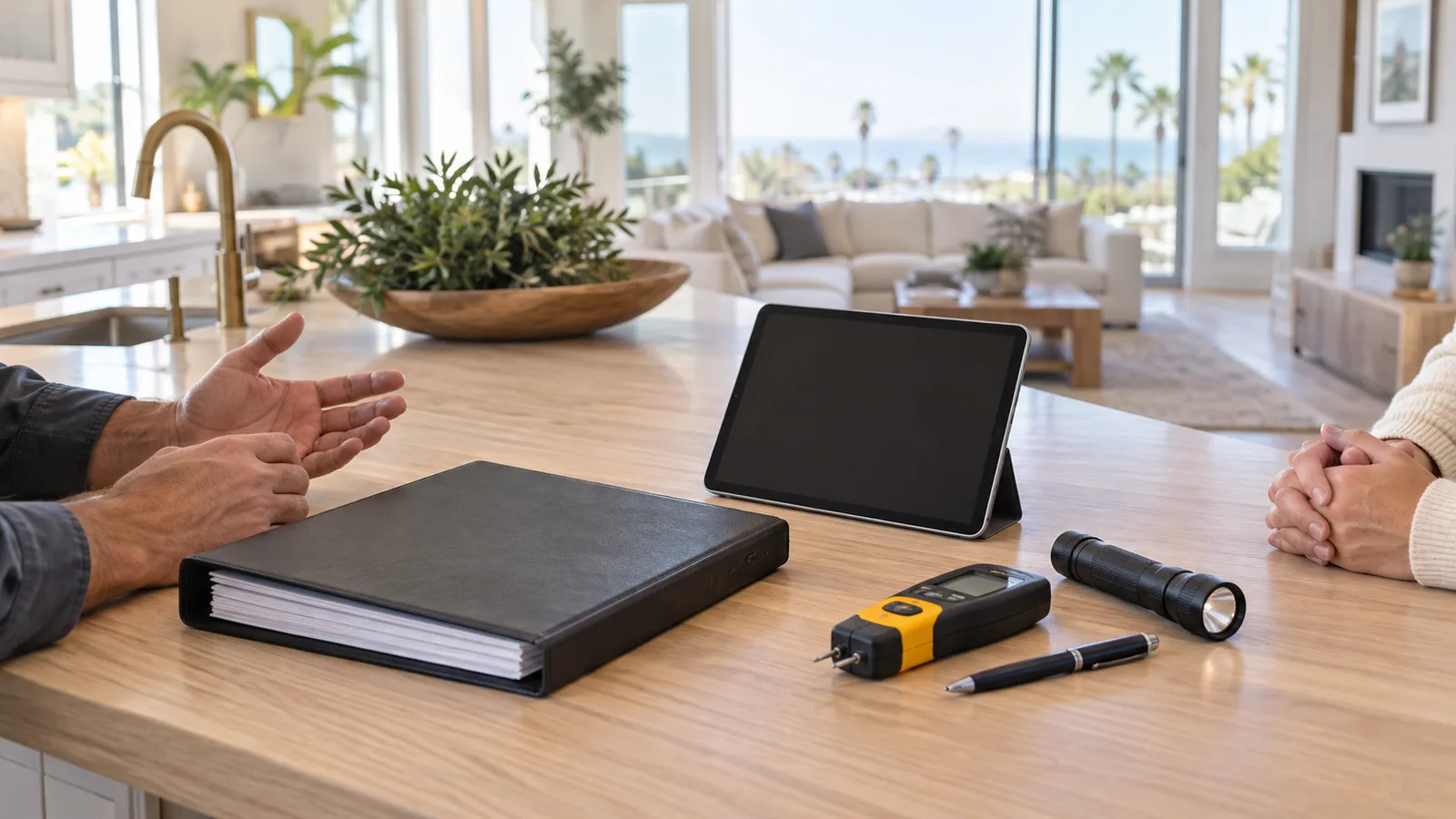
When you buy a house in the United States, few decisions carry as much weight as choosing the inspector. During the contingency period — the window in which the buyer can still examine the property and walk away or renegotiate — the inspector is the one who tells you what is behind the fresh paint. In the episode, the show's realtors call the inspection one of the most important parts of the contingency.
Even so, plenty of people hire the first name that comes up. Aguiar, the home inspector featured in the episode, explains what the rules actually are and what is left for you to check.
Is there an inspector license in California?
Not in the sense of a license issued by the state government. Unlike states such as Texas and Florida, which require a state license, California does not license home inspectors. In practice, the credential the market goes by is certification from professional associations. Aguiar works through InterNACHI (International Association of Certified Home Inspectors), which requires monthly dues, continuing education hours and periodic exams; without keeping the certification current, an inspector loses the membership number — and, he says, can't even use the main reporting platforms in the business. Another relevant association in the state is CREIA (California Real Estate Inspection Association).
What California law requires of the inspector
Even without a license, the work is regulated. The Business and Professions Code, sections 7195 to 7199, defines what a home inspection is and sets rules of conduct. Among them:
- the inspection must meet the standard of care of a reasonably prudent inspector, with a visual examination of the property's accessible systems and components;
- it is an unfair business practice for an inspector to offer or perform repairs, for a fee, on a house that they or their company inspected in the previous 12 months;
- it is prohibited to inspect a property in which the inspector has a financial interest, or to pay or receive a referral fee tied to the sale;
- the inspector's pay may not depend on the outcome of the inspection or on the deal closing;
- contract clauses that waive or limit the inspector's liability for error are, as a rule, void.
That last combination is what protects the buyer: the inspector doesn't earn more if the house sells, and can't sell the fix for the problem they found themselves.
Why construction experience counts
Aguiar got into the trade at the urging of a Brazilian friend who does inspections in Texas, but he says what holds the work up is knowing how to do repairs: replacing drywall, hardwood flooring, shock-protected outlets. The logic, in his words, is simple: someone who can't replace an outlet can't evaluate an outlet; someone who can't adjust a door can't tell you whether it is out of adjustment.
He criticizes a model common at large firms: teams of dozens of people paid by the hour, often beginners, pushed to do three inspections a day. The show's realtors agree that the result can be a report that scares people for no reason — or that misses what matters.
Who is the inspector's client?
The question comes up in the episode: if the agent made the referral, who does the inspector work for? Aguiar is blunt: the client is whoever signs the inspection agreement (the contract) and pays for it. Usually that's the buyer. In his system, the agent shows up as an agent, not as the client.
The realtors point out that the buyer has the right to pick whichever professional they want; the agent can suggest names, but the choice belongs to the person buying. And Aguiar sums up the principle: helping close the sale is not hiding a problem.
"Helping close the sale doesn't mean lying, it doesn't mean leaving problems out, it doesn't mean hiding things." — Aguiar, in the episode
An inspection ordered by the seller
The seller can also order an inspection before listing the house. But, as the participants point out, if the seller has a report, it has to be handed to the buyer: in California, the seller is required to disclose what they know about problems affecting the value or desirability of the property. That does not replace the buyer's inspection, which the buyer is entitled to carry out within the contract window.
The question the inspector should not answer
Aguiar tells of a case that left him "pale": at the end of an inspection, the buyer asked the inspector whether he would buy the house, and the answer was "no" — on a house in excellent condition. The inspector's job is to describe conditions, not to give a buying opinion or estimate what each repair costs. Estimates come from a licensed contractor; the decision belongs to the buyer, with the agent.
A checklist for hiring
- Ask for the certification and verify it on the association's website (InterNACHI, CREIA or another).
- Ask about hands-on experience in construction and how long they have been inspecting in your area.
- Ask for a sample report. Check whether it has photos, a clear location for each problem and language you can understand.
- Confirm the insurance for professional liability (errors and omissions) and general liability.
- Ask what is left out and which specialized inspections they recommend (roof, sewer, termites, mold).
- Be there at the end. A live walkthrough makes clear what is serious and what is a detail.
- Be wary of anyone offering to do the repair. In California, that is prohibited on the house they just inspected.
This text is for informational purposes and does not replace legal advice. Confirm the current status of the rules and credentials directly with the entities cited.
Sources and verification
- California Business and Professions Code, chapter 9.3 (sections 7195 to 7199) — definition of a home inspection, standard of care, prohibition on repairs to a property inspected in the previous 12 months, conflicts of interest and the voiding of liability-limiting clauses.
- InterNACHI (International Association of Certified Home Inspectors) and CREIA (California Real Estate Inspection Association) — certification and continuing education requirements.
- California Civil Code, section 1102 and following — seller disclosure duties on residential property.
- Transcript and chapters of episode 8 of the Cadê Moradia podcast (April 2026), with inspector Aguiar and the show's realtors.
Watch this part of the episode:
Licenses and certifications: what's required in California? — starting at 4:12 · CADÊ BRAZIL
This article is a reference edition of episode 8 of the podcast and is subject to edits and editorial additions. For the full conversation, watch the episode. — Updated on 17/09/2026.