How do you prepare a child for an armed attack at school without stripping away their sense of safety? It's one of the hardest questions parents and teachers face in the United States, and it runs through one of the most personal segments of episode 45 of Palavrão Tático. On one side, guest Marcelo Bini — an active assailant response instructor who co-wrote a children's book with his son on the topic. On the other, the experience of one host as a father, who talks openly with his kids about risk and keeps a ballistic panel tucked inside their backpacks. In between sits a tension with no easy answer: realistic training works for adults, but a child isn't a police officer.
Blue blood for the little ones
The guest shares a detail that captures the dilemma well. When his training company visits a school, the simulation changes depending on the students' age: for children under 8, the mock blood used to teach first aid can't be red — it's blue. The logic is pedagogical: young children have a harder time separating make-believe from reality, and a scene that's too realistic can be traumatizing.
That concern has technical backing. The National Association of School Psychologists (NASP), in partnership with the organization Safe and Sound Schools, published guidelines on armed assailant drills in schools that recommend exercises appropriate to students' age and developmental stage, advance notice to families and staff, attention to students with a history of trauma, and caution around realistic simulations involving students — sound effects, armed actors, or staged injuries are recommended for adult training, not for children.
One procedure for any emergency
The solution the guest describes is folding the armed attack into a protocol shared across several kinds of emergencies:
"If an assailant comes into the school, or if someone gets hurt, twists a knee playing outside, the procedure is the same. If there's a fire, the procedure is the same. Tornado, hurricane: run, hide, fight."
The advantage, he explains, is twofold: it levels the playing field for everyone and conditions the brain to react the same way to anything out of the ordinary — without exposing the child to the idea of an "active shooter." It's the logic U.S. authorities call the all-hazards approach, found in the federal guide for school emergency operations plans published by the Department of Education and partner agencies in 2013. The "Run, Hide, Fight" slogan became widely known from a 2012 video produced by the City of Houston with support from the Department of Homeland Security (DHS), and it became the basis for federal guidance to civilians. In schools, standardized protocols such as the Standard Response Protocol, from the I Love U Guys Foundation, use simple, consistent commands across different situations.
In California, every public school must maintain a comprehensive school safety plan, reviewed annually, under the state's Education Code — it's within that plan that emergency procedures and drills fall.
The book: "When the Alarm Goes Off: Miguel Learns the Plan"
The book's story starts at home. The guest's son, around 9 to 11 years old, came home from a school drill without understanding what he'd learned: was this about a "bad person"? The way the father found to explain it was to write it down with him. The result is "When the Alarm Goes Off: Miguel Learns the Plan," written by Marcelo Bini and illustrated by Miguel Bini, available on Amazon.
The book follows Miguel, a fourth grader whose class learns a new kind of drill. The teacher introduces the R.E.A.D.Y. plan, in five steps — Recognize, Escape, Act, Don't Freeze, and You Matter. According to the book's description, the content draws on best practices from NASP, the APA Foundation, the ALICE Training Institute, and the Department of Homeland Security. The guest highlights two deliberate choices: Miguel's classmates are based on real friends, with real names, and the phrase "active shooter" never appears anywhere in the book — even though the response protocol taught is the same.
The police officer dad and the question "why?"
One of the hosts says he never waited for the school to explain the topic to his kids. He always sat down with them to say the world isn't only made of good people: "there are people who want to hurt you, there are people who want to kill." The effect shows up in ordinary situations. Days before the recording, driving on Highway 71, his 11-year-old daughter saw a highway patrol car stopped behind a car with a flat tire and started asking questions: was it the sheriff or the highway patrol? Why didn't he pull over the way her dad had taught, leaving a safety buffer? Why did he stop so far back?
The answer turned into a lesson in technique: with only two lanes and cars moving at high speed, the officer avoided blocking the lane; he stopped farther back and angled his wheels outward, so that if a car rear-ended the patrol vehicle, it would be thrown clear of the person working the stop. The host says that's when he realized his 9- and 11-year-old kids had already developed critical thinking — observing, asking why something is happening. It's the same "recognize" that opens the plan in the book.
The ballistic panel in the backpack
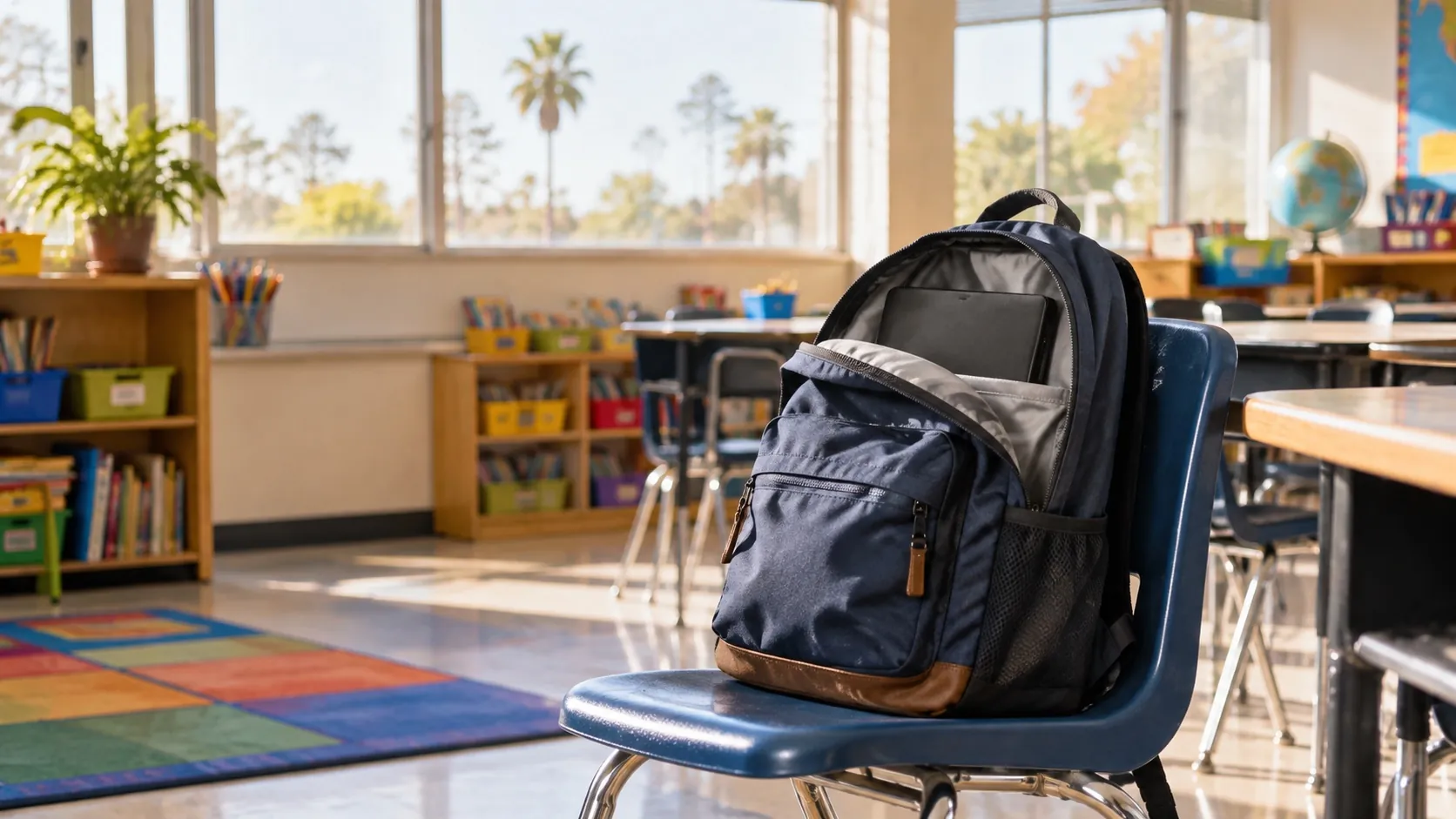
The most sensitive part of the conversation is practical. The host says he places, in the padded laptop compartment of his kids' backpacks, the rear panel from an old duty vest — removing the side straps and folding the edges to make it fit. The instruction given to the kids is simple: they know what a gun sounds like; if they hear any kind of emergency, the backpack goes on their back and they run.
"It's sad to have to think this way, sad to have to teach your kid this. Some people think, 'you're stealing your kid's innocence.' Yeah — well, evil is still out there."
For anyone considering something similar, a few technical facts help clarify the limits. Everyday-issue police vests are typically Level IIIA under U.S. National Institute of Justice (NIJ) standards — standard 0101.06, from 2008, and its successor 0101.07, published in 2023. That level is designed for handgun ammunition, not rifle rounds. Manufacturers typically warranty panels for around five years, because the materials degrade over time and with use — the host himself acknowledges that his panels are more than five years old. In California, civilian purchase and possession of body armor is legal; state law (Penal Code section 31360) only bars possession by people convicted of a violent felony. Ballistic backpacks are sold commercially in the U.S., but they don't replace a response plan — at best, they add to it.
"It doesn't matter what I think or what you think"
The guest closes with a conversation he once had with a school principal, who asked him, at the end of a training session, whether he didn't think guns were dangerous. His answer: nothing either of them thinks will change the fact that evil exists and that the school needs to be ready for it. Preparation, he repeats, is what gives a child back the sense of control — that's what the book tries to teach when it tells Miguel that he matters.
Sources and verification
National Association of School Psychologists (NASP) and Safe and Sound Schools, "Best Practice Considerations for Armed Assailant Drills in Schools." U.S. Department of Education and partner agencies, "Guide for Developing High-Quality School Emergency Operations Plans" (2013). City of Houston / DHS, "Run. Hide. Fight." video (2012). I Love U Guys Foundation, Standard Response Protocol. National Institute of Justice, NIJ standards 0101.06 (2008) and 0101.07 (2023). California Penal Code, section 31360. Marcelo Bini and Miguel Bini, "When the Alarm Goes Off: Miguel Learns the Plan" (Amazon; book description). The accounts about the use of mock blood, the conversations with the kids, and the backpack panel modification are personal experiences of the participants, not technical advice from this newsroom.
Who's speaking here: Eliel Teixeira and Edwin Wu are active-duty police officers in the Los Angeles, California area — Brazilian-born, U.S. citizens, with long careers in law enforcement. In this episode, they're joined by Marcelo Bini, an active assailant response instructor.
Note: everything described here applies under California rules — and, on several points, to each host's specific department. Rules on schools and body armor vary in other U.S. states.
Watch this part of the episode:
"Miguel Learns a Plan": safety education for kids — starting at 35:40 · Palavrão Tático
This article is a reference edition of episode 45 of Palavrão Tático and is subject to edits and editorial additions. For the full conversation, watch the episode. — Updated on 16/09/2026.