

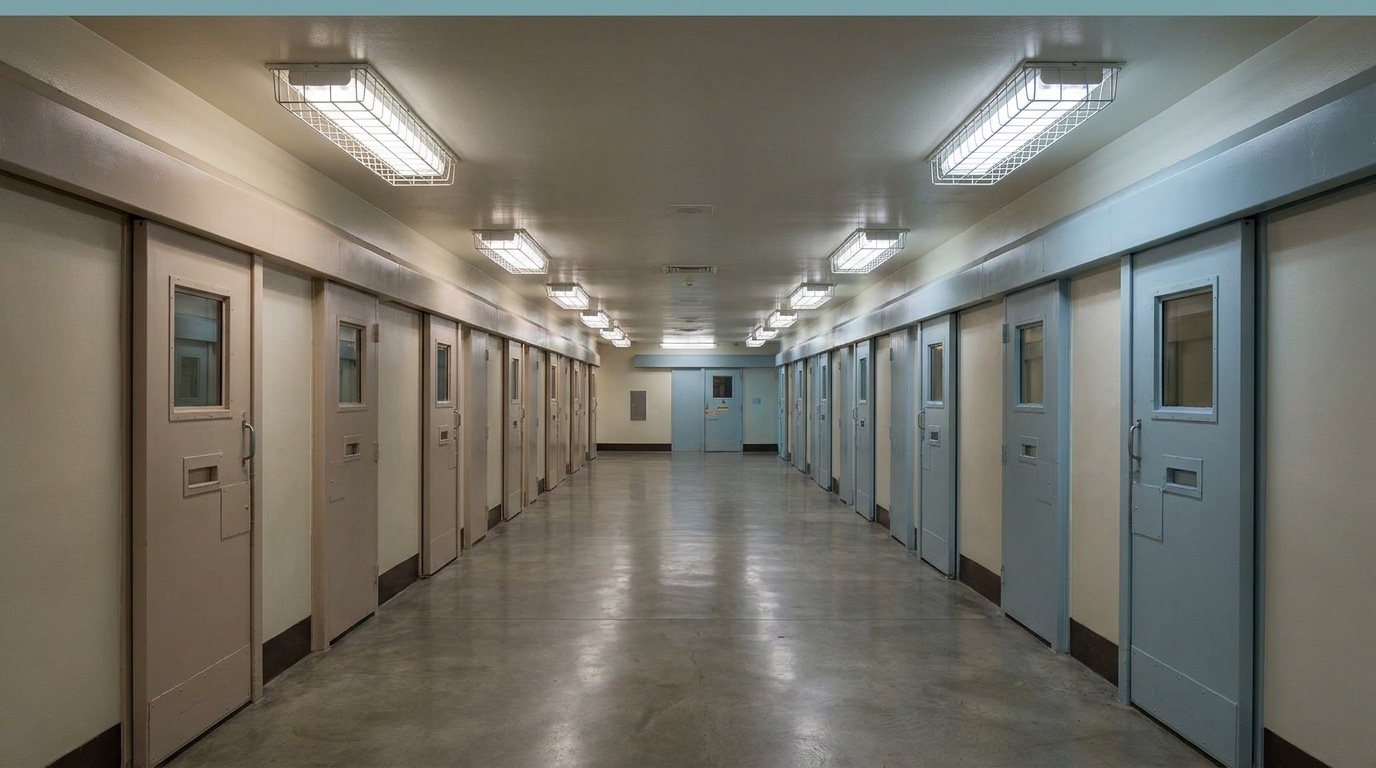
In Brazil people talk a lot about the corrections police. Here in California the custody world works its own way — and it starts with a constitutional surprise.
The sheriff's mission No. 1 is the jail
Constitutionally, in California, the elected sheriff's first obligation is to the region's jail system: the county jails are run by him. Uniformed patrol is secondary — it is up to each city to decide whether to stand up its own police force or contract the sheriff to patrol. But the jail is his by law. Some municipalities, however, can also create their own city jails — like Los Angeles and Santa Ana.
County vs. State: jail and prison
There is an important split: in most cases, the county jail holds people who are still awaiting trial (pre-conviction). Once convicted, the person goes to the state prison system, the CDCR (California Department of Corrections and Rehabilitation) — and, depending on the sentence handed down, an inmate sometimes serves the time in the jail itself instead of being transferred to prison. California has one of the largest inmate populations in its jails and prisons; and Los Angeles, being the largest county, has the biggest jail population — LA's jails run to nearly twenty thousand detainees awaiting trial.
Correctional officer vs. parole officer
Inside CDCR there are two paths. The correctional officer works inside the jail — handling inmates, doing transports, running the day to day. The parole officer works in plain clothes, supervising people released on parole. Both have limited police powers (full powers only on duty/in uniform). And here is a detail the street cop uses: someone on parole has not stopped being a convicted felon — he is required to identify himself as such during contacts and can be searched at any time, by any officer, without the officer having to articulate a reason: the convict waives the protection against random searches as one of the conditions of supervised parole.
Starting in the jail is a school
For a long time, the sheriff's rookie started his career inside custody, waiting for an opening to transfer to patrol. It could be hell for anyone who did not like it (some spent years there and asked to transfer to other agencies), but it is a priceless education: that is where an officer learns who is who in the criminal world, the gang territories, the techniques the crooks use across every kind of crime. Add to that the extremely strong union for the job — so strong that the correctional officer starts getting paid from the moment he parks the car until he reaches the locker room.
"Working in custody opened my eyes to how crime works. For me it was an education."
Who's talking here: Eliel Teixeira and Edwin Wu are working police officers in the Los Angeles area, California — born in Brazil, American citizens, with long careers in law enforcement. On Palavrão Tático they talk cop to cop, for officers and enthusiasts, without translating any of it into civilian language.
Heads up: everything described here follows the rules of California — and, on several points, the specific department each of them works for. In other American states (Florida, Texas, New York…) the rules can be quite different.
Watch this part of the episode:
Corrections policing and the sheriff and custody system in California — starting at 14:00 · Palavrão Tático
This article is a reference edition of episode 39 of Palavrão Tático and is subject to edits and editorial additions. For the full conversation, watch the episode. — Updated on 07/08/2026.