
There is no "national police exam" in the United States. Each state — and within it, each agency — decides how to train its officers. The contrast between the path followed in Texas and the California model shows just how much this entry point can vary within the same country.
No single exam: you choose the academy
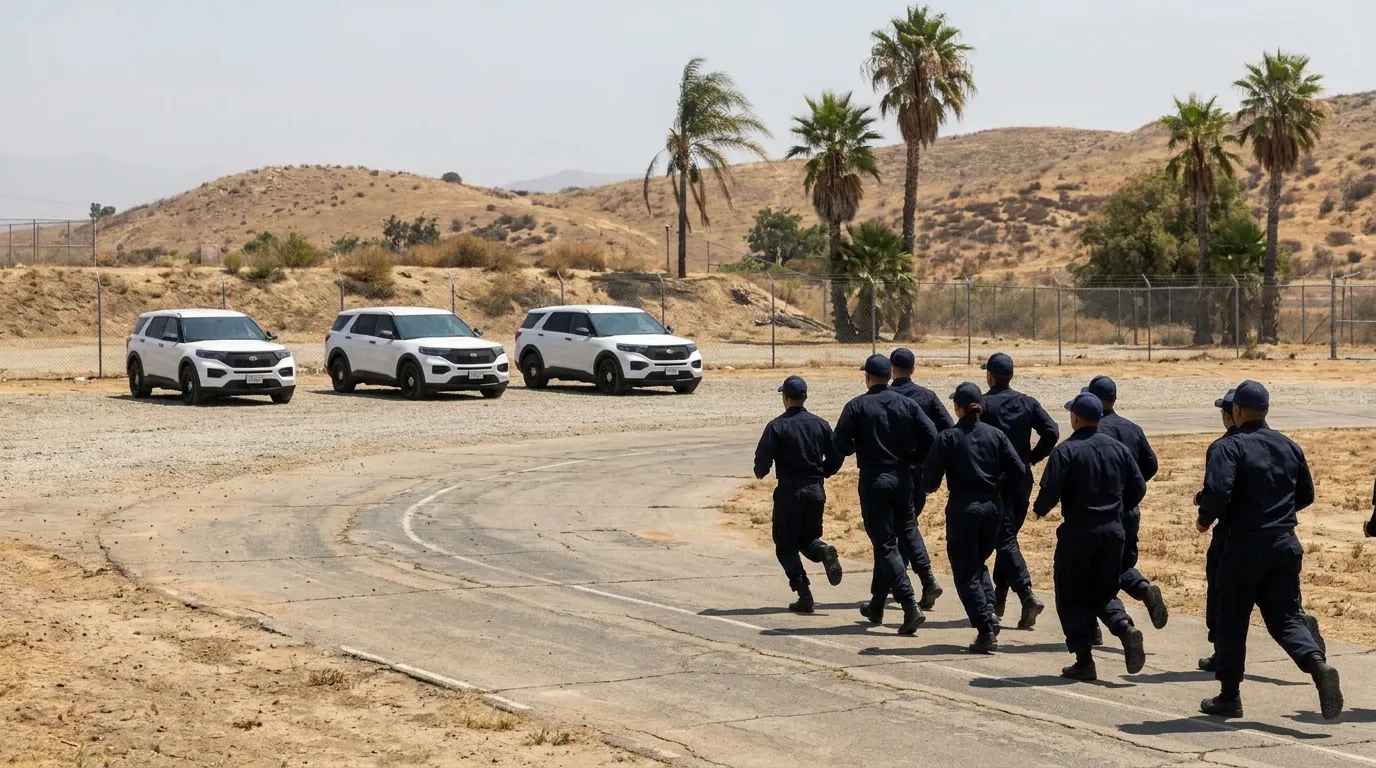
Unlike the Brazilian model — a centralized civil-service exam, a formal announcement, a test, a training course paid for by the state — in the United States the candidate usually chooses (or the department assigns) an academy, often housed within a community college. In big cities, departments like the LAPD run their own academy; across much of Texas, the path runs through a third-party educational institution.
Part-time, paid out of pocket — or full-time, paid by the department
In Texas, someone with no department affiliation yet usually pays for their own academy and attends part-time — in the episode's account, 7am to 1pm, nine months straight, while holding down another job to make ends meet. Someone already hired by a department is typically sent through the full-time track, which is shorter (roughly six to seven months), with the course paid for by the agency itself.
"It's usually full-time — in Texas you don't see a lot of full-time, that's for people paying for their own academy, and they still have to hold down a real job."
Minimum hours: Texas sits around 980 hours
Texas's current statewide minimum training requirement runs around 980 hours — a level the hosts themselves flagged as "about the same as here," referring to California. That's no coincidence: in recent years the national trend across the U.S. has been to raise the training floor, adding courses and hands-on training hours.
In California, POST does the certifying
In California, the minimum requirement is set by POST (the Commission on Peace Officer Standards and Training) through the Regular Basic Course: 664 hours in the intensive format (full-time, Monday through Friday, 8am to 5pm) or 730 hours in the modular format, which pairs with the reserve officer program. In practice, though, most POST-certified academies run well past that floor — many exceed 800 hours, and some top 1,000.
Same destination, different paths
The practical outcome — a certified officer, authorized to carry a badge and a firearm on the state's behalf — is the same in both places. But the road to get there differs: who pays for the training, how long it takes, whether the candidate keeps another job during the course. For a Brazilian considering a police career in the U.S., the practical lesson is: the rules of your dream department can look very different from the rules of the state next door — and it's worth confirming that before moving cities for a job.
Who's talking here: Eliel Teixeira and Edwin Wu are active-duty police officers in the Los Angeles, California area — Brazilian-born, now U.S. citizens, with long careers in law enforcement. On Palavrão Tático, they talk cop-to-cop and to enthusiasts, with no translation into civilian language.
Note: everything described here applies under California rules — and, on several points, to each host's specific department. In other U.S. states (Texas, Florida, New York…) the rules can be quite different.
Watch this part of the episode:
Police academy: Texas vs. California (approximate excerpt) — starting at 47:10 · Palavrão Tático
This article is a reference edition of episode 43 of Palavrão Tático and is subject to edits and editorial additions. For the full conversation, watch the episode. — Updated on 16/08/2026.