



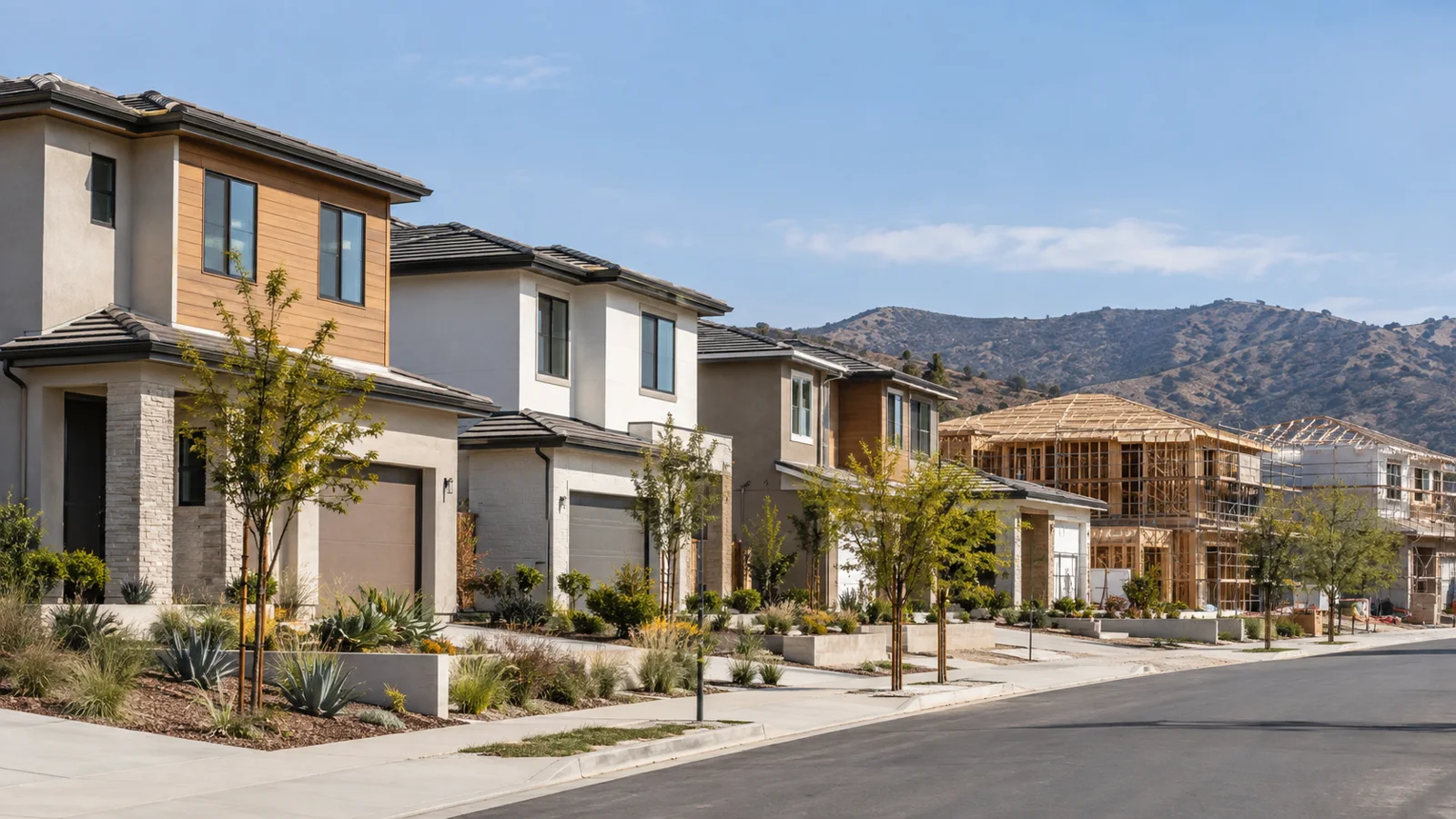
At the end of the episode, the show's realtors trade news about new developments in their areas. One realtor talks about condos and townhomes , newly built, planned for the next few years in Torrance and Carson, in the South Bay. Another realtor presents a neighborhood just launched in Santa Clarita. And all three agree on one observation: in new construction in California, the price usually rises fast.
The developments mentioned
In the South Bay, the realtor says the new units should be finished in the next few years in Torrance — a city in high demand, central and with very little construction of this kind, which makes the price hard to predict — and in Carson, where she believes the values should land around $600,000. The final prices, she notes, were not yet set at the time of recording.
In Santa Clarita, the realtor describes a development that opened the week of the recording, built on the last free corner of an intersection whose other three already had a mall, supermarkets, restaurants and a gas station. The idea is for the resident to do everything on foot, with freeway access in under 10 minutes. The project has three kinds of product — apartments, townhomes and detached houses —, built by different builders.
Why new construction appreciates faster
The realtor says she takes clients to developments she visited a year earlier and finds the prices already higher. Another realtor observes the same in his area: someone who buys in the early phase, off plan or right at delivery, usually pays less than someone who buys months later.
The realtors point to the reasons: buyers associate recent construction with fewer problems; new houses follow the current building code, are more energy efficient, with more fire-resistant materials and, often, with automation. There's a commercial reason too — builders usually sell in phases and adjust the price list with each phase in which demand holds up.
That describes the behavior the realtors have seen in recent developments; it is not a guarantee of appreciation.
Builder incentives
The realtors point out that builders usually offer incentives and cite the most common ones:
- an interest rate reduction (rate buydown), temporary or permanent, through a lender tied to the builder;
- paying the closing costs;
- a credit toward finishes or changes to the property.
In practice, many of these benefits are conditioned on using the builder's lender (preferred lender). It's worth comparing: get the full proposal from the builder's lender and from an independent lender, and check whether the incentive offsets higher rates or fees. An incentive can also be applied to reduce the price instead of paying costs — each approach has a different effect on the payment and on the appraisal.
New construction, the realtors point out, usually seeks approval for FHA, VA and conventionalfinancing, which widens the options for buyers with a small down payment.
The costs the brochure doesn't show
- HOA: new neighborhoods almost always have an association, with a monthly fee — and the first year's fee, subsidized by the builder, can rise once the association passes to the residents.
- Mello-Roos: many new developments in California sit in special districts (Community Facilities Districts) that charge an additional tax, for years or decades, to pay for schools, streets and infrastructure. It's common in Santa Clarita and in other growth areas, and can add hundreds of dollars a month.
- Property tax on the new value, which includes the construction.
- Items not included: window coverings, refrigerator, backyard landscaping and fences are sometimes on the buyer.
Have your own agent
At the sales office, the representative works for the builder. In most cases you can be represented by your own agent at no additional cost — but many builders require the agent to be registered on the first visit. In the episode, the realtors joke about who will represent whom, and about exclusivity agreements: if the buyer has already signed with an agent, that's the professional who should go with them.
Line up the financing beforehand
The recommendation all three repeat is to start early. Anyone who wants to buy in one of these units a year or two from now should look for a lender now — even with no money saved and even with bad credit — to understand what needs fixing. By the time the building is finished, the person is already in a position to buy. Talking to a lender and an agent, they point out, costs nothing.
Checklist
- Register your agent on the first visit.
- Ask in writing for the incentives, the terms and the expiration date.
- Compare the builder's lender with at least one independent one.
- Ask about HOA and Mello-Roos and add them to the monthly cost.
- Read the builder's contract, which is usually different from the standard purchase agreement.
- Get an independent inspection before delivery and before the warranty expires (see this paper's article on the 11-month inspection).
The figures and forecasts cited reflect the realtors' assessment at the time of recording (April 2026) and are not a promise of price or appreciation.
Sources and verification
- California Government Code, sections 53311 and following (Mello-Roos Community Facilities Act of 1982) — special taxes in infrastructure districts.
- California Department of Real Estate — Public Report required for the sale of units in new developments, with information on HOA and costs.
- Consumer Financial Protection Bureau — builder incentives and comparing loan offers (Loan Estimate).
- Transcript and chapters of episode 10 of the Cadê Moradia podcast (April 2026), with the show's realtors.
Watch this part of the episode:
New construction in the South Bay and Torrance — starting at 36:20 · CADÊ BRAZIL
This article is a reference edition of episode 10 of the podcast and is subject to edits and editorial additions. For the full conversation, watch the episode. — Updated on 17/09/2026.