



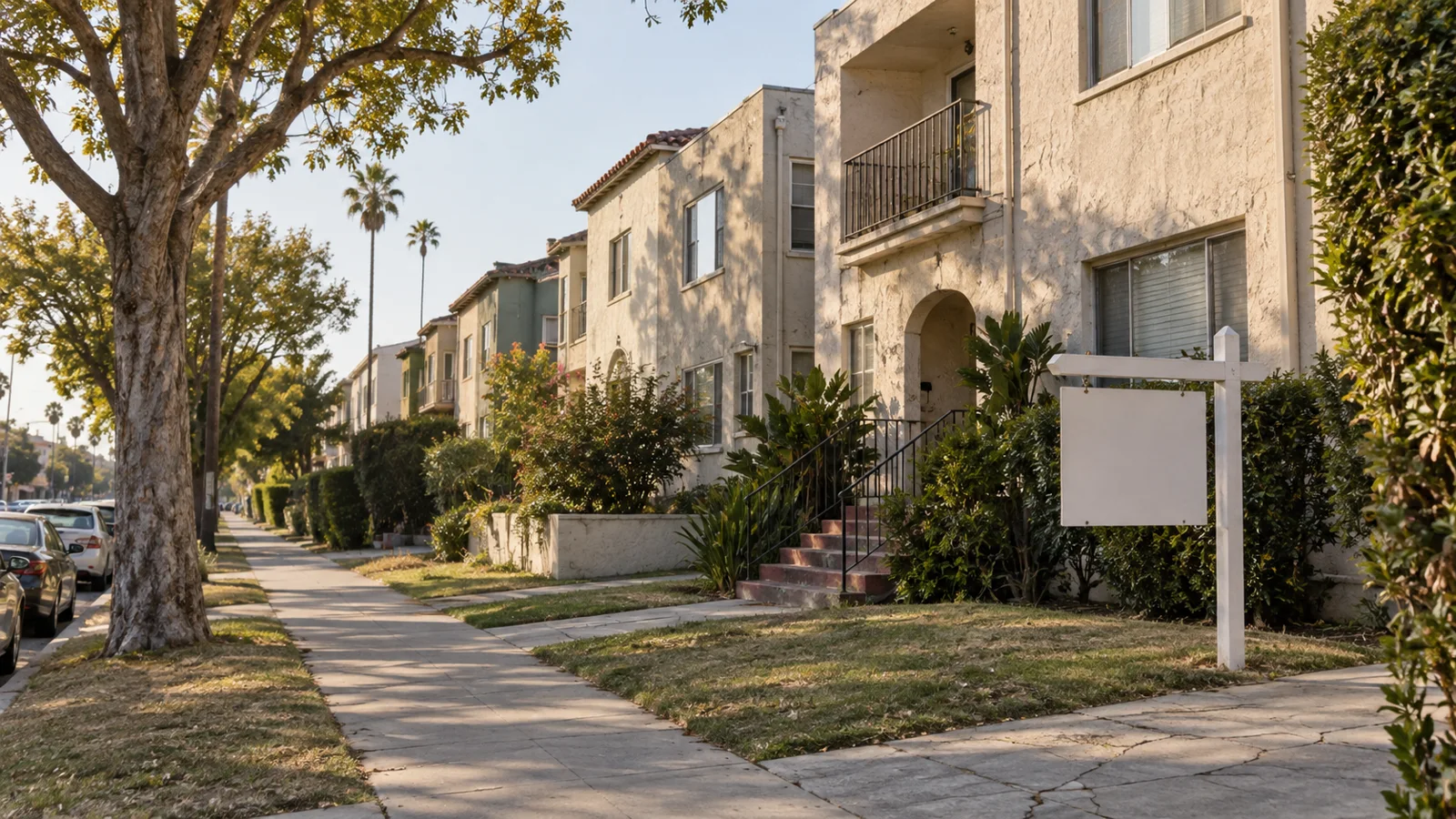
One of the show's realtors points, in the episode, to what she considers the main reason so many people put off buying a home: rent control (rent control). Someone paying a rent that goes up very little each year has a harder time trading it for a bigger payment and the responsibility of maintaining a property.
In the conversation, the realtors try to recall the exact cap — one of them mentions 10% a year — and conclude that the rule changes from city to city. They're right about the conclusion: the cap depends on where the property is, when it was built and who owns it.
The state rule: AB 1482
Since January 1, 2020, the Tenant Protection Act, known as AB 1482, has capped increases at most residential properties in California:
- the increase over 12 months cannot exceed 5% plus the change in the regional inflation index (CPI), with an absolute ceiling of 10% — that's where the number mentioned in the episode comes from;
- the law also requires just cause to end a tenancy after 12 months of occupancy.
Outside AB 1482 are, among others:
- properties built in the last 15 years (a rolling count);
- single-family homes and condominiums whose owner is not a company, fund or corporation, provided the tenant received the notice required by law;
- properties already covered by stricter local rent control.
The City of Los Angeles rule: RSO
Within the boundaries of the city of Los Angeles, the Rent Stabilization Ordinance (RSO)applies, one of the oldest in the state. It generally covers properties with two or more units built through October 1, 1978 — most of the city's older apartment buildings.
The RSO's annual cap is calculated from inflation. In 2026, the City Council changed the formula: the increase became 90% of the average CPI, with a floor of 1% and a ceiling of 4%, and it stopped allowing additional increases for services. For the period from July 1, 2026 to June 30, 2027, the allowed increase is 3%.
One realtor notes in the episode that the City of Los Angeles rule is lower than other cities' — and that the county follows a different one. That's exactly right: the City of Los Angeles and the County of Los Angeles are different jurisdictions. The county has its own ordinance for unincorporated areas, and cities like Santa Monica, West Hollywood, Culver City, Pasadena and Inglewood have rules of their own.
And when the tenant moves out?
One of the realtors asks whether the landlord can raise the rent freely when a tenant leaves. As a rule, yes. The state's Costa-Hawkins law allows what is called vacancy decontrol: when the tenant leaves voluntarily or is evicted for a lawful reason, the landlord sets the price for the next lease. From then on, the annual caps apply again to the new rent.
The same law bars cities from imposing rent control on single-family homes, individual condominiums and properties built after 1995 — which explains why so many new units fall outside the local rules, though they may be subject to AB 1482 after 15 years.
What this means for the decision to buy
For someone renting under rent control, the comparison between rent and a mortgage payment has to account for three points:
- Controlled rent rises slowly, but it rises; and the protection ends if you have to move — the next rent is at market price.
- The payment on a fixed-rate mortgage doesn't rise on principal and interest; property tax and insurance do, but in California the tax is capped at a 2% annual increase on the assessed base.
- Equity: rent doesn't convert into wealth of your own; a mortgage payment, in part, does.
The realtors don't downplay the difficulty: trading a low rent for a more expensive monthly payment is a heavy decision, and every family has to run its own numbers.
For anyone thinking of becoming a landlord
The other side applies to anyone buying to rent out. Before buying, check whether the property is subject to the RSO, to AB 1482 or to another local ordinance, whether registration with the city is mandatory and what the eviction and increase rules are. That directly changes the return calculation.
This text is for informational purposes and does not replace legal advice. Rent control rules change frequently; confirm the property's status with the city's housing department.
Sources and verification
- AB 1482 (Tenant Protection Act of 2019), California Civil Code, sections 1946.2 and 1947.12 — cap of 5% plus regional CPI with a 10% ceiling, just cause and exemptions.
- Los Angeles Housing Department (LAHD) — Rent Stabilization Ordinance: application to properties built through October 1, 1978, new formula in effect since February 2, 2026 (90% of CPI, minimum of 1% and maximum of 4%) and a 3% increase for July 1, 2026 to June 30, 2027.
- Costa-Hawkins Rental Housing Act (Civil Code, section 1954.50 and following) — vacancy decontrol and limits on local rent control.
- Transcript of episode 10 of the Cadê Moradia podcast (April 2026). The timestamp given is approximate, interpolated between the chapters "O programa Dream for All" (17:02) and "Exemplo real: Apartamento em Culver City" (22:08).
Watch this part of the episode:
Rent control (approximate timestamp) — starting at 20:10 · CADÊ BRAZIL
This article is a reference edition of episode 10 of the podcast and is subject to edits and editorial additions. For the full conversation, watch the episode. — Updated on 17/09/2026.