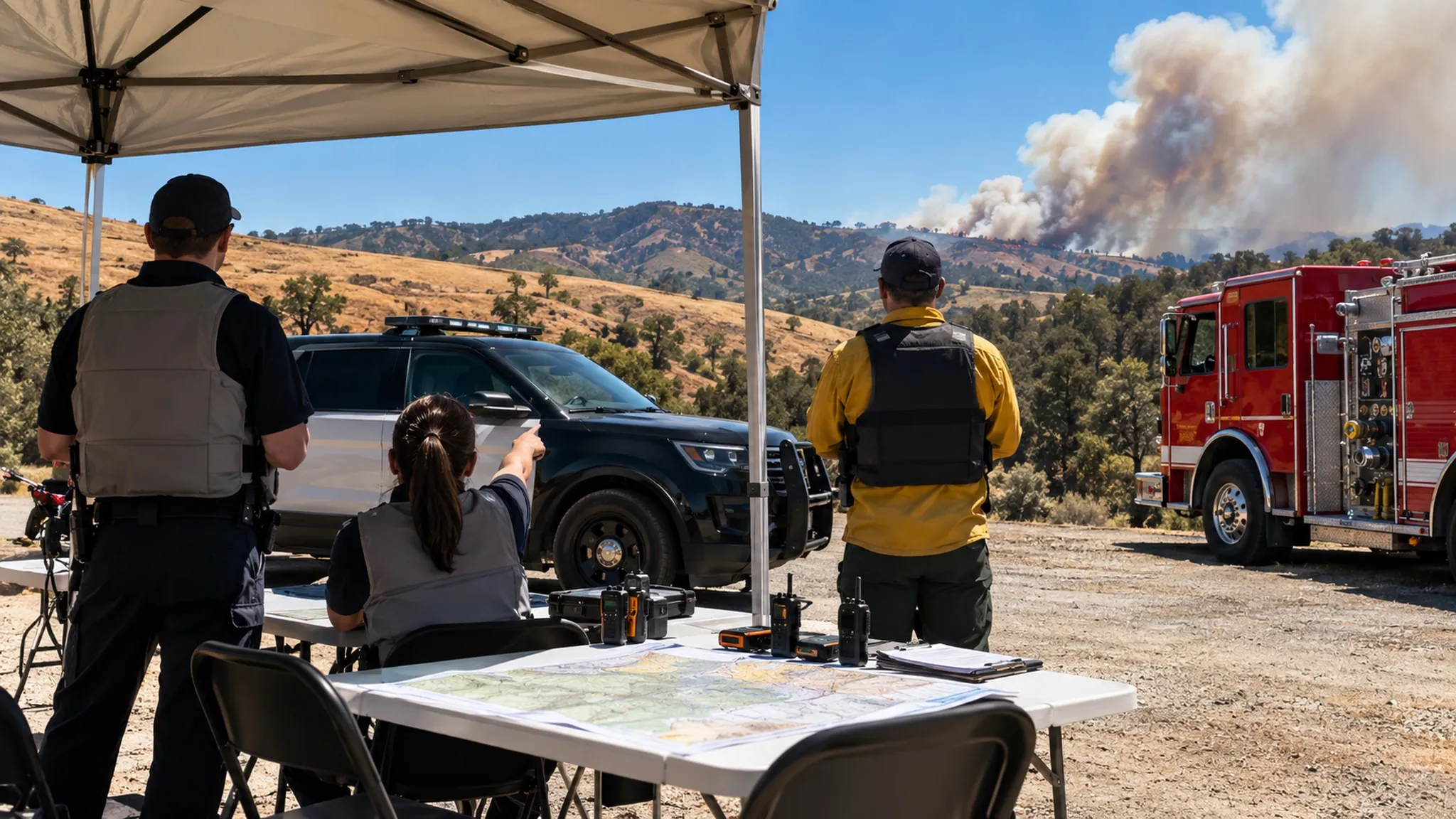


What is the right number of police officers for a state? The hosts of Palavrão Tático put the question straight to the guest of episode 49, Maurício de Tomasi, a chief investigator (delegado) with the São Paulo Civil Police — who studied public administration precisely to handle this kind of math. "That's the million-dollar question," he answered. And his answer has two parts: a calculation that has gone stale, and a crime that has changed address.
A calculation made in the 1990s
In São Paulo's Civil Police, the number of officers each career track should have is set by the state government, by law. According to the guest, the last update to the roughly 40,000-officer headcount was made in the mid-1990s — 1994 or 1995, if memory serves. At the time, São Paulo had between 34 and 35 million residents. Today it has about 46 million, according to estimates from IBGE, Brazil's national statistics bureau.
"If you wanted to keep the same ratio of officers per citizen, it would have had to grow by about 20%," he figured. More people, in theory, means more calls for service. And that assumes a fully staffed department — which, as he himself explained in the episode, is far from the case today.
The second calculation: what the machine already does
But the ratio isn't everything. In the 1990s, every unit needed ten, twelve people to handle human resources, payroll and paperwork. Today, much of that is handled by software. The front desk is another example: what once took several officers to take reports, the online police station (delegacia eletrônica) now handles online, with fewer people serving more. "You shift the need for officers somewhere else."
The hosts explained that the same model is advancing in the Los Angeles area: many non-emergency incidents can already be reported online, and there are scheduled video-call appointments so residents can file a report without tying up an entire unit. Los Angeles agencies such as the LAPD and the Los Angeles County Sheriff's Department (LASD) maintain online reporting systems for non-emergency crimes with no known suspect.
The guest's recommendation as a manager: first fill the headcount the law already authorizes, measure how that workforce operates and performs, and only then decide whether more or fewer people are needed — and with what profile.
Car theft held steady. Fraud did not.
This is where the most important part of his answer comes in. According to the guest, vehicle theft in São Paulo has held steady for years, even as the number of cars on the road has grown — while online scams and cybercrime have skyrocketed. The national numbers point the same way: the Brazilian Public Security Yearbook (Anuário Brasileiro de Segurança Pública), published by the Brazilian Public Security Forum, recorded about 2.26 million fraud cases (estelionato) in 2025, up more than 400% from 2018, while vehicle robberies and thefts fell. São Paulo is among the states with the highest fraud rates in the country. The same report shows the size of the challenge: only a tiny fraction of those reports ever becomes a court case.
"Wealth today is in the online world," the chief summed up. "That's where our communication is, that's where crime is going to be."
From the street to the screen: a different kind of police needs to grow
The consequence, as he sees it, is structural. Street crime — the corner robbery, the theft — is the crime of patrol, of visible presence. When crime leaves the street and moves online, it demands an agency designed for investigation. "If crime today is online, you need an investigator who is well versed in investigating online." That's why he advocates stronger investment in investigative police forces, and says São Paulo's Police Academy already invests in digital investigation, from the entrance exam through the training course.
"It's not just a question of numbers. It's a question of profile." And the profile of the agencies, he argued, needs to keep up with the profile of crime. Whether managers and governments have already grasped this to the point of turning it into public policy, he can't say — but he hopes so. "The defining mark of our time is this: the migration from street crime to virtual crime."
What the two of them think about it
In the episode, Eliel Teixeira and Edwin Wu talk with the guest about the ideal size of a police force and discuss the online and video reporting that departments in the Los Angeles area already use. The conversation about the online police station and police intelligence continues in the next segment of the episode.
Sources and verification
Brazilian Public Security Forum (Fórum Brasileiro de Segurança Pública), Brazilian Public Security Yearbook (2026 edition, 2025 data), as reported by the press. IBGE, state population estimates. São Paulo State Complementary Law 207/1979. São Paulo State Public Security Department (SSP-SP), Online Police Station (Delegacia Eletrônica). Los Angeles Police Department and Los Angeles County Sheriff's Department, online crime reporting systems. The year the headcount was last set, the 20% estimate and the assessment of the investigator profile are the guest's own, from the episode.
Who's talking here: Eliel Teixeira and Edwin Wu are active-duty police officers in the Los Angeles area, California — Brazilian-born, American citizens, with long careers in law enforcement. In this episode, produced in partnership with Criminal Cast, they host Maurício de Tomasi, a chief investigator (delegado) with the São Paulo State Civil Police, professor of criminology and criminal procedure, and host of Criminal Cast.
Note: what is described here about American policing applies to California rules — and, on several points, to each host's specific department. Rules differ in other U.S. states. What is described about Brazil applies to the São Paulo Civil Police; each Brazilian police force has its own organic law, its own hiring notice and its own internal regulations.
This article is a reference edition of episode 49 of Palavrão Tático and is subject to edits and editorial additions. For the full conversation, watch the episode. — Updated on 15/10/2026.