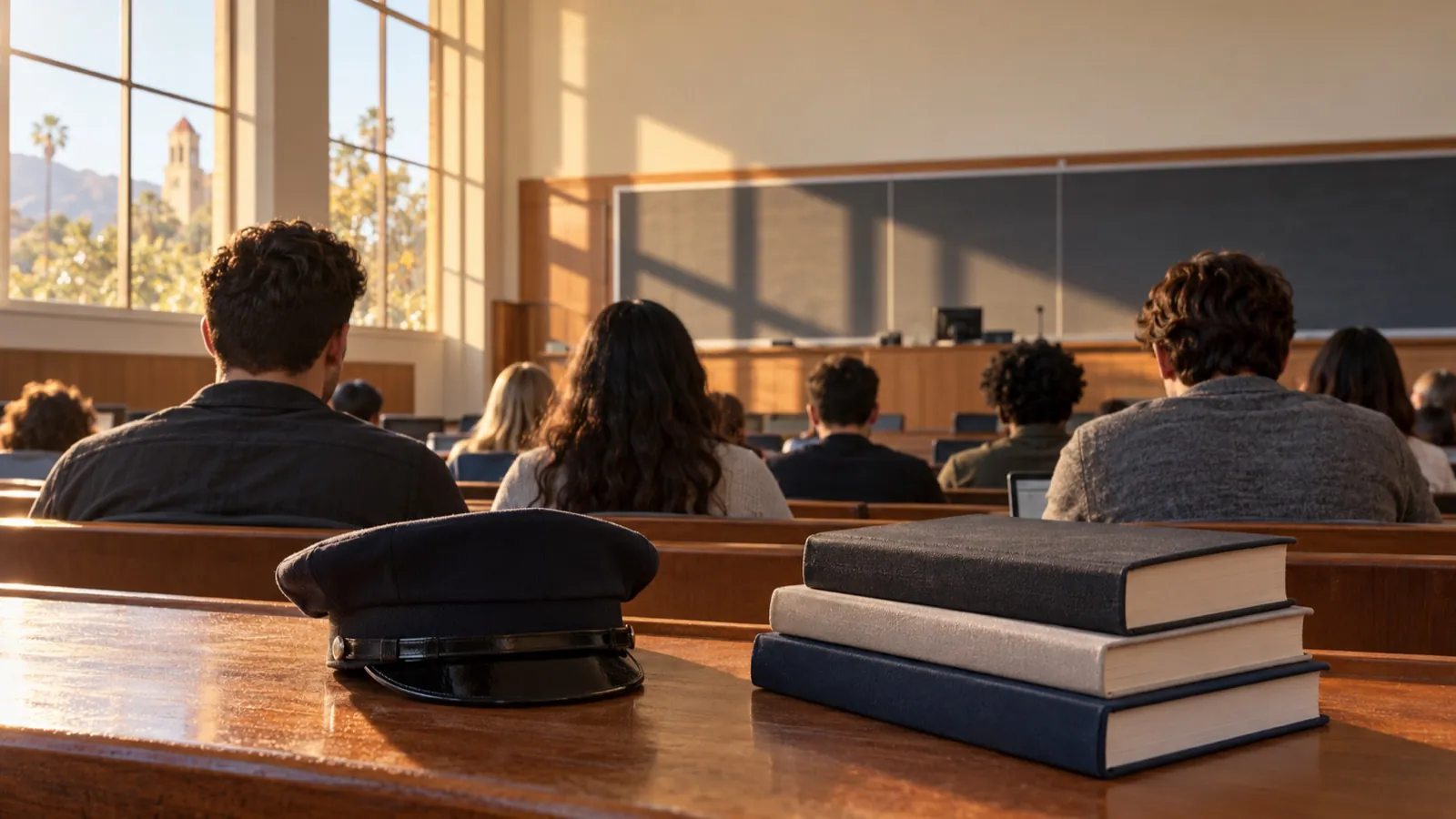
Legal science is one thing; police science is another. The line, spoken by one of the Palavrão Tático hosts in the second part of the conversation with police chief Maurício de Tomasi, sums up a difference that anyone who has worked on both sides — Brazil and the United States — feels firsthand. In the U.S., studying crime and policing became an academic career of its own more than a century ago. In Brazil, for a long time, all of it stayed inside law school. And that, the three say, is changing.
The split that happened in the United States
The hosts described what they see on the American side: over the 20th century, the study of crime broke away from law and grew two branches of its own — criminology, which studies crime, its causes and patterns, and criminal justice , which studies law enforcement, police management, the prison system and the courts as organizations.
History backs them up, and California sits at the center of it. August Vollmer, Berkeley's police chief in the early 20th century and considered one of the fathers of American professional policing, brought police training into the university: the University of California, Berkeley, began offering police administration courses as early as the 1910s and, in 1950, created its School of Criminology. In the 1930s, Michigan State University opened one of the first police administration programs in the country.
The big leap came in the late 1960s. The 1968 federal crime control law (Omnibus Crime Control and Safe Streets Act) created the Law Enforcement Education Program (LEEP), which paid for college studies for police officers. Programs in criminal justice multiplied, and today they rank among the most popular majors in the country. In California, many departments pay incentive pay for higher education, and the top certificates from the Commission on Peace Officer Standards and Training (POST) combine years of service with college credits.
In Brazil, everything stayed under Law
On the Brazilian side, the hosts' observation is that this split never happened. Criminology stayed confined to law school, which "ended up covering everything" but never kept pace with police science. In practice, a cop who wanted to study policing studied law.
The police chief agreed with the diagnosis. Until about 20 years ago, he said, criminology was largely restricted to law schools — "something that wasn't the case in other countries," where crime was debated in other disciplines, such as sociology, psychology and public policy. In the first part of the interview, he had already recalled that when criminology started appearing on the São Paulo Civil Police chief exam, many people didn't even really know what the subject was.
What is changing
As the guest sees it, Brazil is on a maturing curve on three fronts:
- A tradition of debating crime outside of Law — in other disciplines and other degree programs;
- Institutions that produce research and debate, citing Novas Ideias na Segurança Pública (NISP), the Fórum Brasileiro de Segurança Pública and the Instituto Igarapé, among others, each with its own leaning;
- People willing to learn through the lens of the scientific method, which brings order to the discussion.
He makes a point of saying he welcomes the fact that these institutions defend different, sometimes opposing, positions. "I think it's from those discussions that you sometimes learn something new." The hosts have also seen the change in practice: when the class of São Paulo's Curso Superior de Polícia (CSP, the senior officer course) visited Los Angeles, the officers' questions and thesis topics came from a scientific angle — which researcher is studying this, what the data shows — and not only from a legal one.
Academia and the street talking to each other
That bridge is exactly what the police chief set out to build when he created Criminal Cast, the podcast he hosts. The idea, he said, was to bring together two worlds that rarely talk: on one side, researchers, universities and research centers; on the other, "the cop who's out there on the street, on patrol, making arrests." Something that, according to him, is very common in the United States and in England, and that he wanted to see grow in Brazil.
The show alternates interviews with lecture series — the great thinkers of criminology, a criminology for beginners and current topics such as immigration, terrorism and money laundering. The pieces talk to each other: in one lecture, he points to the interview where a specialist explains in practice what the theory describes.
One example he shared shows how far that bridge can go. Sociologist Guaraci Mingardi, one of the first researchers to write about organized crime in Brazil, wanted to study the police from the inside while doing graduate work at the Universidade de São Paulo (USP) — and, according to the guest, took the exam to become a São Paulo Civil Police investigator so he could live the routine he was researching. That produced the book Tiras, Gansos e Trutas, about daily life in the São Paulo Civil Police, now hard to find. The police chief said many people ask him where to find it, and that he would like, one day, to make his guests' books available in a kind of virtual library.
Why this matters to the cop on the street
For a police officer, the difference is not academic. Law tells you what is allowed, what is a crime and what the procedure is. Police science and criminology ask something else: what works, where crime concentrates, which strategy reduces violence, how to measure the results of an operation. One doesn't replace the other — but when only the first exists, the police have no tool to evaluate their own work.
That is also why, the hosts said, Palavrão Tático started publishing articles like this one: the podcast is great for conversation, but it can't go deep on everything; the written piece adds context, quotes and references.
What the two think about it
In the episode, Eliel Teixeira and Edwin Wu talk about the separation between law, criminology and criminal justice administration that they observe in the United States, and about the ground this view has been gaining in Brazil. They also discuss the idea of a two-way exchange: the systems are different, but the problems are often the same.
Sources and verification
University of California, Berkeley, history of the School of Criminology (1950–1976) and of August Vollmer's work. Omnibus Crime Control and Safe Streets Act (1968) and the Law Enforcement Education Program (LEEP). California Commission on Peace Officer Standards and Training (POST), professional certificate requirements. Guaraci Mingardi, Tiras, Gansos e Trutas: cotidiano e reforma na Polícia Civil (1992). The assessment of criminology in Brazil, the institutions mentioned and the history of Criminal Cast come from the guest, in the episode.
Who's talking: Eliel Teixeira and Edwin Wu are active-duty police officers in the Los Angeles, California area — Brazilian-born, American citizens, with long careers in law enforcement. In this episode, produced in partnership with Criminal Cast, they once again host Maurício de Tomasi, a chief of the São Paulo State Civil Police, criminology and criminal procedure professor and host of Criminal Cast.
Note: what is described here about American policing applies to the rules of California — and, on several points, to each officer's specific department. Rules vary in other U.S. states. What is described about Brazil applies to the Civil Police of São Paulo; each Brazilian police force has its own organic law and internal rules.
This article is a reference edition of episode 50 of Palavrão Tático and is subject to edits and editorial additions. For the full conversation, watch the episode. — Updated on 22/10/2026.