
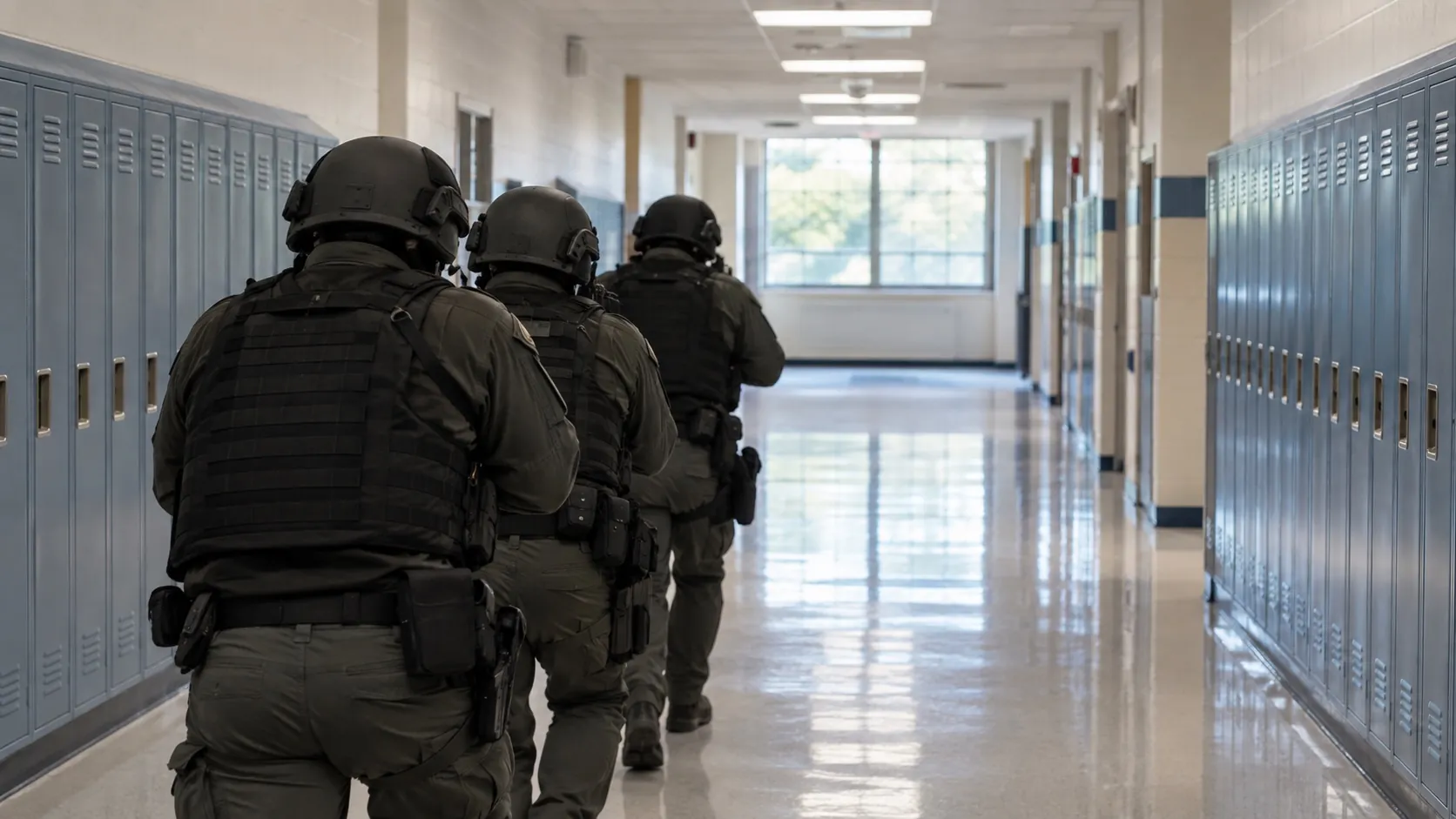
A roughly 30-day course dedicated solely to responding to and preventing armed attacks in schools isn't common anywhere in the world. In Espírito Santo, it exists — and it ended up in Los Angeles. In episode 45 of Palavrão Tático, guest Marcelo Bini, a former police officer in Texas and active-shooter response instructor, explains how his relationship with the Independent School Police Company (Cipe) of Espírito Santo's state military police began, what it was like teaching in both editions of the unit's course, and why, in his view, the work done there has become a reference point beyond Brazil. Eliel Teixeira and Edwin Wu fill in the other side of the story: they're the ones who helped open the doors for the Espírito Santo officers to train in California.
What Cipe Is
The state military police's school patrol in Espírito Santo predates the company itself. According to the force, in October 2010 the patrol was restructured to focus on preventive community policing in schools, starting with eight dedicated officers. The structure grew over the decade and, in April 2023, was formalized as its own operational unit: Cipe, responsible for school patrolling and for spreading that doctrine across the state. Its work also produced the Basic School Policing Course, which has already trained more than 400 military police officers in Espírito Santo, and training initiatives aimed at school principals.
The Course: CEPAAT
The course the guest talks about is the Active Shooter Response and Prevention Course (CEPAAT), run by Cipe. The first edition began in May 2023, with 35 students from eight institutions — Espírito Santo's own state military police, the state's civil police, military police forces from Mato Grosso, Bahia, Paraná and Acre, and municipal guards from Vitória and Viana — totaling 224 class hours across 21 subjects. The second edition held its opening class on May 4, 2026, at the Military Police Academy in Cariacica, and wrapped up in June. The guest instructed in both.
The structure he describes combines dense theory with heavy simulation. His portion, at the end of the course, is a full day on the history of attacks in the United States — from the University of Texas tower shooter in 1966 to current cases — and on what each one changed in police protocol. Then come roughly five days of simulation. At the closing, students believe the course is over and go to put away the patrol vehicles; that's when the "incident" drops and they have to respond inside a school.
An Initiative That Came From the Bottom Up
The origin of the partnership is a detail the guest makes a point of telling. It all started with a message from a corporal in the Espírito Santo state military police who had been shot on duty and applied a tourniquet on himself, a technique he'd learned in one of the guest's trainings. That officer's wife, also a corporal, worked in school policing and wanted to bring to Espírito Santo someone who had lived through an attack inside a school — the guest had responded to an active-shooter incident in a Texas school in 2018.
"I always say the example didn't come from the top down, it came from the bottom up. She saw a need, acted on it, and spread it."
Online talks followed, then weekend courses, and eventually the idea for the longer course. The corporal who drove the initiative later moved to the Special Missions Battalion, but, according to the guest, she's still remembered in the unit as the first to bet on it.
The Context: Aracruz, 2022
The course didn't emerge in a vacuum. On November 25, 2022, a 16-year-old attacked two schools in Aracruz, in northern Espírito Santo — Escola Estadual Primo Bitti and Centro Educacional Praia de Coqueiral. Four people died (three teachers and one student) and at least 12 were injured. It was one of the deadliest in a series of attacks Brazil experienced between 2022 and 2023.
In the episode, the guest recounts speaking with teachers from Aracruz after the attack, through the relationship Cipe maintains with the city's school community, and hearing from a teacher who was still bedridden that she was already expected back in the classroom the following week. It's a side of the problem that rarely makes it into protocols: the recovery of survivors and of those who responded to the incident.
Why They Insist on the Word 'Terrorist'
One part of the conversation is deliberately about vocabulary. The guest says, in his own words, that he makes a point of calling anyone who enters a school to kill children a terrorist: "if that's not terrorism, I don't know what is." The choice has a legal backdrop worth explaining. In Brazil, the Anti-Terrorism Law (Law 13.260/2016) defines terrorism based on specific motivations — xenophobia, or discrimination or prejudice based on race, color, ethnicity, and religion — combined with the intent to cause social or generalized terror. Because of that, most attacks on schools don't legally qualify as terrorism, even when the effect on the community is exactly that. What the episode discusses is how to name the problem; the legal classification remains the one set by the law.
From a Visit to a Full Course in Los Angeles
The bridge to California ran through the guest and the hosts. A group from the Espírito Santo state military police wanted to see Los Angeles; the guest, who was in Texas, made the connection, and the hosts organized the first visit — just a tour of facilities and teams. Afterward, the unit's command decided a full course was worth doing, and the second trip was real training in Los Angeles, with American instructors who are friends of the hosts. The Espírito Santo officers even appeared on Palavrão Tático during that trip.
The impression, they say, was strong: nothing like the attitude of someone who's just there for the hours and the certificate. The instructors singled out students who asked questions, engaged, and applied themselves. In the second edition of CEPAAT, according to the guest, the level of preparation rose even further: the course became more competitive, candidates arrived having studied real cases of school attacks — what happened, what failed, what changed in the protocol — and the selection process included a rigorous interview, especially for Cipe's own officers.
The Obstacle That Isn't Tactical
The guest points to a problem that, in his view, slows school security down in both Brazil and the United States: the politics surrounding everything. He says he's walked out of several negotiating tables on school security after sensing other interests at play, and that he keeps working with Cipe because he sees work there that's respected by people on every side. The point he repeats is that school security isn't just a police problem — it involves the medical field, education, teachers, and the students themselves, who are usually the first to notice something's wrong with a classmate.
Sources and Verification
Espírito Santo's state military police, institutional publications about the Independent School Police Company (Cipe), the graduation of the 1st CEPAAT (2023), and the opening of the 2nd CEPAAT (May 2026). Law No. 13,260/2016 (Anti-Terrorism Law), Article 2. News coverage and public records of the attack on schools in Aracruz (ES) on November 25, 2022. The course's official name, dates, and numbers of students and class hours come from Espírito Santo's state military police; the accounts of how the partnership began, the experience as an instructor, the trips to Los Angeles, and the conversations with teachers come from the episode's participants.
Who's speaking here: Eliel Teixeira and Edwin Wu are active-duty police officers in the Los Angeles, California area — Brazilian-born, naturalized U.S. citizens, with long careers in law enforcement. In this episode, they host Marcelo Bini, who worked as a police officer in Texas and is an active-shooter response instructor.
Note: This article covers a unit of the Brazilian police and training conducted in the U.S. The American rules and protocols mentioned apply to California and to Texas as indicated — they may differ in other states.
Watch this part of the episode:
The origin of the partnership with CIP and the 30-day course — starting at 18:35 · Palavrão Tático
This article is a reference edition of episode 45 of Palavrão Tático and is subject to edits and editorial additions. For the full conversation, watch the episode. — Updated on 16/09/2026.