
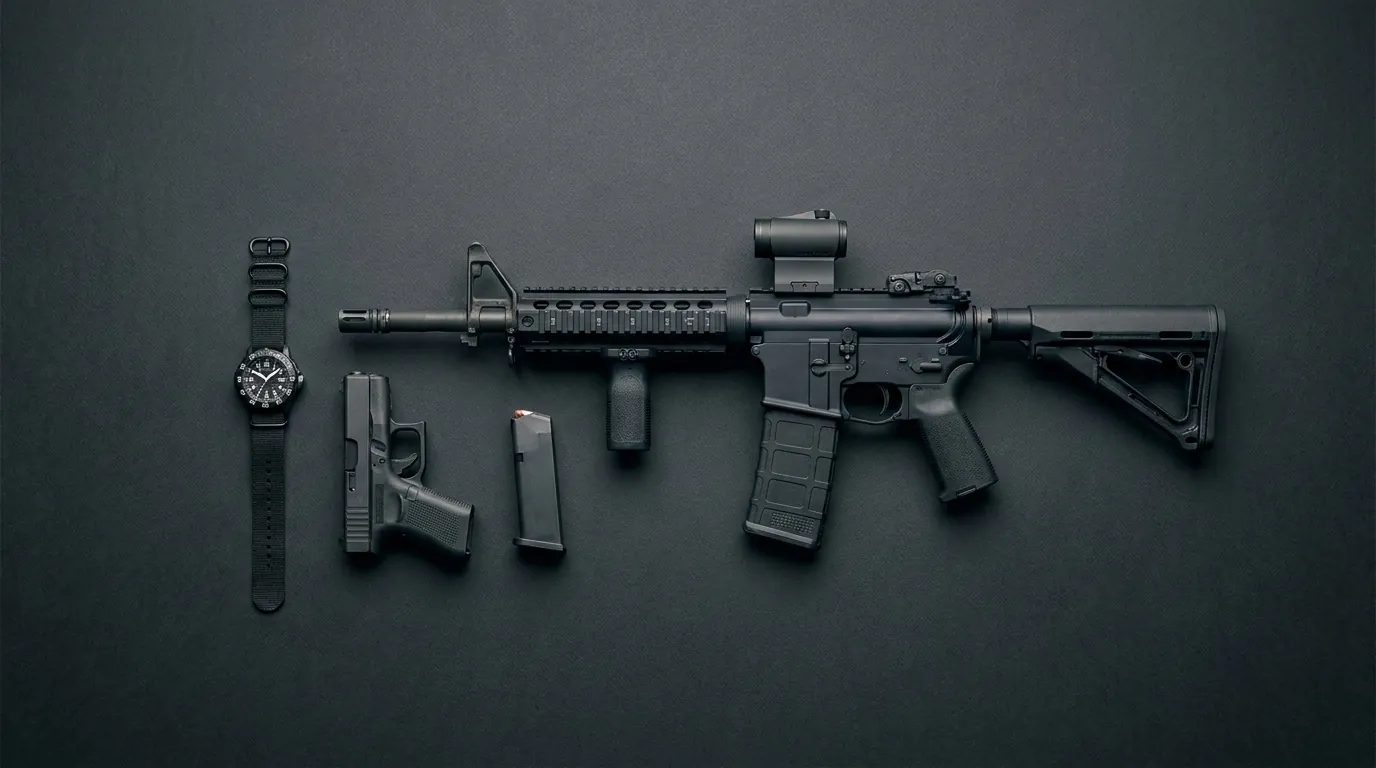
In American policing, EDC (everyday carry) is what you actually carry every day — not what looks good in a display case. And gear is one of the topics folks at home ask for the most. So here is an honest walk-through of what gets used: the watch, the concealed-carry pistol and the rifle.
From the G-Shock to the Apple Watch Ultra
The G-Shock is still the favorite watch — it never stopped being. It was practically part of the uniform: every officer had one. Cheap (about $30 or $40 back then), indestructible, with a fluorescent dial that glowed all night without a battery — it charged itself in the sun — and atomic time, which set the hour and the time zone automatically.
The only difference is that today there are professionals who also like the Apple Watch Ultra, for the features tied into the iPhone and the apps on the watch itself: a notification on your wrist without pulling the phone out mid-call, maps, waterproofing, and backtrack — if you are chasing someone and get lost in a part of the city you do not know, the watch walks you back. The price bites (around $700 to $800) and the profile is bigger, easier to bang up, so it needs a case and a screen protector. Battery: with few notifications, it can stretch to two days.
Concealed-carry pistols
On the belt, the logic changes: someone who carries every day for protection wants something different from someone who shoots competitively. The M&P Shield 2.0 Performance scored points — thin, light, with ports in the barrel and slide (it sheds weight, vents, and works like a comp, helping with recoil) and fluorescent iron sights with green-and-orange contrast so good that at night it almost makes a red dot unnecessary. The catch on the new version: if you want to mount a red dot, you have to buy a new slide — half the price of the gun. Not worth it.
On the other side, the Sig P365: a crisper trigger, shorter reset, higher capacity (12+1 against the Shield's 8+1, or 10 with the extended base). In exchange, the muzzle rises more. It is the old trade-off: the Smith & Wesson trigger is more forgiving, with take-up that helps a less experienced shooter find the wall; the Sig is cleaner and demands more control when presenting the gun.
"What a competitive shooter wants in a pistol is completely different from what someone carrying every day for protection needs."
The competition guns: Canik, Springfield and HK
In competition territory, the favorites come out. The Springfield Echelon 4.0C (made in Croatia) has the modular COG system — you can pull the mechanism and drop it into a bigger frame, just like the Sig. Canik is famous for its factory trigger, one of the best out there: the SFX Rival and the TTI Combat (the John Wick one) are clones of Walther ergonomics, which explains how they feel in the hand, and they take magazines from other pistols in the same caliber. And the long HK VP9 brings a curious detail: a rubber ring in the barrel that dampens recoil and gas — it ships with four or five spares.
The AR-15 and California law
The rifle is where the law tightens up. The lower is worth spending on — theirs is an American Defense that runs close to $500 — because if there is an ammunition failure and something lets go, the lower is what contains it. On top: Magpul handguard and iron sights, a light with a green laser, a Sightmark red dot (about $140, aviation-grade material, takes a beating), Aero Precision BCG.
The California detail: here you cannot have a 90-degree pistol grip on a rifle with a standard detachable magazine. Either you run an angled grip (the "featureless" route the law allows), or you accept the pin that locks the magazine in. And there is the FRT (Force Reset Trigger), which turns the AR into something close to full-auto: for now it is legal — but there are at least two new bills moving in California to change that. Worth keeping an eye on.
Who is speaking here: Eliel Teixeira and Edwin Wu are working police officers in the Los Angeles area, California — Brazilian-born, American citizens, with long careers in law enforcement. On Palavrão Tático they talk police to police officers and enthusiasts, with no translation into civilian language.
Heads up: everything described here applies to California rules — and, on several points, to each officer's specific department. In other American states (Florida, Texas, New York…) the rules can be quite different.
Watch this part of the episode:
Gear review: G-Shock and Apple Watch Ultra on duty — starting at 20:48 · Palavrão Tático
This article is a reference edition of episode 41 of Palavrão Tático and is subject to edits and editorial additions. For the full conversation, watch the episode. — Updated on 08/08/2026.