
Three, four, five, seven voices talking at once in your headphones — some loud, some whispering, some giving orders. And, with all of that in your head, the instruction: now try to have a conversation with the person in front of you. In episode 45 of Palavrão Tático, one of the participants says he lasted about a minute and a half in that exercise before ripping the headphones off. It's a training tool used to prepare officers for calls involving people in psychiatric crisis, and it's the starting point for a distinction Eliel Teixeira, Edwin Wu and guest Marcelo Bini insist on making: the empathy an officer needs is not customer-service empathy. Confusing the two, they say, can cost the life of the person in uniform.
The voices exercise
"Hearing voices" simulations have been used for years in mental health courses for frontline professionals. The best known was developed by American psychologist Patricia Deegan — herself diagnosed with schizophrenia — under the name "Hearing Distressing Voices." The participant is given an audio track of distressing voices and has to carry out simple tasks while listening: answering questions, taking a test, following instructions. The goal is for the officer to understand, in his own body, why a person in crisis doesn't obey clear commands, takes a long time to answer, or reacts in a way that seems hostile.
"Now try to talk to the guy who's going through that exact thing — and try to get that person to obey you, on a call where the person is hearing voices. That's the kind of empathy that has to be trained into an officer."
Where crisis training comes from
The most widespread model in the U.S. is CIT (Crisis Intervention Team), created in Memphis, Tennessee, in 1988, after police killed a man in a mental health crisis. The core idea is to train officers intensively in mental health, connected to treatment services, so that a call can end in something other than force or arrest. The model spread across the country and is today a reference for state programs.
In California, the subject became law in 2015. SB 29 began requiring Field Training Officers — the officers who guide recent graduates through their field training — to have at least eight hours of crisis intervention and behavioral health training, combining lecture and active learning such as scenarios. SB 11, from the same year, expanded mental health instruction in the academy and in continuing professional training, and the state police standards commission (POST) maintains specific courses on responding to people with mental illness, intellectual disabilities and substance use issues. Add to that the change in the legal use-of-force standard under AB 392 (2019), which began requiring deadly force to be necessary, and SB 230 (2019), which required departments to adopt de-escalation policies and training.
Empathy isn't a help desk
The participants' point is that part of the public — and sometimes part of the command staff itself — expects a front-counter kind of empathy from officers: a smile, endless patience, and the goal of not generating a complaint. They describe departments where officers were taught to think first about "whether I'm going to get a complaint."
"A lot of people think that police in the United States have to have empathy like customer service. Police don't provide customer service. If it's customer-service empathy, the officer is going to die."
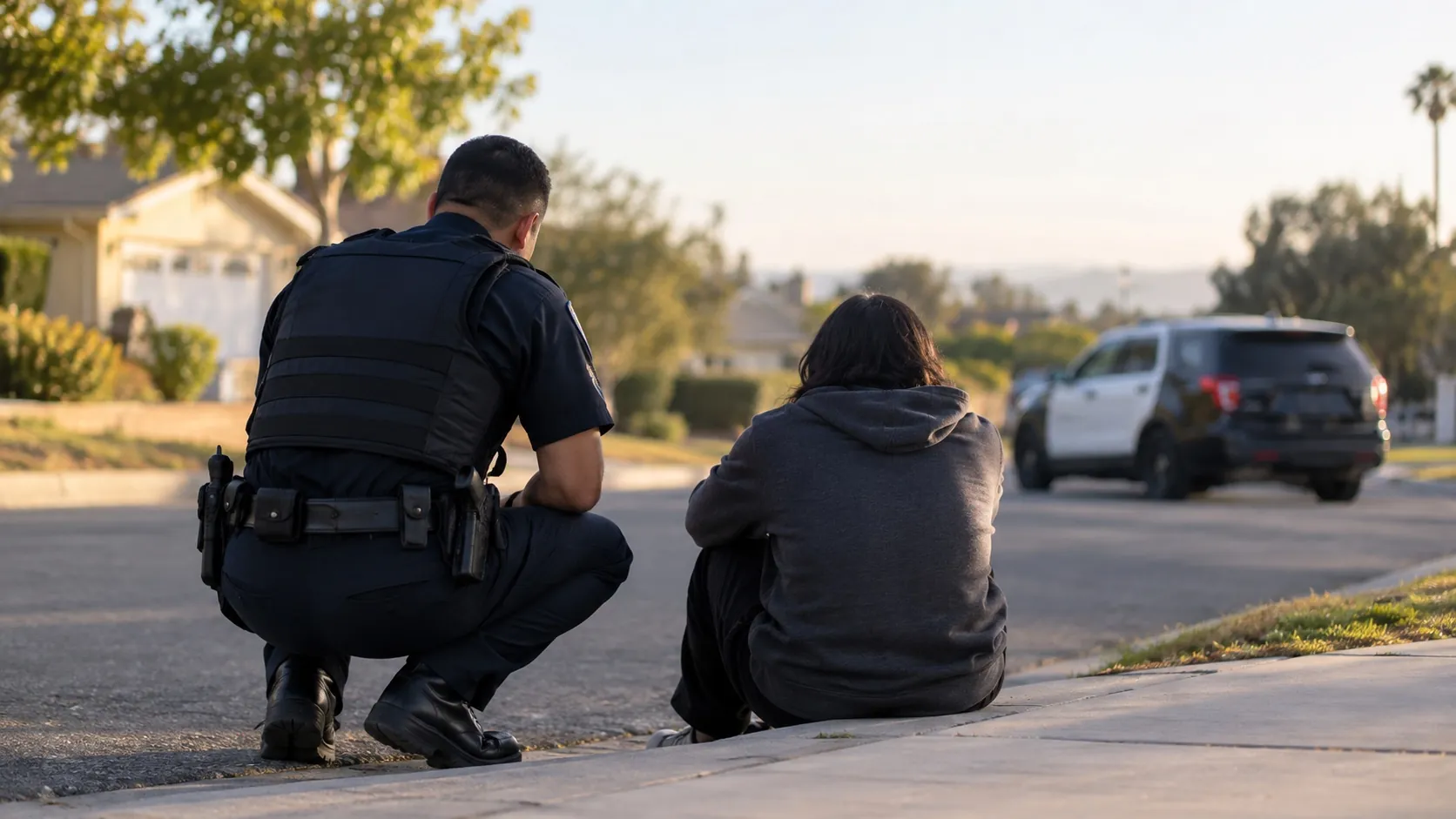
Useful empathy, in their reading, is something else: understanding the mental state of the person on the other side in order to choose the right form of communication, distance, timing and tactics. It isn't about pleasing — it's about understanding in order to control the situation with the least force possible. The academic literature on procedural justice, associated with psychologist Tom Tyler, of Yale University, points the same way: people tend to cooperate more with police when they feel they were heard, treated with respect, and that decisions followed clear criteria — which has nothing to do with giving in to what the person wants.
The officer who hesitates because of the camera
The participants point to the side effect of misunderstood empathy: the officer who, in the middle of a call, is thinking about how it's going to look on video. "Is the optics different, my arm here, are they going to think that…" — without doing anything wrong. That hesitation is a barrier to police work and, on calls with real risk, a vulnerability.
The guest also points out that an officer isn't a machine and sometimes reacts the way anyone would to verbal abuse. He describes a traffic stop where he answered a driver's profanity in the same tone — which earned him a formal write-up. Her complaint included accusations the recording disproved. The story, told with humor, illustrates both sides: the camera protects the officer against false accusations and, at the same time, records every word he says. Professionalism is still the rule, even when the provocation comes first.
What this changes on the street
- In a psychiatric crisis, loud repeated commands can make things worse: the person may literally be unable to process what they're hearing.
- Time and distance are de-escalation tools — when the tactical situation allows.
- Empathy doesn't replace safety: understanding the person doesn't mean dropping your guard.
- Fear of a complaint can't decide the tactics. What decides is the law, department policy and training.
Sources and verification
Patricia E. Deegan, "Hearing Distressing Voices" simulation (National Empowerment Center). Memphis CIT model (1988) and CIT International. California Senate Bill 29 (2015) and Senate Bill 11 (2015); California Penal Code, sections 13515.25 and following; California POST, Crisis Intervention Behavioral Health Training programs. Assembly Bill 392 (2019) and Senate Bill 230 (2019). Tom R. Tyler, research on procedural justice and police legitimacy. The accounts of the voices training and of the stop that led to a write-up come from the episode's participants.
Who's speaking here: Eliel Teixeira and Edwin Wu are active-duty police officers in the Los Angeles, California area — Brazilian-born, American citizens, with long careers in law enforcement. In this episode they host Marcelo Bini, who worked as a police officer in Texas.
Heads up: everything described here applies to California rules — and, on several points, to each person's specific department. In other American states (Texas, Florida, New York…) the rules can be quite different.
Watch this part of the episode:
Tactical empathy applied to everyday police work — starting at 55:10 · Palavrão Tático
This article is a reference edition of episode 45 of Palavrão Tático and is subject to edits and editorial additions. For the full conversation, watch the episode. — Updated on 16/09/2026.