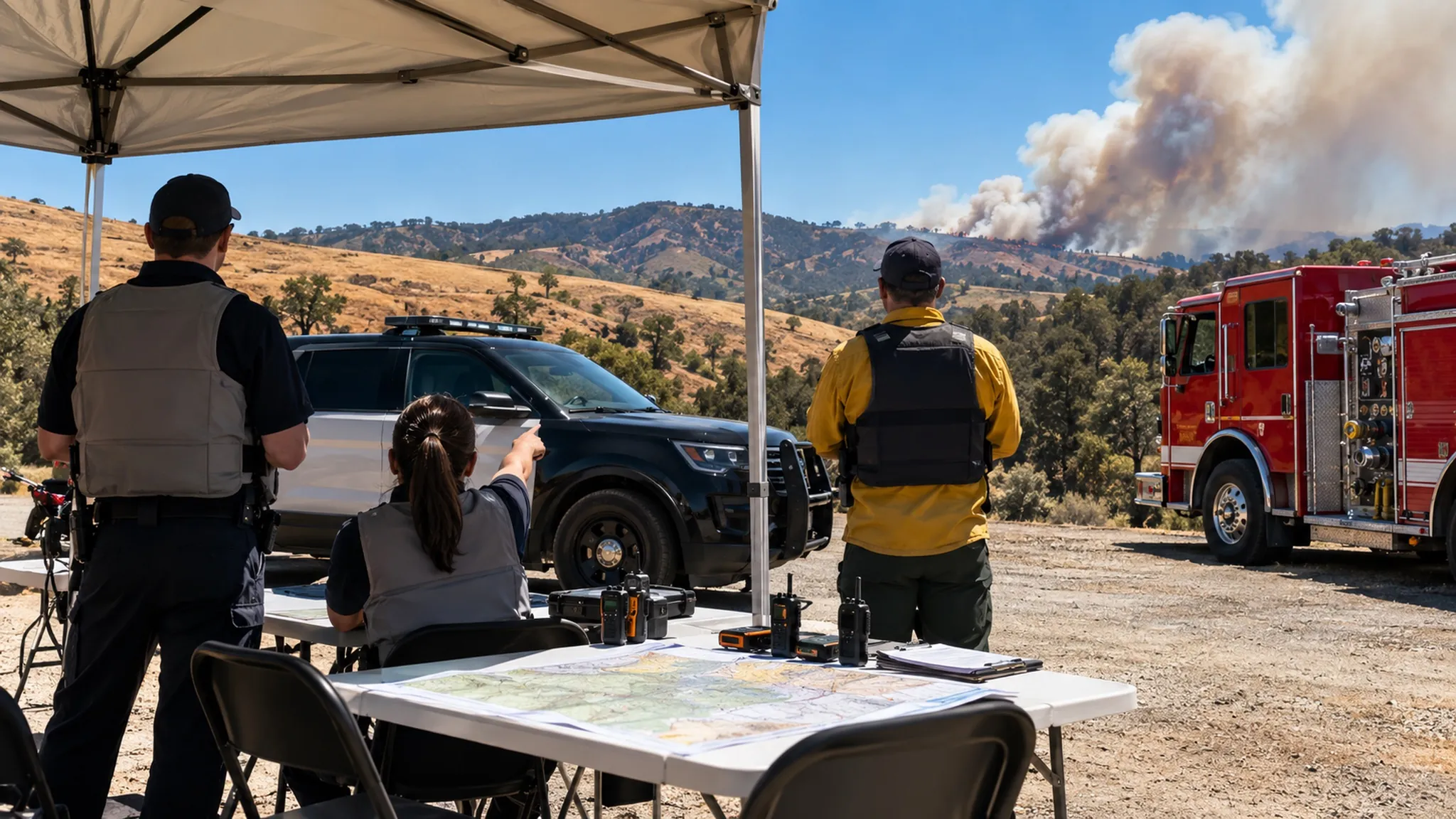


The victim lives in Los Angeles. The scam link was sent by someone in Michigan. The money landed in an account opened in Delaware. Whoever withdrew it was in New Mexico. The question: who investigates — and how do you investigate that from a desk in Los Angeles? The example comes from Maurício de Thomazi, a delegado (chief investigator) with the São Paulo Civil Police and a guest on Palavrão Tático, and it sums up what he sees as the biggest shift in modern crime: crime has broken away from physical space.
Crime left the map
The question came from the hosts. A lot of crews, they said, are walking away from traditional crime — car theft, robbery — and moving into online scams. The math is simple: lower risk, higher payoff. And many times the suspects operate from another state or another country precisely to stay out of reach of the local police, who end up holding the report with no suspect in reach.
"The challenge is the same," the delegado answered. He said it's what he tells his criminology students: policing was always built around a territory — this county, this state, this city. "Now that has fractured." The crew that used to sit in one place no longer has a physical location, and the police have to find an investigative model that can handle that.
In California: the victim reports where they live
California law already addresses this problem in at least one key area: identity theft (Penal Code 530.5), the entry point for a large share of financial scams. Two rules keep the victim from being bounced from one agency to the next:
- Penal Code 530.6 — a person who learns their identity has been used by someone else can go to the law enforcement agency for the city or county where they live, and that agency must take the report and begin the investigation, even if the scam was carried out somewhere else;
- Penal Code 786 — for this crime, jurisdiction to prosecute includes the county where the victim resided when the offense occurred, in addition to where the information was stolen and where it was used.
That settles where to report and where to prosecute. It doesn't settle the rest: the suspect is still in another state, the bank account sits under another jurisdiction, and every piece of data requires a court order or a formal request to the company holding it.
When the case goes federal
That's where the federal side comes in. A scam that uses interstate communications — internet, phone, electronic transfer — can be charged as wire fraud, a federal crime under Title 18 of the United States Code (Section 1343). In practice, larger cases, with many victims or high dollar amounts, tend to involve federal agencies such as the Federal Bureau of Investigation (FBI) and the Secret Service, which have nationwide reach.
The FBI runs the Internet Crime Complaint Center (IC3), the national channel for reporting internet crime. The IC3 annual report for 2024 logged roughly 860,000 complaints and $16.6 billion in reported losses — a 33% increase over the previous year. Year after year, California shows up in the report as the state with the most victims and the largest losses.
For those on patrol, the practical takeaway is that the local report is still step one: it's what the victim uses with the bank and the credit bureaus, and what opens the investigation. An IC3 complaint adds to it; it doesn't replace it.
In Brazil: the same answer, through the victim's home
Brazil reached a similar solution. Under the general rule of the Code of Criminal Procedure (Article 70), jurisdiction belongs to the place where the crime was completed — which, in transfer scams, pushed the investigation to the city of the scammer's bank branch. In 2021, Law 14.155 added a paragraph to Article 70: for fraud (estelionato) committed through a deposit, a bad check or a transfer of funds (which includes Pix, Brazil's instant payment system), jurisdiction is now set by the victim's place of residence. In other words, someone who lives in São Paulo and falls for a scam tied to an account in the Northeast reports it — and sees the case handled — where they live.
California and Brazil, each with its own system, reached the same conclusion: when crime has no territory, the most stable point of reference is the victim.
The police went to social media too
The hosts brought an example of adaptation from the other side of the counter. A few years ago, their agency set up a unit to monitor social media, because people had started reporting crimes in Facebook and Instagram comments instead of calling the police. Officers followed the messages — including by text and WhatsApp — so they could respond right away when someone reported a crime.
Their take is that this is what sets today's policing apart: keeping up with how the public modernizes and how crime modernizes, at the same time. The usual caveat applies: social media is no substitute for 911. Emergencies go by phone.
The new profile of the investigator
In the earlier part of the conversation — covered in the episode 49 story about crime moving online — the delegado had already argued that online crime demands an investigator trained in digital investigation. Here he went further: having the right profile isn't enough; you need an investigative model that works without borders — cooperation between agencies, fast data requests to platforms and banks, and specialized units able to follow the money and the digital trail across several states at once.
For the victim, the advice is the same in both countries: report right away, keep every piece of proof (screenshots, statements, the bank's case number) and notify the financial institution immediately. In a digital scam, every hour lost is money that disappears.
What the two of them say about it
In the episode, Eliel Teixeira and Edwin Wu talk about crews migrating to online scams and about their agency's experience monitoring social media. The guest addresses the break from physical space as the defining mark of modern crime.
Sources and verification
California Penal Code, Sections 530.5, 530.6 and 786. United States Code, Title 18, Section 1343 (wire fraud). Federal Bureau of Investigation, Internet Crime Report 2024 (IC3). Brazilian Code of Criminal Procedure, Article 70, as amended by Law 14.155/2021. The example of accounts in several states and the assessment of crime breaking from physical space come from the guest; the social media monitoring unit was described by the hosts in the episode.
Who's talking here: Eliel Teixeira and Edwin Wu are active-duty police officers in the Los Angeles area, California — Brazilian-born, American citizens, with long careers in law enforcement. In this episode, produced in partnership with Criminocast, they once again host Maurício de Thomazi, a delegado with the São Paulo State Civil Police, professor of criminology and criminal procedure, and host of Criminocast.
Note: what is described here about American policing reflects the rules in California — and, in several respects, each officer's own department. Rules differ in other U.S. states. What is described about Brazil applies to the São Paulo Civil Police; each Brazilian police force has its own organic law and internal rules.
This article is a reference edition of episode 50 of Palavrão Tático and is subject to edits and editorial additions. For the full conversation, watch the episode. — Updated on 22/10/2026.