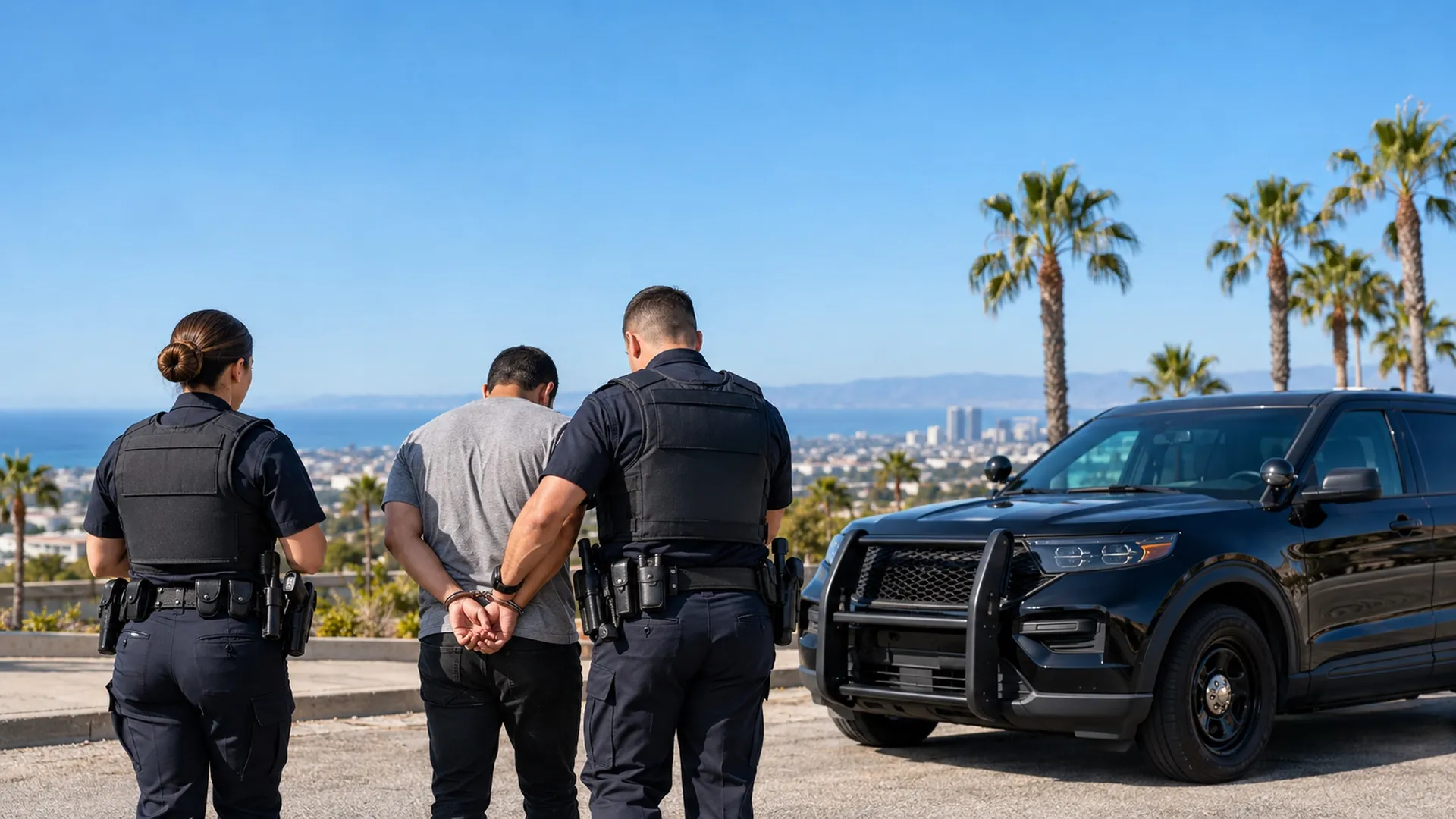


It was the question one of the hosts knew would "set the playground on fire": in the middle of the Military Police, the Civil Police and the delegado, where does the Municipal Guard fit? For anyone who built a career in American policing, where the city department is the police, the Brazilian setup is not intuitive. In the third conversation with delegado Maurício de Thomazi, of the São Paulo Civil Police, Eliel Teixeira and Edwin Wu asked for the explanation from the start. The guest warned them first: "I don't even know where to begin answering that." And he began with the Constitution.
The original design: one police force patrols, another investigates
The current structure comes from the 1988 Constitution, which, in the guest's words, "changed everything." Article 144 lists the public safety agencies, and the basic design at the state level is this:
- Military Police (PM): uniformed, visible policing — the patrol;
- Civil Police: investigation, the judicial police, headed by the delegado;
- at the federal level, the Federal Police, which plays a role similar to the Civil Police, and the Federal Highway Police, which patrols federal highways;
- the penal police, federal and state, added to the Constitution by Amendment 104 of 2019. They are organized not by territory but by subject: they run the prison system, with perimeter-wall security, prisoner transport and intelligence inside the facilities. The guest pointed to the US Marshals as the closest American parallel, "but it's not exactly the same thing."
What surprises an American cop the most is the delegado. If the PM arrests someone in the act, they have to take that person to the station, because the delegado is the authority who formally records the in-the-act arrest and is legally responsible for it (Article 304 of the Code of Criminal Procedure). Only after that is the arrestee brought before a judge at the custody hearing. "That's the big difference between your system and ours," the guest said. In the United States, the officer who makes the arrest is responsible for it and writes the report that goes to the prosecutor.
The Municipal Guard: from the park to the street
The Constitution gave cities a limited role. Paragraph 8 of Article 144 allows them to create municipal guards "intended to protect their property, services and facilities." Originally, the guest explained, that is what it was: a guard inside the city school (a kind of school resource officer, he compared), the park, the city hospital.
Over time, that role grew in practice. Cities with money invested in more patrol cars, more personnel and better equipment. And whoever looks after the park and the hospital drives down the street, which is also municipal. That's where the guard runs into drug dealing, responds to domestic violence, stops a robbery. In many cities, the guard ended up sharing patrol duties with the PM.
The law and the courts followed:
- the General Statute of Municipal Guards (Law 13,022 of 2014) defined their powers, including preventive patrol and cooperation with the other forces;
- Law 13,675 of 2018, which created the Unified Public Safety System (SUSP), listed the guards among the system's operational members;
- in February 2025, Brazil's Supreme Federal Court (STF) concluded its ruling on Theme 656, a case of general repercussion (RE 608,588), and held that it is constitutional for municipal guards to carry out urban security work, including uniformed patrol and community policing, as long as they respect the duties of the Civil and Military Police and have no investigative power.
Can they arrest? In practice, yes
The hosts' question was direct: does the guard have the same arrest power? On paper, according to the guest, the guard is there for municipal facilities. In practice, the guard driving from the park to the hospital who sees a robbery steps in, arrests, cuffs and takes the suspect to the station, and the in-the-act arrest is processed just the same. There is a simple legal basis for it: Article 301 of the Code of Criminal Procedure says that anyone may, and police authorities and their agents must, arrest someone caught in the act of a crime.
Every now and then a ruling throws out an arrest "because the guard isn't the police." But, from what the guest has seen, in 99% of cases the courts find that everything was fine: the guard came across the incident, even had a duty to step in, presented the arrestee to the delegado, and the delegado took on the legal responsibility. In practice, it is a municipal patrol police.
Municipal Police? In São Paulo, the courts blocked the name
The guest recalled that there was an attempt to rename São Paulo's guard as the Municipal Police, and that it turned into a "war of injunctions." The official record confirms it. The São Paulo City Council approved renaming the Metropolitan Civil Guard (GCM), and in March 2025 the São Paulo State Court of Justice suspended the change in a constitutional challenge filed by the state Attorney General's Office. The reasoning was that the São Paulo State Constitution reserves the word "police" for specific agencies. In April 2025, STF Justice Flávio Dino rejected a request from the federation of municipal guard unions to overturn the injunction. Other cities in Greater São Paulo, such as São Bernardo do Campo, had similar laws suspended.
Even so, the guest believes the trend is for the guards to become municipal police nationwide: "it's better to have it than not," and it's better to recognize as police those who in practice already are. He points to what is missing for it to work:
- standardized training, something like California's POST, so everyone speaks the same language;
- a clear division of duties with the PM, to avoid overlap.
He said the São Paulo GCM academy already trains guards from smaller cities, which can't afford to run their own academy for classes of 20 or 50 guards. As a result, it ends up shaping doctrine and standards "without even planning to," as a kind of "off-label" POST.
And in California, who is the city's police?
The comparison helps explain the confusion. In California, the city police department is a full-fledged municipal police: it patrols, investigates and arrests, and the officer is responsible for their own arrest. The sheriff covers the county and the areas without their own police. Many cities don't even have a department and contract the sheriff for policing, like dozens of cities in Los Angeles County. All peace officers, at any level, follow POST's minimum selection and training standards.
Who's in charge when several agencies respond together
Before getting to the guard, the conversation went through a street-level question: if officers from two departments respond together to a major incident, does one agency's lieutenant give orders to the other's sergeant? On the American side, the answer is the ICS (Incident Command System), whose history Palavrão Tático covered in episode 48. First you define who "owns" the incident, usually the agency responsible for the area or the one with the expertise. In incidents involving fire and hazardous materials, for example, command commonly goes to the fire department.
And, as the hosts pointed out, in ICS rank is not the criterion. The incident commander is chosen for knowledge and ability, not rank. If the best-prepared person on scene is a corporal, he's the one in command. According to them, that was the concept that took the most discussion when they taught the system to the Military Police command in São Paulo, because in any military or paramilitary organization the first thing that counts is rank.
What the two of them think about it
In the episode, Eliel Teixeira and Edwin Wu take on the subject with the frankness of people who have friends in the Civil Police, the PM and the Guard and know the topic is controversial. Edwin, who has been away from Brazil for many years, asks the questions of someone trained in the American system. The conversation ends with a question left for the next segment: why, in Brazil, does responsibility for an arrest go through a single figure, the delegado, when in other countries it belongs to the officer?
Sources and verification
Brazilian Federal Constitution, Art. 144 (public safety agencies; § 8, municipal guards) and Constitutional Amendment 104/2019 (penal police). Code of Criminal Procedure, Arts. 301 and 304. Law 13,022/2014 (General Statute of Municipal Guards). Law 13,675/2018 (SUSP). Supreme Federal Court, RE 608,588, Theme 656 of general repercussion (ruling concluded in February 2025). São Paulo State Court of Justice, March 2025 injunction in a constitutional challenge over the GCM name change, and decision by Justice Flávio Dino (STF), April 2025, as reported by Agência Brasil. California Commission on Peace Officer Standards and Training (POST). The 99% estimate of arrests upheld and the training of guards from other cities at the GCM academy are the guest's accounts.
Who's talking here: Eliel Teixeira and Edwin Wu are active-duty police officers in the Los Angeles, California area — Brazilian-born, American citizens, with long careers in law enforcement. In this episode, produced in partnership with Criminocast, they welcome for the third time Maurício de Thomazi, a delegado with the São Paulo State Civil Police, professor of criminology and criminal procedure, and host of Criminocast.
Note: what is described here about American policing applies to the rules of California — and, in several respects, to each officer's specific department. Rules differ in other American states. What is described about Brazil applies to the Civil Police of São Paulo; each Brazilian police force has its own organic law and internal rules.
This article is a reference edition of episode 51 of Palavrão Tático and is subject to edits and editorial additions. For the full conversation, watch the episode. — Updated on 30/10/2026.