



A dark stain on the bathroom ceiling, a musty smell in the closet, paint peeling near the floor. Any buyer looks at it and thinks: mold. The home inspector sees it too — but, as inspector Aguiar explains in the episode, he can't write that word in the report without proof.
Why the inspector says "moisture," not "mold"
On a general inspection, what the professional can attest to is what he measures or sees: moisture, with a meter, and stains or signs of water intrusion. Stating that the stain is mold — a fungus, with different species and different risks — takes an analysis.
Aguiar gives a practical example of the risk. If the buyer's inspector writes "there's mold," the agent takes that to the seller; the seller orders a lab air test, and the result comes back normal. Whoever made the claim without a basis is exposed to a lawsuit.
"I have to stay away from the word mold. I have to say there's moisture here." — Aguiar, in the episode
How a mold inspection works
Aguiar also offers the specialized inspection. The process he describes follows the industry's usual method:
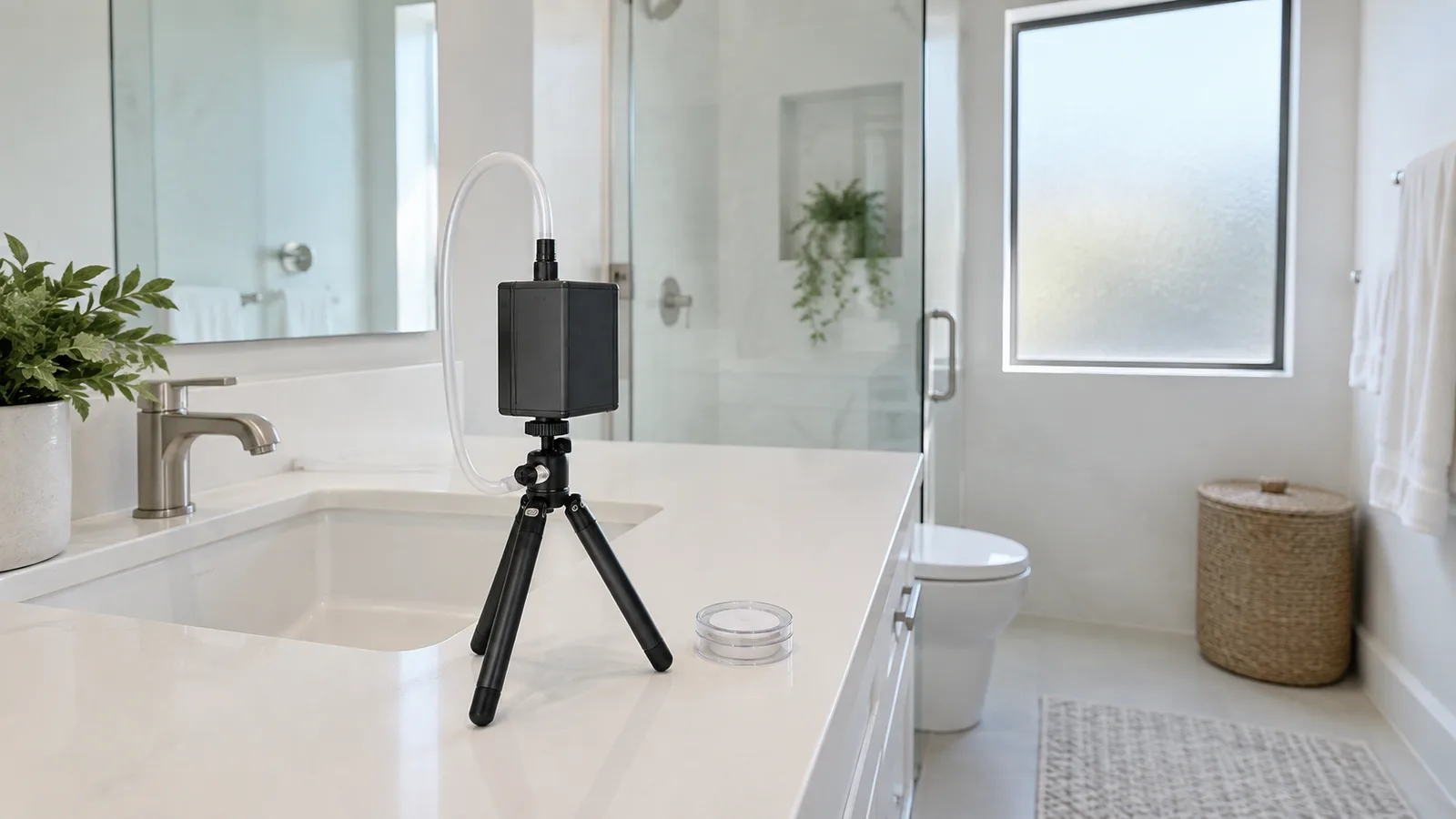
- Indoor air samples: a device draws in a defined volume of air and traps the particles in a cassette. Samples are taken in the dampest rooms — bathrooms, kitchen, laundry — or wherever there is a suspicion. Aguiar usually takes three or four.
- An outdoor air sample, mandatory as a baseline: fungal spores are naturally present in outside air. What matters is the comparison — inside the house, the concentration and the types shouldn't be very different from outside.
- A surface sample (swab, a kind of cotton bud, or tape lift), when there is a visible stain that has to be identified.
- The lab: the samples go out for analysis, and the report gives the types of fungus found and the concentration, compared against the outdoor sample.
Aguiar notes that he doesn't have to be a microbiologist, because the lab does the analysis; the inspector's job is to sample properly, in the right place, and explain the result.
What California law says
California passed the Toxic Mold Protection Actin 2001, assigning the Department of Public Health (CDPH) the task of evaluating whether to set exposure limits and standards for identification and remediation. To this day, however, there is no legal limit on airborne spores in a home, and no specific state license for mold inspectors. The official health guidance is practical: if there is visible growth or a moldy smell, the priority is finding and fixing the moisture source and removing the affected material — more than measuring.
Mold also falls under the disclosure rules: the seller must report known problems, including water intrusion and water damage, and state housing law treats visible, significant mold as a condition that makes a rental property substandard.
Hidden moisture
Aguiar says he has found houses, some recently remodeled, where someone "covered everything up" — closed over the damp area for the sale — and the house had a strong moldy smell. The point the buyer needs to hold on to is that mold is a consequence. Without fixing the leak, the poor ventilation or the water intrusion, cleaning doesn't solve it.
The risk is higher in beach houses, where the salt air keeps humidity high, and in properties that sat closed up for a long time. Houses with a crawl space deserve attention to the moisture under the floor.
What to do when the report flags moisture
- Ask for the exact location and the meter reading in the report.
- Investigate the cause: a plumber for a leak, a roofer for water intrusion, an evaluation of the bathroom and attic ventilation.
- Consider a mold test when there is a smell, extensive staining or someone in the family with asthma, allergies or a weakened immune system.
- Use the contingency window to negotiate fixing the cause and remediation by a specialized company.
- Ask for documentation of the work and, if possible, a new test after remediation.
- After you move in, ventilate, run the bathroom fan and keep indoor humidity under control.
This text is for informational purposes and does not replace medical advice or evaluation by remediation professionals.
Sources and verification
- California Health and Safety Code, sections 26100 and following — Toxic Mold Protection Act of 2001 (SB 732).
- California Department of Public Health (CDPH) — guidance on mold and moisture in homes: priority on fixing the moisture source; absence of numerical exposure standards.
- U.S. Environmental Protection Agency — guide to mold, moisture and sampling (comparison of indoor and outdoor samples).
- California Health and Safety Code, section 17920.3 — visible, significant mold as a substandard housing condition.
- Transcript and chapters of episode 8 of the Cadê Moradia podcast (April 2026), with inspector Aguiar and the show's realtors.
Watch this part of the episode:
How a mold inspection works. — starting at 39:53 · CADÊ BRAZIL
This article is a reference edition of episode 8 of the podcast and is subject to edits and editorial additions. For the full conversation, watch the episode. — Updated on 17/09/2026.