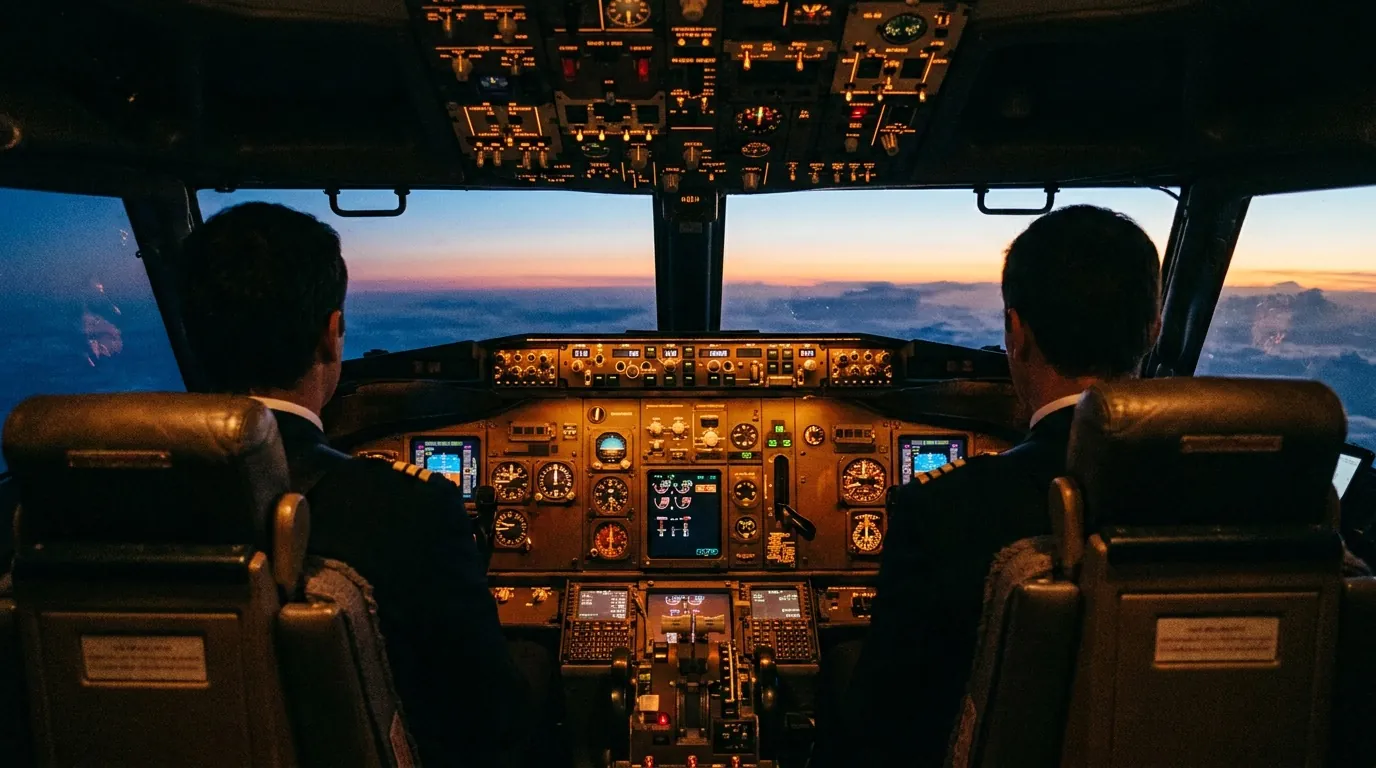
An aviation case came up in the middle of a conversation about policing — and not by accident. The underlying question is the same in both professions: what happens when the person closest to the problem can't warn the person in command?
Sixteen accidents in thirty years
Between 1970 and 1999, Korean Air racked up 16 accidents and incidents, with roughly 700 victims — a disproportionate record for any major airline. The crisis peaked with Flight 801, which crashed into a hillside approaching Guam in 1997: 228 of the 254 people on board died. The pilots, individually, were technically competent. The problem wasn't flying skill.
The co-pilot knew — and couldn't say it in time
Investigations, including black-box analysis from more than one of these accidents, showed the same pattern repeating: the first officer (co-pilot) identified the error, but struggled to contradict the captain directly enough to change the aircraft's course in time. Korean hierarchical culture — reinforced at the time by how many former military officers ran the airline — made directly disagreeing with a superior almost unspeakable inside the cockpit.
"The first officer was struggling to tell the captain that the plane was going down. That whole hierarchy thing, extremely closed off, rigid. Even at the airport, the captain walks and the co-pilot has to stay 3 steps behind."
The same pattern, on a ship
The Sewol ferry disaster, in South Korea in 2014, followed a similar logic — just outside the cockpit. As the vessel was sinking, the captain instructed passengers to stay in their cabins. Many obeyed, even as they watched the water rise, even with rescuers banging on the windows telling them to get out. The order had come from above; questioning it wasn't part of the cultural repertoire of the people on board.
"We got there with the ship sinking and we're banging on the windows: ‘get out, we're here to rescue you,’ and they didn't get out, man. Because the captain gave the order."
Aviation's answer: training people to disagree
The airline industry's response, widespread from the 1990s-2000s onward, was Crew Resource Management (CRM) — a set of training protocols that formally requires a subordinate to voice any safety concern, and requires the captain to stop and hear that objection before proceeding. It isn't a goodwill suggestion: it's a procedure with standardized language, rehearsed in simulators, tested in evaluations.
The lesson for anyone wearing a badge
The police chain of command carries the same risk structure. A recruit or a junior officer who spots a safety problem — a risky tactical call, a misread scene — needs a real channel to raise their hand without it costing them their career. A department that punishes anyone who questions, even without realizing it, is doing exactly the opposite of what aviation learned at the cost of hundreds of lives.
Who's talking here: Eliel Teixeira and Edwin Wu are active-duty police officers in the Los Angeles, California area — Brazilian-born, American citizens, with long careers in law enforcement. On Palavrão Tático, they talk cop-to-cop and to enthusiasts, with no translation into civilian language.
Note: everything described here applies to California rules — and, on several points, to each host's specific department. In other U.S. states (Texas, Florida, New York…) the rules can be quite different.
Watch this part of the episode:
Korean Air, Sewol, and hierarchy as a cause of accidents (approximate excerpt) — starting at 41:10 · Palavrão Tático
This article is a reference edition of episode 43 of Palavrão Tático and is subject to edits and editorial additions. For the full conversation, watch the episode. — Updated on 15/08/2026.