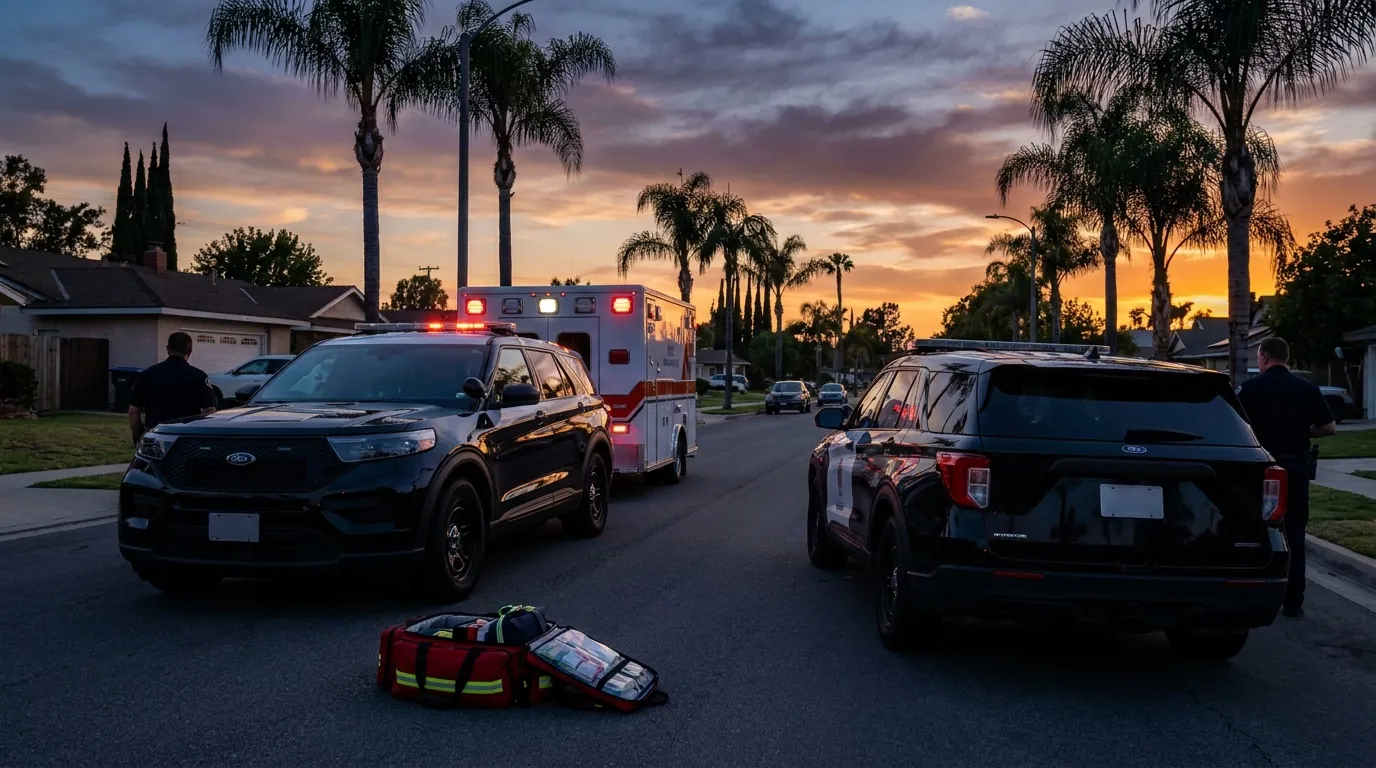


Some statutes only turn up for someone who reads the Penal Code as a hobby. In episode 45 of Palavrão Tático, guest Marcelo Bini — a former Texas police officer, active-shooter response instructor, and now in a federal career — revisits a case that became an inside joke on the show: the time when, during a traffic stop, he found a collection of sex toys in the car and charged the driver under a little-known provision of the Texas Penal Code. The "vibrator law," as it got nicknamed in conversation, really exists. And the story of how it remains printed in the code, even after federal courts declared part of it unconstitutional, says a lot about how American law works in practice — and about why reading the whole code is a habit that pays off for any officer.
What the Texas Penal Code says
The provision sits in Chapter 43 of the Texas Penal Code, devoted to offenses against public decency, in the subchapter on obscenity. Section 43.21 defines what the law calls an "obscene device": a device — the statute itself cites the dildo as an example — designed or marketed as useful primarily for the stimulation of human genital organs. Section 43.23 criminalizes promoting that kind of item, or possessing it with intent to promote it (selling, distributing, lending, advertising).
The detail that turned the guest's case into a podcast story sits in subsection (f) of that same section: anyone possessing six or more obscene devices, or identical or similar items, is presumed to possess them with intent to promote. In other words, the law doesn't punish owning one item at home; it creates a presumption based on quantity. Six items in the car stop being, in the eyes of the statute, personal use and start pointing to commerce.
The severity depends on the specific conduct. Ordinary promotion is treated as a Class A misdemeanor — the highest tier of minor offenses in Texas; so-called "wholesale" promotion of obscene material is charged as a state jail felony, the lowest felony category in that state. The same section provides an affirmative defense: it's not a crime to possess or promote the material for a legitimate medical, psychiatric, judicial, legislative, or law-enforcement purpose.
The 2008 ruling that gutted the statute
In March 2008, the Fifth Circuit Court of Appeals — the federal court covering Texas, Louisiana, and Mississippi — decided Reliable Consultants, Inc. v. Earle. The plaintiff company ran four stores in Texas selling these products for private use and challenged the ban. The court held that banning the sale of sexual devices for private use between adults violated the Fourteenth Amendment of the U.S. Constitution, relying on the Supreme Court precedent in Lawrence v. Texas (2003), which recognized constitutional protection for consensual sexual intimacy between adults.
In practice, the ruling stripped the ban on promoting these devices of its force. But there's a point that tends to surprise people coming from outside the American system: the Texas Legislature never repealed the statute. It's still published in the Penal Code. A court's declaration of unconstitutionality doesn't automatically erase the text — only the Legislature can do that, and it depends on political will and calendar. That's why American state codes are dotted with provisions that remain "on the books" but wouldn't survive a court challenge.
And it's not a uniform picture nationwide. While the Fifth Circuit struck down the Texas ban, the Eleventh Circuit Court of Appeals upheld a similar Alabama law in 2007 (Williams v. Attorney General of Alabama). It's a classic example of how the same constitutional question can get different answers depending on the region of the country, until the Supreme Court weighs in — which, on this topic, it hasn't.
If it was never going to hold up, why include it in the charge?
The guest himself makes clear in the episode that this charge wasn't the point of the arrest. The driver had outstanding warrants and was in parole violation, and went back into the system for much more serious reasons. The obscene-device charge was tacked onto the record — and, as he himself says, wouldn't stand on its own: "I wouldn't do that, as an officer, if it were the only charge."
"It's right there in the Penal Code. I didn't make it up, she didn't deny it, I applied the law. I didn't invent anything, didn't plant anything — it's there, plain and simple."
This point matters for understanding how charging works in the United States. The officer records the facts and the charges he sees fit; the prosecutor decides what actually goes to court, weighing evidence, viability, and — precisely — whether a statute would survive a constitutional challenge. A provision gutted by a federal ruling rarely survives that screening. The guest says he had already told a judge he spoke with often that "one day" he'd use that statute — and months later, the case came up.
Mens rea and actus reus: how to read any criminal statute
The most useful part of the conversation for anyone working the street isn't the curious statute itself, but the method. The guest describes how he started reading the Transportation Code, then the Penal Code and the Code of Criminal Procedure on his own, without a law degree, to find legal tools for the job. And he explains the structure that repeats across practically every American criminal statute:
- Actus reus — the act: the conduct described in the statute (promoting, possessing with intent to promote, driving, carrying).
- Mens rea — the required mental state: whether the act must be intentional, knowing, reckless, or negligent. In Texas, these degrees are defined in section 6.03 of the Penal Code (intentionally, knowingly, recklessly, with criminal negligence).
- The penalty — the classification of the offense, which determines whether it's a misdemeanor or a felony, and at what level.
In California, the same principle shows up directly in Penal Code section 20: every crime requires the union, or joint operation, of act and intent (or criminal negligence). Anyone who understands this structure can read any new statute and know, within minutes, what needs to be proven in the report.
And in California?
Here the picture is different. California's Penal Code addresses obscene material in section 311 and following, focused on audiovisual material and, above all, on protecting minors. California has no ban equivalent to Texas's on selling sexual devices between adults — sex shops operate normally, subject to municipal zoning rules. A stop like the one described in the episode, if it happened in Los Angeles, wouldn't have that charge available.
What still holds true in both states is the underlying lesson: an officer works within what's written, and written with precision. Knowing that a statute exists is half the job; the other half is knowing whether it still holds up in court.
Sources and verification
Texas Penal Code, sections 43.21 (definitions, including "obscene device"), 43.23 (obscenity; subsection (f), presumption from six or more devices; affirmative defense for medical, judicial, legislative, or law-enforcement purposes), and 6.03 (culpable mental states). U.S. Court of Appeals for the Fifth Circuit, Reliable Consultants, Inc. v. Earle, 517 F.3d 738 (2008). U.S. Supreme Court, Lawrence v. Texas, 539 U.S. 558 (2003). U.S. Court of Appeals for the Eleventh Circuit, Williams v. Attorney General of Alabama (2007). California Penal Code, sections 20 and 311. The account of the stop, the driver's record, and the conversations with the judge comes from the guest, as told in the episode, and is reproduced here as a personal account — case details were not independently verified by this newsroom.
Who's speaking here: Eliel Teixeira and Edwin Wu are active-duty police officers in the Los Angeles, California area — Brazilian-born, American citizens, with long careers in law enforcement. In this episode, they host Marcelo Bini, who worked as a police officer in Texas.
Note: the case told in this article happened under Texas law. The rules in California, where the hosts work, are different — every U.S. state has its own Penal Code.
Watch this part of the episode:
Texas's sodomy law and the seizure of items — starting at 4:35 · Palavrão Tático
This article is a reference edition of episode 45 of Palavrão Tático and is subject to edits and editorial additions. For the full conversation, watch the episode. — Updated on 16/09/2026.