



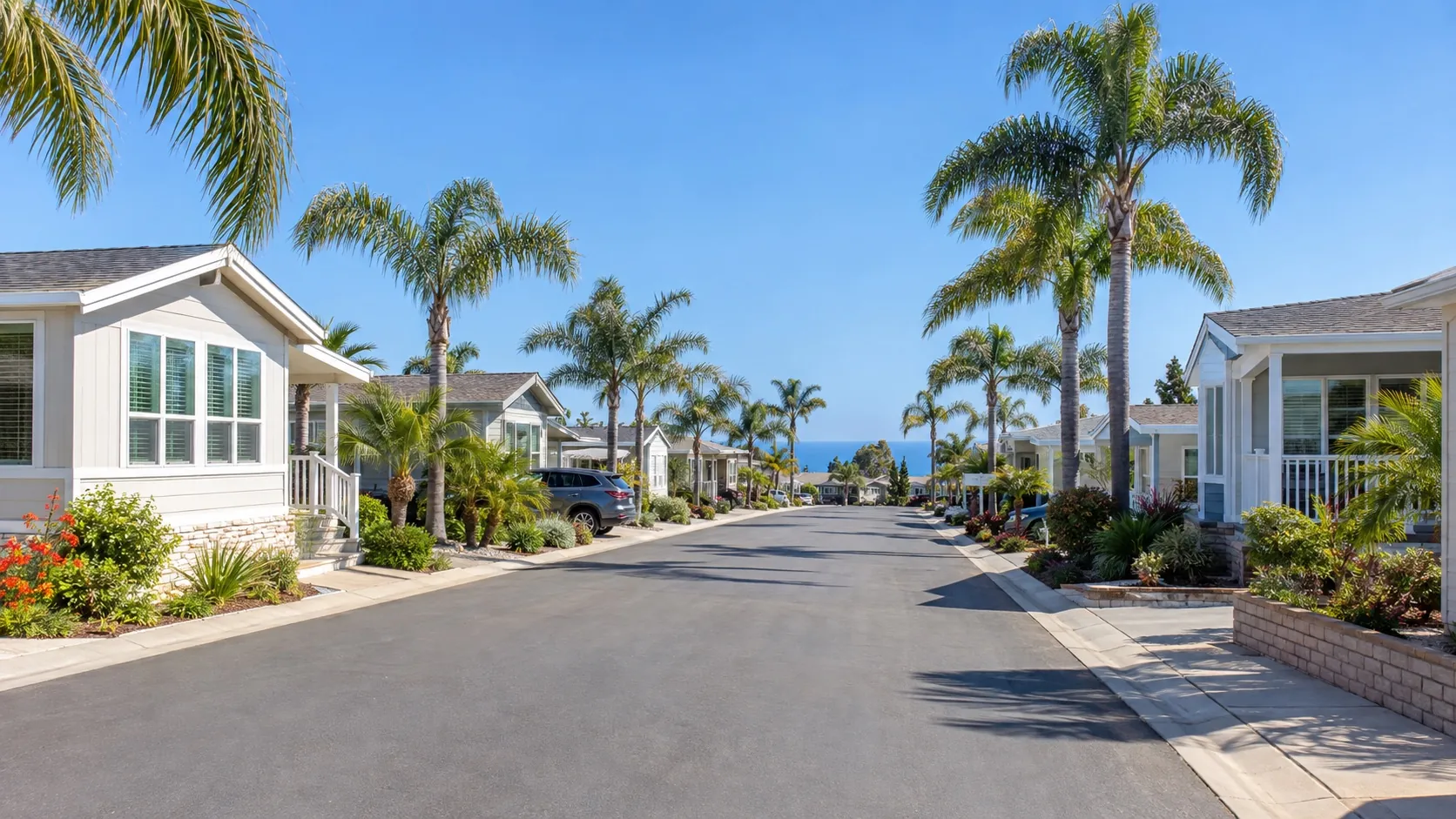
When the episode's question is where to show property to someone without $1 million, one of the agents brings up the option that, in his view, almost nobody mentions: the manufactured home — the prefabricated house.
"There are nice homes, about 1,800 square feet, good-looking, for $300,000, $250,000. And close to the beach." — excerpt from the episode
The arrangement: the house is yours, the land isn't
The explanation given on the show is precise. In the most common arrangement in California, the buyer owns the house and pays rent for the land it sits on, inside a community. The comparison used is to a car: an asset that's yours, that can even be moved, but that doesn't come with the ground underneath it.
These communities tend to have condo-like amenities — the episode mentions a pool, courts, and security — and the space rent works, in practice, like a monthly fee.
Why the price is so much lower
In Southern California, most of a property's value sits in the land, not the construction. Take the land out of the equation, and the price drops dramatically — and that's what allows a spacious, modern house a few minutes from the beach to cost a fraction of a traditional house in the same area.
The trade-off: different appreciation
The episode is upfront about the weak point: because it doesn't include the land, the house doesn't appreciate like a traditional house. The agents note that in areas with no room left to build, demand keeps the price steady — but without the same performance.
It's a difference worth understanding without drama: for someone comparing it to paying rent, the math can be very favorable; for someone comparing it to buying a house with land, it's a different kind of asset.
Can the land rent spike?
It's the right question, and it comes up in the episode. The answer given is that several California cities have specific rent control on spaces in mobile home parks — San Juan Capistrano is cited as an example. The state also has its own law governing the relationship between resident and park, the Mobilehome Residency Law, with rules on contracts, rent increases, and termination.
Checking this is mandatory and it's city-by-city: is there a local ordinance? is the park subject to it? what have recent rent increases looked like? Without those answers, the future monthly cost is a question mark.
Financing: also different
- A home in a park is usually financed as personal property (a chattel loan), with a shorter term and higher interest than a traditional mortgage.
- There are specific federal programs, such as FHA options for manufactured housing, with their own terms.
- When the house is installed on land the owner owns and permanently affixed, it can be treated as real property — and then a conventional mortgage becomes possible again.
On that last scenario, the episode offers a useful detail: there are loans that finance, in a single package, the land, the house, and the infrastructure — power, water, sewer — for anyone who wants to buy a lot and install their own home. It's the path for someone looking for a larger property, farther from city centers.
Before closing
- Read the park's contract: term, rent-increase rules, transfer at sale, community rules.
- Confirm the house's age and code — homes built before 1976 follow a different standard and affect financing and insurance.
- Add the space rent to the payment to compare against a condo or a house.
- Ask about resale: how a sale within that park works and how long it usually takes.
Sources and verification
- HUD — Manufactured Home Construction and Safety Standards (the federal code in effect since 1976) and financing programs for manufactured housing.
- California Mobilehome Residency Law (California Civil Code) — relationship between resident and park, contracts and rent increases; municipal space-rent control ordinances.
- California Department of Housing and Community Development — registration and titling of manufactured homes.
- Price ranges of $250,000 to $300,000, square footage cited, and description of the communities: agents on the episode (April 2026).
- Transcript of episode 7 of the Cadê Moradia podcast.
Watch this part of the episode:
Manufactured homes: the entry-level alternative (approximate excerpt) — starting at 16:21 · CADÊ BRAZIL
This article is a reference edition of episode 7 of the podcast and is subject to edits and editorial additions. For the full conversation, watch the episode. — Updated on 18/09/2026.