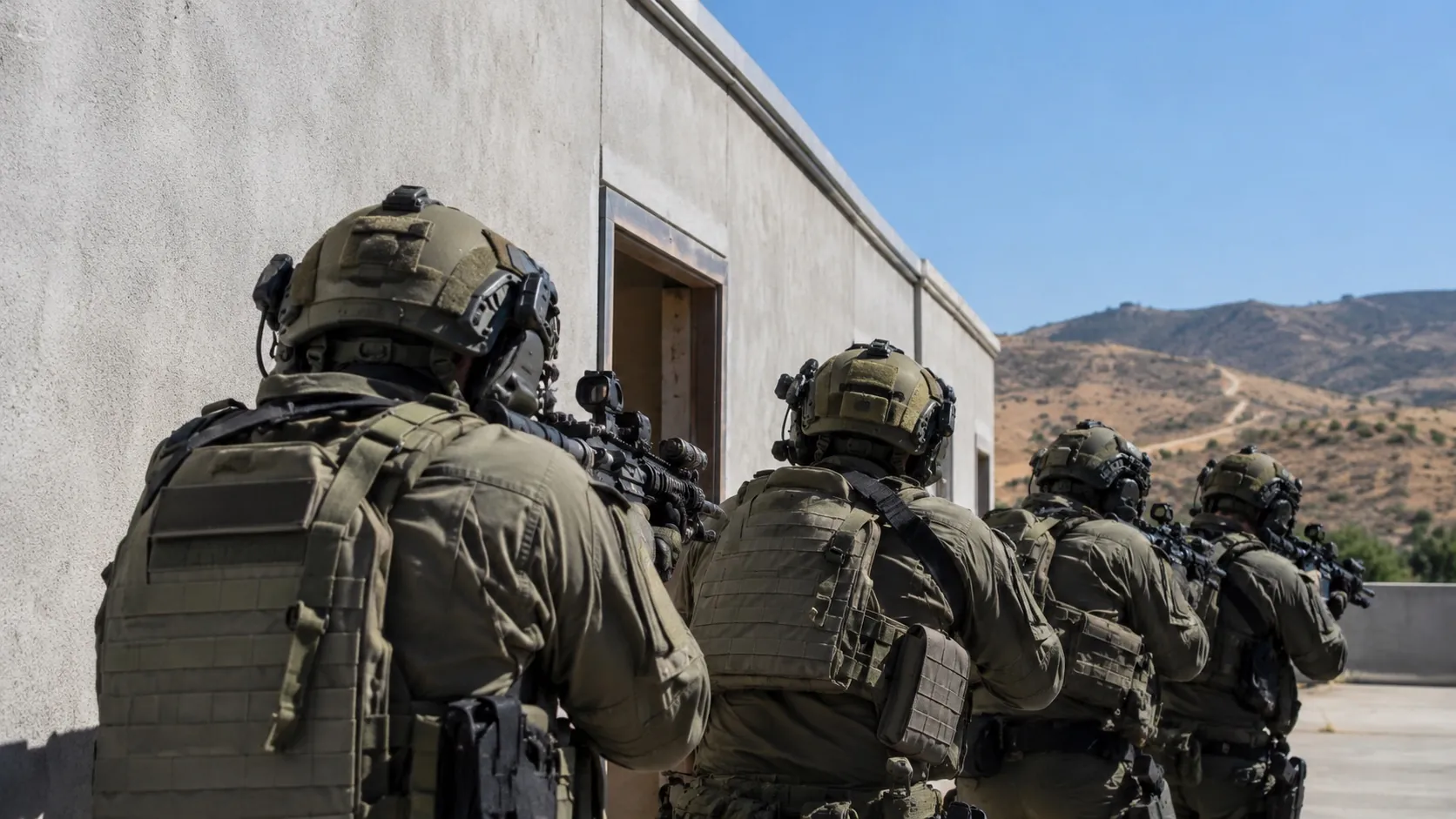

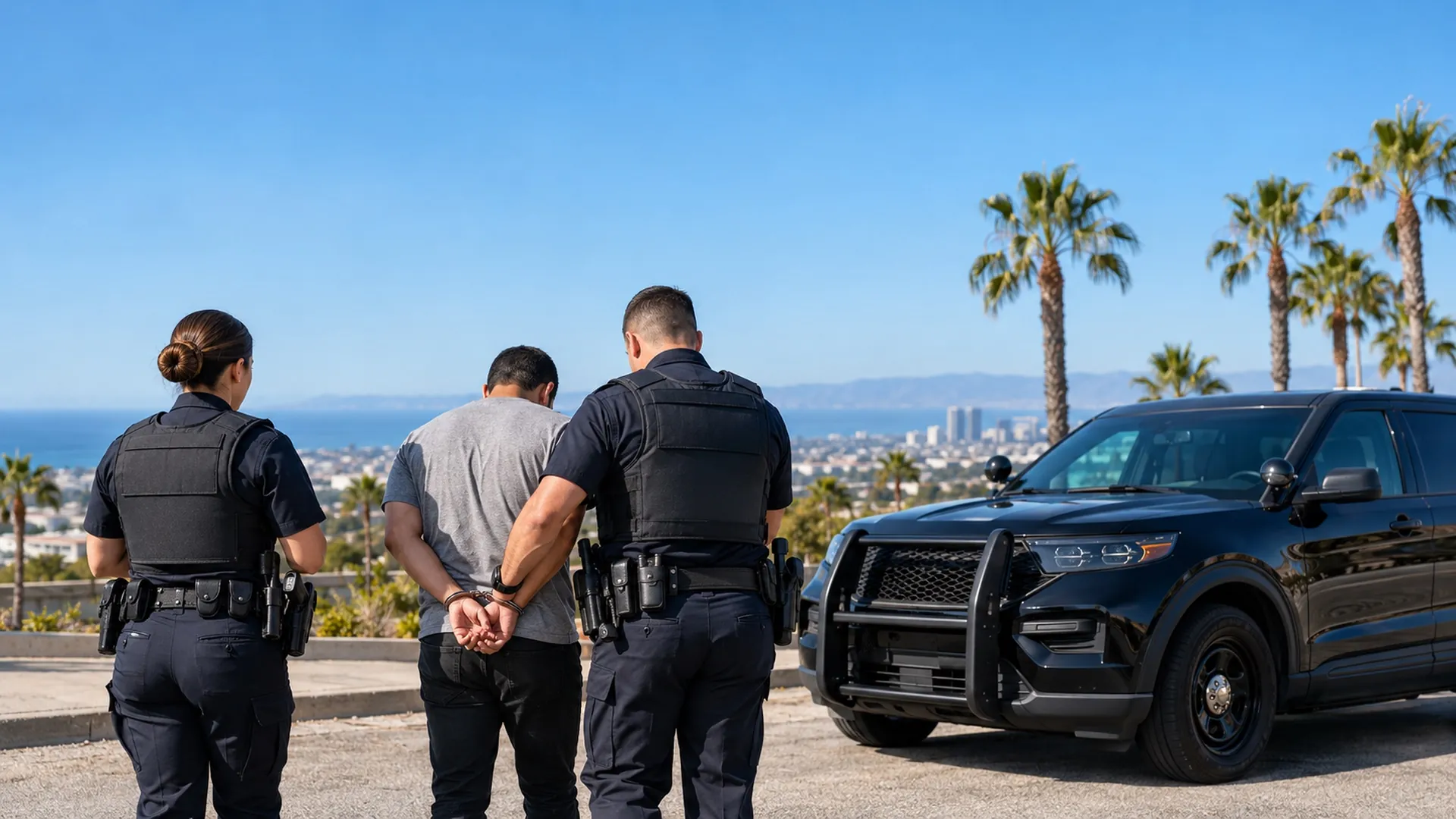
Anyone who moves to Brazil from the United States is struck by the bureaucracy. Anyone who makes the opposite trip — and is a cop — is struck by something else: the law changes when you cross a state line. That was one of the first impressions of the guests on episode 47 of Palavrão Tático, police officers Paulo Brandão and Felipe Teixeira, from Brazil's Federal District, who spent two weeks in Los Angeles taking the county's basic SWAT course. Eliel Teixeira and Edwin Wu ask them what they made of American policing — and above all, of California.
One country, fifty penal codes
In Brazil, the Constitution gives the federal government exclusive power to legislate on criminal law and criminal procedure (Art. 22, I). The Penal Code, the Code of Criminal Procedure and the gun laws apply from one end of the country to the other — a military police officer in Brasília and one in Porto Alegre work under the same law, even though each force has its own internal regulations.
In the United States, the logic is reversed. The US Constitution reserves to the states everything not expressly delegated to the federal government, and the bulk of criminal law stays with them. Each state has its own penal code and its own rules on stops, use of force, carrying firearms, training and officer certification. On top of that come federal laws and Supreme Court decisions that apply to everyone — but a street cop's day-to-day work is governed by state law and by their department's policy.
The guests felt this firsthand. Before Los Angeles, they attended a conference in Wisconsin and entered the country through Chicago, Illinois. "You can see the characteristics are different" from one place to another, one of them sums up. And California, they note, is the state that departs most from the image Brazilians have of American police — the Hollywood version, where the cop can do anything.
The chokehold California banned
The example that struck both of them most was the chokehold. In Brazil, many police officers see the mata-leão as a less-lethal form of restraint: instead of escalating to a shot, you control the aggressor with a grappling technique. In California, the rule is different.
In September 2020, Governor Gavin Newsom signed AB 1196, which added Section 7286.5 to the state's Government Code: since January 1, 2021, no law enforcement agency in California may authorize the use of a carotid restraint (the hold that compresses the carotid arteries and causes loss of consciousness) or a choke hold (pressure on the windpipe). In practice, both variations of the mata-leão were removed from the authorized repertoire. The LAPD had already suspended the carotid restraint in June of that year, shortly after the death of George Floyd in Minneapolis.
The ban is state-level. In several other states the technique is still allowed, restricted to deadly-force situations, or regulated only by each department's policy. That is exactly the guests' point: what is acceptable in one part of the United States may be prohibited in the neighboring state.
Deadly force: the "necessary" standard
The chokehold is not the only difference. Since January 1, 2020, under AB 392, the California Penal Code (Section 835a) authorizes an officer to use deadly force only when it is necessary to defend life — their own or someone else's — against an imminent threat of death or serious bodily injury, or to apprehend a fleeing person who poses that kind of threat. The law requires that the totality of the circumstances be considered, including the officer's own conduct leading up to the confrontation.
The federal standard, set by the Supreme Court in Graham v. Connor (1989), is that of objectively reasonableforce, judged from the perspective of a reasonable officer on the scene. California went beyond that minimum. A companion law, SB 230, required agencies to adopt use-of-force policies and training that include de-escalation tactics and alternatives to deadly force.
The first class of SWAT school was about the law
For the guests, one detail summed up that culture: the first class of the SWAT course was not about shooting or tactical entry — it was about legal issues. "Look how much these guys care about this," one of them says. Before teaching you how to breach a door, the course teaches you when, with what warrant, and how far you can go.
And that is where the common ground with Brazil shows up. What is "disruptive," in their view, is the idea that the American cop can do anything. They can't: the limit is whatever the law imposes, and whoever goes too far is held accountable — "just like us." The difference lies in the density of written rules and in how each state applies them.
A rights-focused state: rights and duties on the same scale
The guests describe California as a highly "garantista" state — a term common in Brazilian legal circles for systems that prioritize individual guarantees against the power of the State. Their criticism is not of those guarantees themselves, but of the imbalance they perceive on the street: citizens know their rights well and forget their duties. "To exercise your rights, you also have to know your duties," one of them says. When someone breaks the rules, that is where the role of the State — and of the police officer — comes in.
For anyone who is a police officer in Brazil and is thinking about working or training in the United States, the practical lesson is simple: there is no such thing as "the American rule." Before any course, exchange or joint operation, it pays to study the law of the state you are going to set foot in and the host agency's use-of-force policy — they may be far more restrictive than the ones back home.
What the two of them think about it
In the episode, Eliel Teixeira and Edwin Wu talk about the differences between states and between countries based on their own experience as police officers in Los Angeles, and discuss how the Hollywood image distorts the perception of people coming from abroad. The full conversation, with the guests' account of their first weeks in California, is in the episode.
Sources and verification
Federal Constitution of Brazil, Art. 22, I (exclusive federal power to legislate on criminal and procedural law). US Constitution, 10th Amendment (powers reserved to the states). California Assembly Bill 1196 (2020), which created Section 7286.5 of the Government Code — ban on the carotid restraint and choke hold, in effect since 01/01/2021. California Assembly Bill 392 (2019), which amended Section 835a of the Penal Code (deadly force only when necessary), in effect since 01/01/2020. California Senate Bill 230 (2019), use-of-force policies and training. US Supreme Court, Graham v. Connor, 490 U.S. 386 (1989). The impressions about the course and about other states are accounts from the episode's participants.
Who's talking: Eliel Teixeira and Edwin Wu are active-duty police officers in the Los Angeles area, California — Brazilian-born, American citizens, with long careers in law enforcement. In this episode, they host Paulo Brandão, a police officer in Brazil's Federal District for 27 years, and Felipe Teixeira, a police officer in the Federal District for 16 years, who came to Los Angeles for SWAT School.
Note: everything described here applies to the rules of California — and, on several points, to each officer's specific department. In other US states the rules change; in Brazil, each police force has its own organic law and internal regulations.
Watch this part of the episode:
starting at 1:57 · Palavrão Tático
This article is a reference edition of episode 47 of Palavrão Tático and is subject to edits and editorial additions. For the full conversation, watch the episode. — Updated on 02/10/2026.