



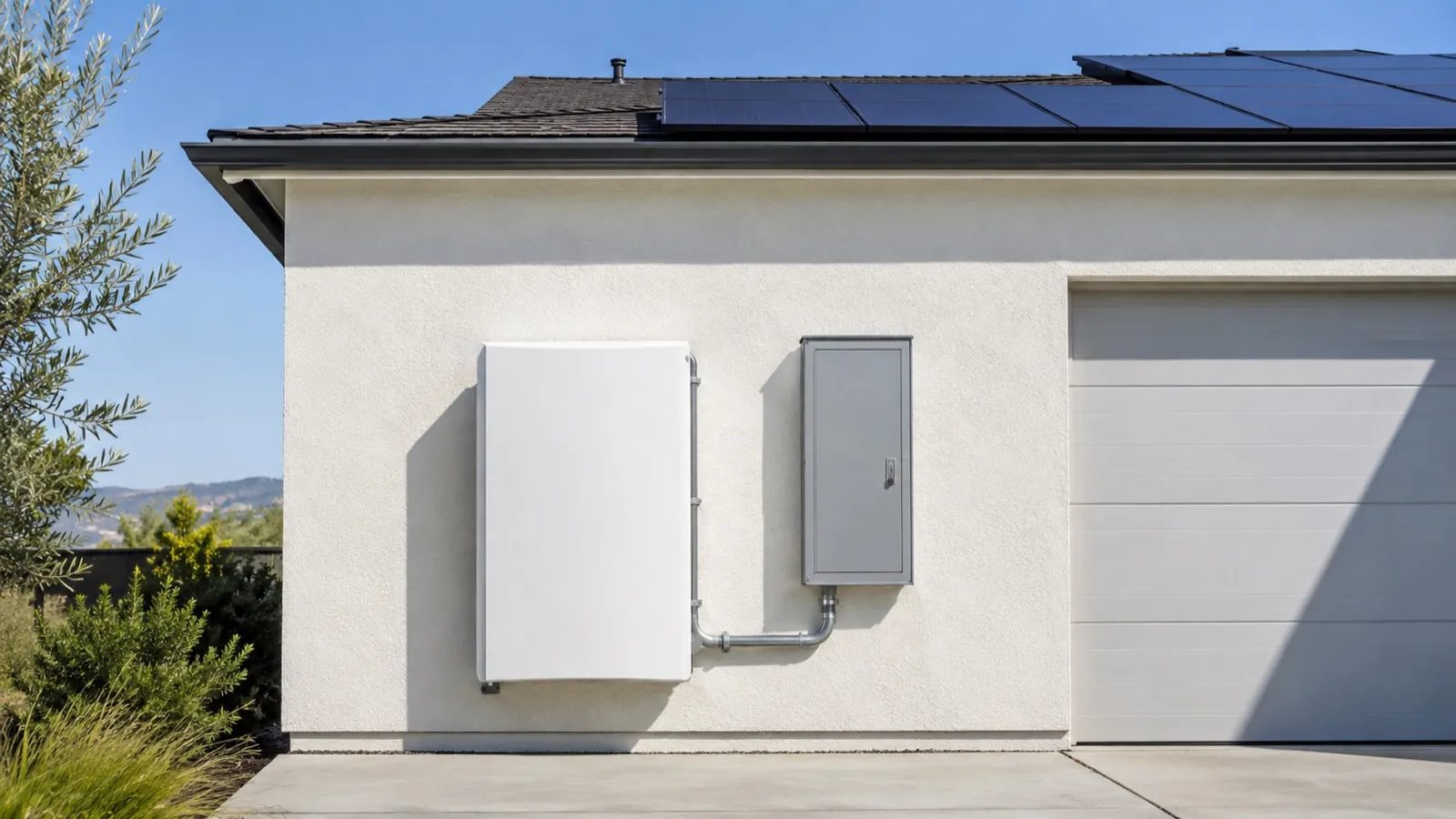
For years, the promise of solar in California was simple: the roof produces during the day, the surplus goes to the grid, and the utility credits that surplus on your bill. In the episode, Tharsio Theodoreli, an installer working in the Los Angeles area since 2018, says that early on some clients got checks for $300 to $500 at the end of the year. That model is over.
"Now we have net metering 3, the most recent one. If you give them 10, they give you 1 back." — Tharsio Theodoreli, in the episode
To understand what changed, and why the battery became a central piece, it's worth knowing the three phases.
What net metering is
Net metering is the compensation system between people who generate energy at home and the electric utility. The meter records the energy the house draws from the grid and the energy it sends back. The rule defines how much each kilowatt-hour sent back is worth. That's the rule the California Public Utilities Commission (CPUC) has changed over the years for customers of the state's three big utilities: Southern California Edison (SCE), Pacific Gas & Electric (PG&E) and San Diego Gas & Electric (SDG&E).
NEM 1, NEM 2 and NEM 3
- NEM 1: exported energy was credited at practically the same value as purchased energy. At the end of an annual cycle, a positive balance could result in a payment to the customer, albeit at a lower rate. This is the "checks" phase Tharsio remembers.
- NEM 2 (from 2017 in SCE territory): kept compensation close to retail value, but added time-of-use rates (time-of-use) and charges that can't be offset by solar credits.
- NEM 3, officially the Net Billing Tariff (in effect for systems connected since April 15, 2023): exported energy is now paid at a value tied to the utility's avoided cost at that hour, well below the retail rate. On average, the credit fell about 75%, from something like 25 to 30 cents per kWh to 5 to 8 cents, according to industry estimates.
Customers already on the earlier rules are entitled to stay on them for a 20-year transition period counted from the system's connection. This matters when buying a home with solar: ask which rule the system is on.
Why the rule changed
In the episode, Tharsio attributes the change to pressure from utilities, which see solar generation as competition. The public debate had two sides. Utilities and the CPUC argued that compensation at retail value shifted grid costs (maintenance, transmission, public programs) onto customers without solar panels, generally lower-income households. The solar industry and environmental groups argued the cut would discourage clean energy and distributed generation. The CPUC's December 2022 decision went with the new model.
The battery became the center of the math
With surplus energy worth little, the logic flipped: the value of a solar system lies in consuming your own energy, not exporting it. And this is where timing comes in. Panels produce the most at midday, when grid energy is cheap. The home's consumption rises in the late afternoon and evening, exactly when time-of-use rates get more expensive (the peak usually runs from 4 p.m. to 9 p.m.).
The battery bridges the gap: it stores midday energy and uses it during the expensive hours, instead of exporting it for pennies.
"The solution for that is batteries. These days I don't build any system without a battery." — Tharsio Theodoreli, in the episode
He adds a caveat: in homes built to sell, builders usually install only the code minimum, with no battery. For the end customer, he says, a battery is essential. Independent estimates indicate that, under the current rule, systems with batteries tend to pay for themselves faster than systems without them.
"Off the grid": what it really means
Tharsio uses the expression off the grid to describe homes with enough panels and batteries not to depend on the utility. He himself clarifies in the episode that this doesn't necessarily mean disconnecting: where the grid exists, the house usually stays connected but can run without it. Two practical cautions:
- Customers connected to the grid keep paying minimum charges to the utility, even when they produce everything they consume.
- Full autonomy depends on sizing panels and batteries for real consumption, including in winter.
Who speaks in the episode: Tharsio Theodoreli, a Brazilian who has lived in the United States for more than 20 years and founder of Solar Freedom USA, a solar design and installation company in the Los Angeles area, where he has worked since 2018. The assessments attributed to him reflect the experience of someone working in the industry.
This article is for information only. Rates and compensation rules are set by the CPUC and change often; confirm the current rule and the terms of your agreement with your utility before deciding.
Sources and verification
- California Public Utilities Commission (CPUC) — December 2022 decision creating the Net Billing Tariff, applicable to systems with interconnection applications from April 15, 2023.
- Industry estimates of the average reduction of about 75% in the value of exported energy (from roughly $0.25 to $0.30 down to $0.05 to $0.08 per kWh).
- Southern California Edison — time-of-use rates, with a peak in the late afternoon and early evening.
- Transition rule: systems on NEM 1 and NEM 2 keep their rule for 20 years from connection.
- Transcript and chapters of episode 14 of the Cadê Moradia podcast (May 2026), with Dina Silveira and guest Tharsio Theodoreli (Solar Freedom USA).
Watch this part of the episode:
Understanding net metering (NEM 1, 2 and 3) and the end of Edison credits — starting at 8:38 · CADÊ BRAZIL
This article is a reference edition of episode 14 of the podcast and is subject to edits and editorial additions. For the full conversation, watch the episode. — Updated on 16/09/2026.