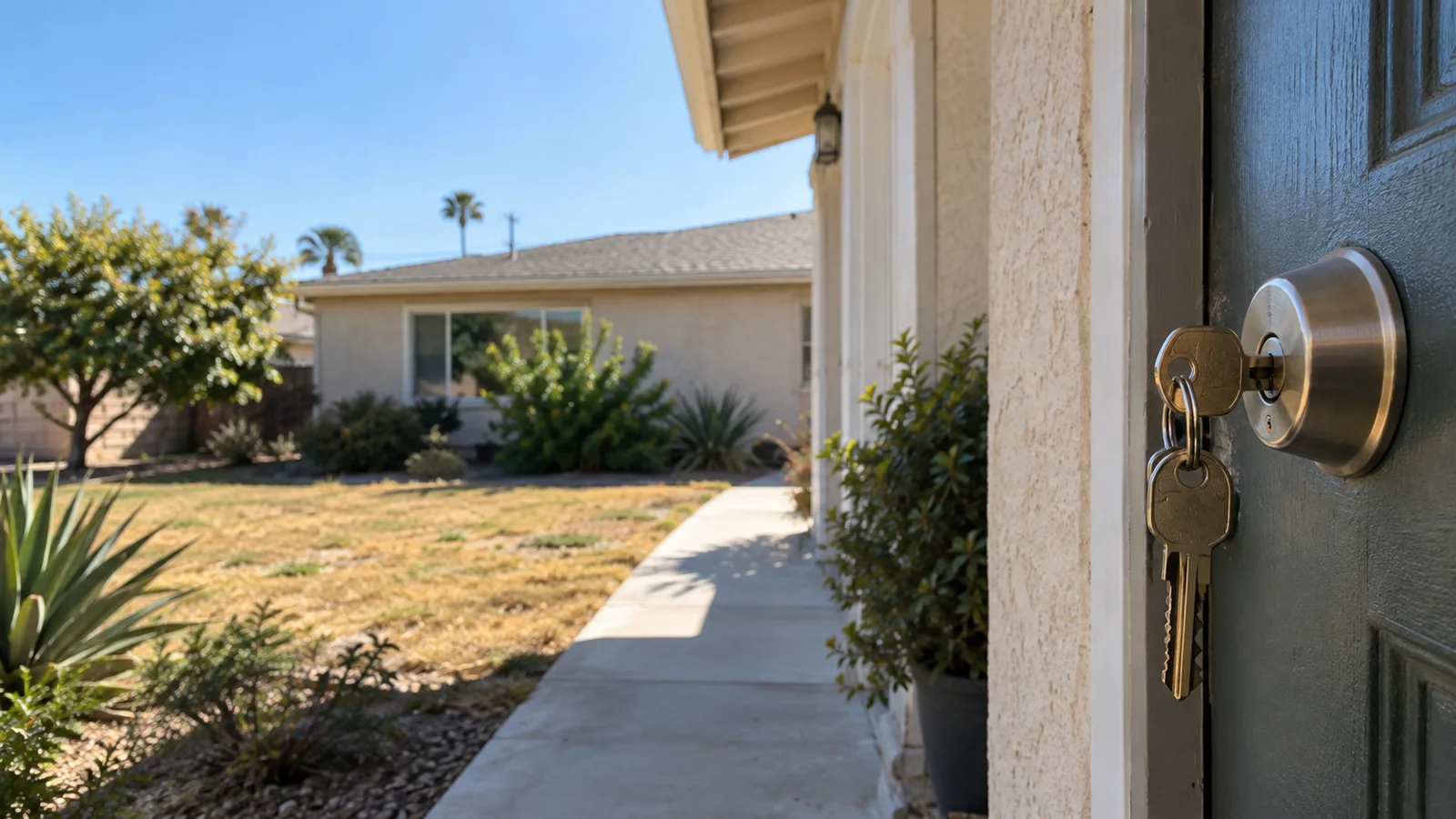


"They think we just show the house." The line, said with a laugh on the episode, sums up a question from listeners: what does a real estate agent actually do? The show's realtors answer with local knowledge, negotiation, law, paperwork, and a lot of coordination. And it starts with another question: how long does buying a house take.
How long it takes
One of the realtors answers the concrete part: once an offer is accepted, escrow — the period when a neutral third party holds the money and documents until closing — runs about 30 days on average, ranging from 21 to 45. It sometimes stretches to 45 because the seller needs more time to move out, which gets negotiated.
Another realtor points out that the question usually means something broader — the total time, from the first conversation. That includes:
- Pre-approval: with good credit, the lender's letter comes through quickly.
- The search: in a balanced market, he estimates one to two months to find the house; in areas with very little inventory, it can take much longer — he mentions clients who've been searching for a year in certain areas, because homes sell too fast and get multiple offers.
- Escrow: the roughly 30 days to closing.
1. Really knowing the area
For one of the realtors, the agent's first job is having complete, up-to-date knowledge of the market they work in. That's why, she explains, each realtor on the show speaks about their own area. An agent can legally sell anywhere in California — but if they don't know the region, they don't know the prices, the neighborhood, or whether that place fits the client. She warns against agents who go years without selling and end up disconnected.
Examples they give of what only local knowledge reveals:
- the street that closed off or changed;
- the side of the neighborhood with a special Mello-Roos tax, which affects the price;
- the school that stopped serving a particular street;
- the condo building with a history of plumbing problems;
- cities with expansive soil, which shifts and causes more cracking;
- landslide-prone areas, like parts of Palos Verdes, which one of the realtors mentions — where a buyer needs to know the risk before signing.
2. Negotiating
Another realtor notes that the professional knows how to read the region's moment — whether it's time to negotiate on price, credits, or timeline — and uses neighborhood and property information in the client's favor. The negotiating tools are covered in more detail in another article in this series.
3. Knowing the law — which keeps changing
One of the realtors observes that California real estate law changes often, always aiming to protect both buyer and seller. She mentions that at the brokerage where she works, the manager still deals with lawsuits from sales closed ten years earlier. That's why realtors stay connected to attorneys and warn clients about anything that could become a problem down the road.
One of the realtors highlights the support of the state realtor association (California Association of REALTORS®, C.A.R.), which tracks court rulings and periodically revises its standard forms. The purchase contract alone runs about 17 pages; with attachments, disclosures, and other documents, the paperwork for a single transaction can come close to a hundred pages.
For people coming from Brazil, one of them notes, the difference is significant: the rules here are more detailed and offer more formal protection to both parties.
4. Mandatory disclosures
Part of the job is making sure the buyer receives the disclosures, the notices and statements required by law. Two are mentioned on the episode:
- Natural Hazard Disclosure (NHD): states whether the property sits in a mapped flood, wildfire, earthquake fault, or landslide/liquefaction zone. It's required under state law (Civil Code, section 1103 and following).
- Megan's Law notice: every residential sales contract must disclose that a public database exists showing the location of registered sex offenders, maintained by the California Department of Justice. The agent doesn't do the search for the client: they hand over the notice and the link, and checking it is part of the buyer's own due diligence before closing.
These join others, like the seller's disclosure statement about the property's condition, covered in a separate article in this paper.
5. Coordinating everything through closing
Between an accepted offer and closing, one of the realtors notes, as many as 15 to 20 people can be involved: escrow, the title company, the lender, the appraiser, inspectors, the other side's agent, contractors, the city. The agent is the one coordinating deadlines and communication — especially for contingencies, the contract conditions that protect the buyer and come with deadlines of their own.
The goal, they say, is to solve whatever can be solved without pulling the client into it. When it works, the client says it was "so easy" — without seeing the work behind it. And there's the schedule: weekends and holidays are the busiest days. One of the realtors held an open house on Easter Sunday.
Why not buy without an agent
One of the realtors draws a comparison: nobody goes through a divorce after a long marriage with lots of shared assets without a lawyer. Buying the family's most valuable asset, she says, shouldn't be any different. Buying without guidance exposes buyers to timeline, contract, and disclosure mistakes that, in the United States, often end up in litigation.
Checklist for choosing an agent
- Check the license on the California Department of Real Estate (DRE) website.
- Ask how many recent transactions they've closed in your area.
- Ask for examples of what they know about the neighborhood: schools, hazards, special taxes.
- Read the representation agreement before signing: term, exclusivity, and commission.
This text is for informational purposes only and doesn't replace legal advice.
Sources and verification
- California Civil Code, sections 1103 to 1103.4 — Natural Hazard Disclosure Statement.
- California Civil Code, section 2079.10a — mandatory notice about the Megan's Law database (meganslaw.ca.gov, California Department of Justice).
- California Association of REALTORS® — California Residential Purchase Agreement (RPA) and standard forms.
- California Department of Real Estate — public license lookup for real estate agents.
- Transcript and chapters from episode 11 of the Cadê Moradia podcast (recorded April 2026), with the show's realtors.
Watch this part of the episode:
What Does a Real Estate Agent Actually Do? — starting at 20:53 · South Bay LA, CA
This article is a reference edition of episode 11 of the podcast and is subject to edits and editorial additions. For the full conversation, watch the episode. — Updated on 17/09/2026.