



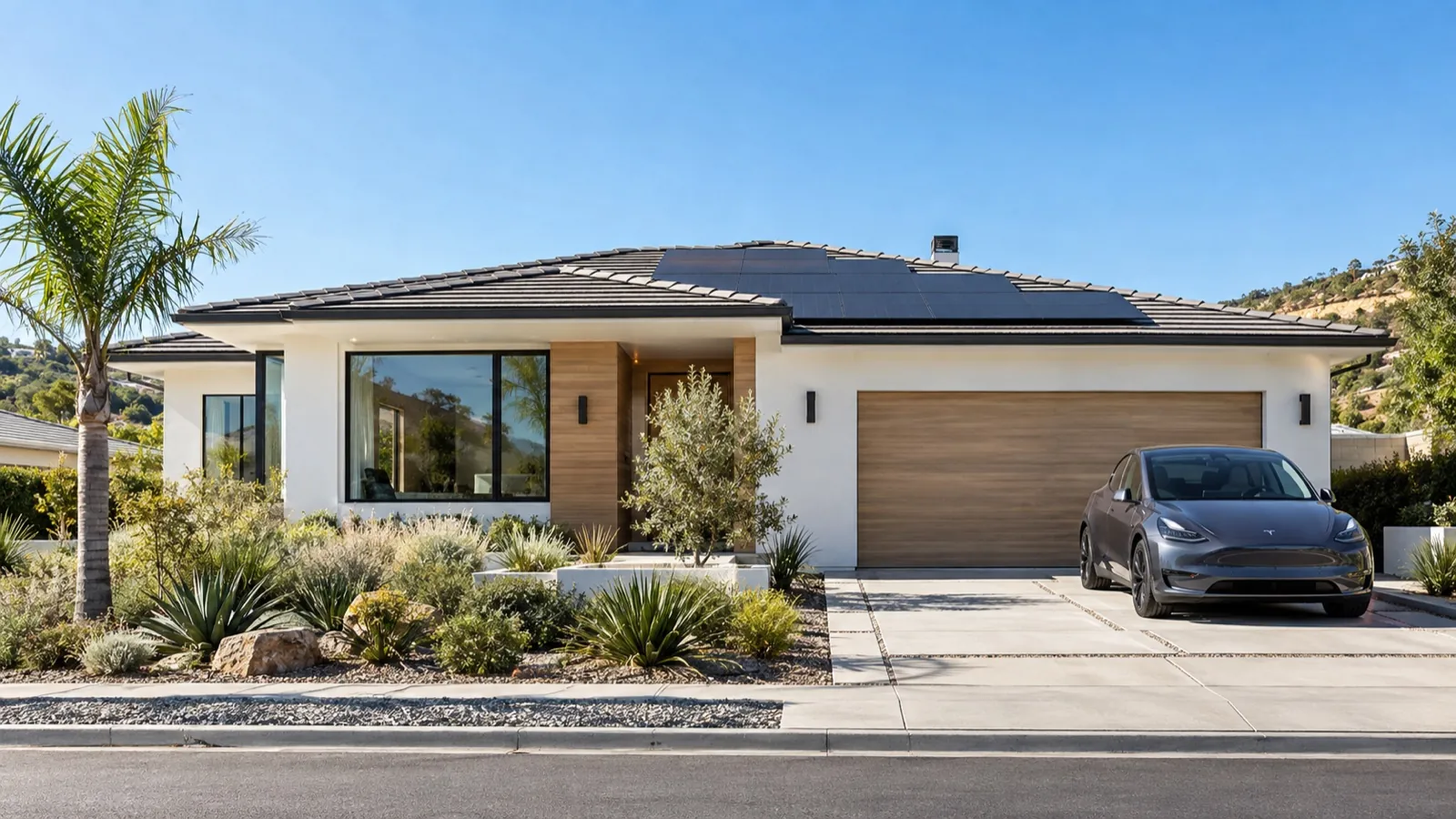
Anyone touring newly built homes in California notices a pattern: almost all of them have solar panels on the roof. It's not a trend. In the episode, Dina Silveira asks guest Tharsio Theodoreli whether new construction is required to have solar, and the answer is direct: yes.
"All new construction, whether residential or commercial, needs to have solar panels. Some exceptions happen, but they're rare." — Tharsio Theodoreli, in the episode
Where the requirement comes from: Title 24
The rule is in Title 24, Part 6, California's Building Energy Efficiency Standards, updated every three years by the state Energy Commission (California Energy Commission). It defines what windows, insulation, roofs, lighting and heating and cooling systems must look like in new construction and, since the 2019 version, solar generation.
- 2019 code (in effect since January 1, 2020): began requiring photovoltaic systems on new low-rise residential buildings, which includes single-family homes, duplexes and residential buildings of up to three stories. California was the first U.S. state to adopt this kind of requirement.
- 2022 code (in effect since January 1, 2023): extended the solar and battery requirement to several types of commercial buildings (offices, retail, schools, hotels, clinics, among others) and to residential buildings of four stories or more. The same code began requiring new homes to be ready for future batteries and electric equipment.
Tharsio places the law "around 2020" and says that, in practice, it fully took hold around 2022. That's the combination of the two stages above.
Who sizes the system
The minimum size isn't the installer's choice. It comes from the Title 24 compliance report, prepared by the architect's team or an energy consultant, which takes into account the floor area and the lot's climate zone (California has 16). A house in a hot inland zone requires a bigger system than a house on the mild coast.
"They run a calculation and say: you need X panels for this building. Whether it's commercial, an apartment, a house, a duplex, a triplex. I just look at the Title 24 and calculate." — Tharsio Theodoreli, in the episode
Exceptions exist for cases where compliance isn't possible, such as a roof that's too small or shading that makes generation unworkable, and they follow criteria set in the code itself.
The minimum isn't enough
This is the point that matters to anyone buying a new home. The Title 24 system is designed to offset a standard consumption estimate, not the family's real habits. For residential systems, it typically falls between 2.7 and 5.7 kilowatts.
"Title 24 usually comes with roughly 7 to 11 panels, which isn't enough for the whole house. On average, a house needs 20 to 30 panels." — Tharsio Theodoreli, in the episode
Tharsio explains that homes built to sell (spec homes) usually come with only the required minimum, because that's what the builder has to meet. For the buyer, this means having panels on the roof doesn't guarantee a low electric bill. How much a home really needs depends on consumption habits, the subject of a separate article in this newspaper.
What about apartments?
Dina asks whether an apartment resident can install panels just for their unit. The answer has two parts:
- New building: the Title 24 requirement is calculated for the building, not per unit, and the system is part of the construction.
- Existing building: residents of a condominium (HOA) who want to install panels generally need approval from the association, especially when the roof is a common area. The state Solar Rights Act prohibits "unreasonable" restrictions on solar energy, but the association can impose technical and aesthetic conditions, and has more leeway over common areas.
What to ask when buying a home with solar
- How many kilowatts the system has and how much it produces per year (ask for the history if the house isn't new).
- Is the system owned or leased? This changes the purchase contract, because a lease has to be transferred to the new owner.
- Does it have a battery, or is it ready for one?
- Which net metering rule the system is under with the utility (NEM 1, NEM 2 or the current rule).
- Is there roof space to expand, if your consumption is higher than expected.
Who speaks in the episode: Tharsio Theodoreli, a Brazilian who has lived in the United States for more than 20 years and founder of Solar Freedom USA, a solar design and installation company in the Los Angeles area, where he has worked since 2018. The assessments attributed to him reflect the experience of someone working in the industry.
This article is for information only. Code requirements change with each revision cycle; confirm the rule that applies to your project with the architect, the city building department and a licensed installer.
Sources and verification
- California Energy Commission — 2019 Building Energy Efficiency Standards (Title 24, Part 6), in effect since January 1, 2020: photovoltaic systems required on new low-rise residential buildings.
- California Energy Commission — 2022 Building Energy Efficiency Standards, in effect since January 1, 2023: solar and battery storage for selected types of commercial buildings and high-rise multifamily residential buildings.
- Typical sizing of systems required by Title 24 on homes (2.7 to 5.7 kW) and the state's 16 climate zones.
- California Civil Code, sections 714 and 714.1 (Solar Rights Act) — limits on homeowners association restrictions on solar energy.
- Transcript and chapters of episode 14 of the Cadê Moradia podcast (May 2026), with Dina Silveira and guest Tharsio Theodoreli (Solar Freedom USA).
Watch this part of the episode:
New rule: are solar panels required on new construction? — starting at 3:54 · CADÊ BRAZIL
This article is a reference edition of episode 14 of the podcast and is subject to edits and editorial additions. For the full conversation, watch the episode. — Updated on 16/09/2026.