
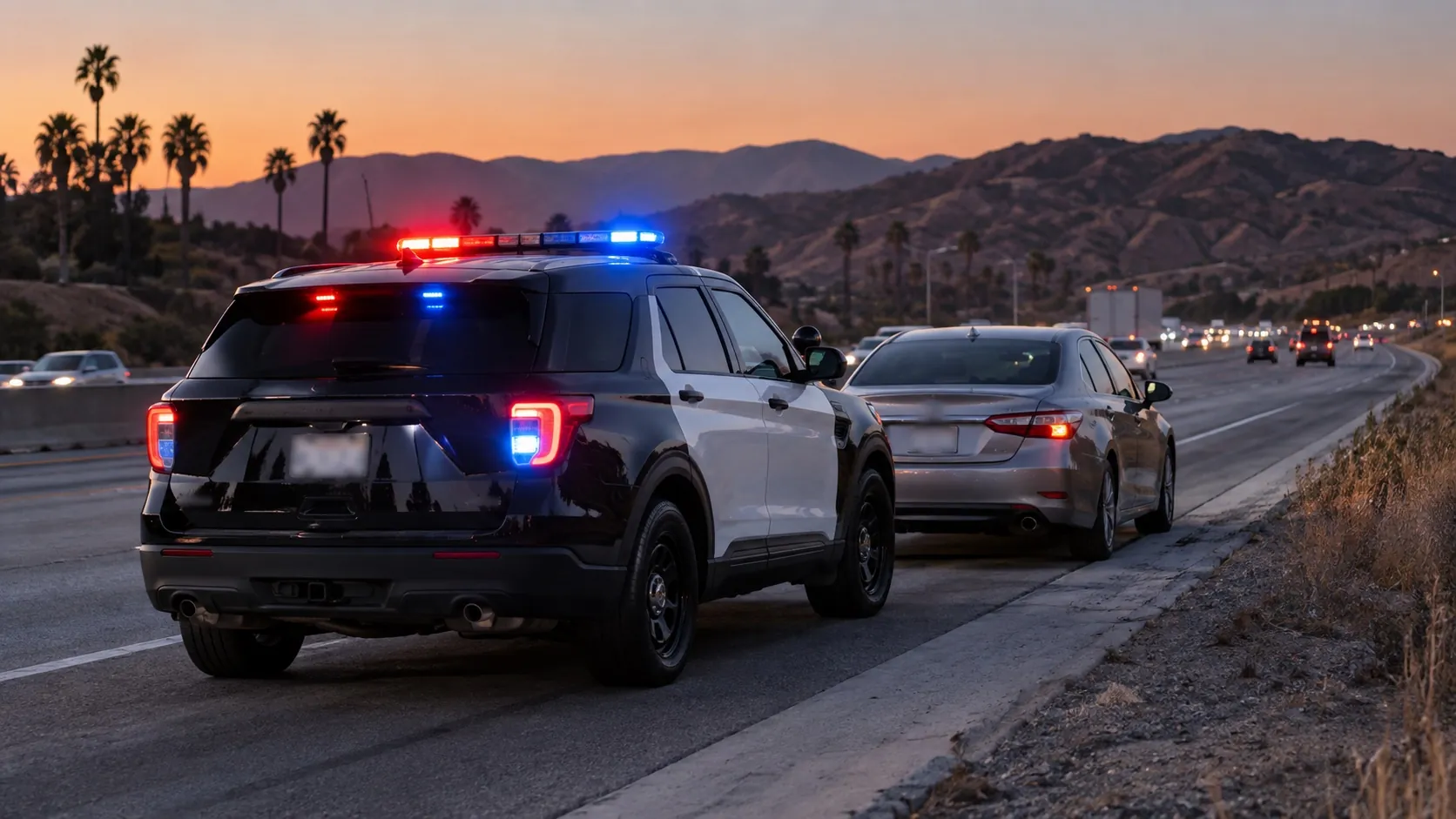
In the United States there is no such thing as pulling over a vehicle for generic "suspicious behavior," and no random checkpoint set up to search cars for drugs or weapons. To stop a vehicle, an officer needs a concrete legal reason. That's why anyone who works a highway traffic corridor learns early something the guest on episode 45 of Palavrão Tático, Marcelo Bini, sums up in one line: "you have to use the Vehicle Code in your favor." A blacked-out plate, an irregular fender, a burned-out light — small violations that, on their own, wouldn't justify anyone's time, but that give legal grounds for a stop that can end in a drug seizure or the rescue of a human trafficking victim. Understanding how this works — and where the limits are, especially in California — is a matter for the street, for the courtroom, and, increasingly, for the legislature.
The legal foundation: the Whren case
The federal rule was set by the Supreme Court in Whren v. United States (1996). Two men were pulled over in Washington for traffic violations by officers who actually suspected drug trafficking. The defense argued the violation was only a pretext. The Court ruled, unanimously, that an officer's subjective motive doesn't matter for Fourth Amendment purposes: if there is probable cause that a traffic violation occurred, the stop is constitutional.
That's what underlies what's known in the jargon as a pretext stop. The officer doesn't invent the violation — it has to exist and be articulable. What changes is the lens: instead of driving past an unlit license plate, an officer patrolling a trafficking corridor uses that violation as a legitimate doorway into a contact that, without it, couldn't happen.
Why you can't just pull over "the suspicious car"
In Brazil, stops based on reasonable suspicion and roadblock operations are part of everyday routine. In the U.S., the logic is different. A vehicle stop is a detention and requires, at minimum, reasonable, articulable suspicion that a crime or violation is occurring — the standard set by Terry v. Ohio (1968) and the case law that followed it. "The car looked suspicious" doesn't hold up in court.
There's one exception worth noting so as not to pass along wrong information: DUI/sobriety checkpoints are permitted. The Supreme Court upheld them in Michigan v. Sitz (1990), and in California, the state Supreme Court set the criteria in Ingersoll v. Palmer (1987): the checkpoint must be planned by supervisors, use a neutral criterion for selecting vehicles, have a reasonable location and time, be clearly marked, and involve only a brief stop. It's an operation with a specific purpose — not an open dragnet to search for anything.
The "small things" that turn into a stop
The list is long, and that's exactly why the guest started reading the entire code. A few examples of the kind of violation that often provides the basis:
- License plate lighting. In California, Vehicle Code 24601 requires the rear plate to be illuminated with white light, legible at 50 feet (about 15 meters), during darkness.
- The definition of darkness. Vehicle Code 280 defines "darkness" as the period from thirty minutes after sunset until thirty minutes before sunrise. That's exactly the detail that comes up in the episode: a colleague asks whether he can stop a car with an unlit license plate light while it's still daylight, and the answer is no — he has to wait thirty minutes after sunset, because before that the requirement doesn't even apply.
- Fenders and mud flaps. Lifted pickup trucks and trucks have specific fender and splash-guard requirements that vary from state to state. In the guest's example, in Texas, irregular ride height was one of the violations used.
- Headlights, taillights, windows, and plates — each item has its own statute, and each statute has conditions (time of day, distance, vehicle type) that all have to be present.
The detail defense attorneys look for
One of the most practical tips from this segment is about credibility in court. The guest used to advise colleagues not to run a plate through the system before actually being able to read it. The reason is the cross-examination at trial:
"The defense attorney: 'What's my client's plate number?' If you couldn't read the plate, how did you run it through the system?"
If the reason for the stop is an unlit plate, and the officer ran that same plate from a distance at which he couldn't have seen it, the report's narrative falls apart. It's not a small detail: in a pretext stop, the entire legality of the contact — and of everything seized afterward — depends on the initial violation being true and demonstrable. Evidence obtained from an unlawful stop can be excluded from the case.
In California, the rule got tighter
Here's the part that matters most for those working in the state. Whren still stands as the federal constitutional rule, but California added its own statutory requirements:
- AB 2773 (Vehicle Code 2806.5), in effect since January 1, 2024. An officer making a traffic or pedestrian stop must state the reason for the stop before asking questions related to a criminal investigation or the violation, and document that reason on the citation or in the report. The exception is when the officer reasonably believes that withholding the reason is necessary to protect life or property from imminent threat (terrorism and kidnapping are the law's own examples). Departments, such as the LASD, have published specific internal guidelines to comply with the rule.
- RIPA (AB 953, from 2015). The Racial and Identity Profiling Act requires agencies to record data on every stop — reason, outcome, perceived race, and other fields — reported to the state Department of Justice, which publishes annual reports. Every pretext stop leaves a statistical trail.
- Department policies. Some departments went further than the law. In 2022, the Los Angeles Police Commission approved a policy restricting stops for minor violations used as pretext, requiring that an officer have information pointing to a more serious crime before using a minor violation as the stated reason.
The practical effect is clear: the tool is still legal, but in California it requires more documentation discipline and more care in the sequence of the stop than in the Texas example described by the guest. In any state, the golden rule is the same: the violation has to exist, has to be demonstrable, and has to be in the report exactly as it happened.
Sources and verification
U.S. Supreme Court: Whren v. United States, 517 U.S. 806 (1996); Terry v. Ohio, 392 U.S. 1 (1968); Michigan Dept. of State Police v. Sitz, 496 U.S. 444 (1990). California Supreme Court: Ingersoll v. Palmer, 43 Cal.3d 1321 (1987). California Vehicle Code, sections 280, 2806.5, and 24601. Assembly Bill 2773 (2022) and Assembly Bill 953 (2015, Racial and Identity Profiling Act). The Los Angeles Police Commission's 2022 policy on pretext stops. The Texas scenarios described are the guest's own accounts from the episode and were not independently verified; fender and lighting rules vary by state and vehicle type.
Who's speaking here: Eliel Teixeira and Edwin Wu are active-duty police officers in the Los Angeles, California area — Brazilian-born, naturalized American citizens, with long careers in law enforcement. In this episode, they host Marcelo Bini, who worked as a police officer in Texas.
Note: everything described here applies to California rules — and, in many respects, to each officer's specific department. The guest's examples are from Texas, where the rules are different.
Watch this part of the episode:
Traffic-stop tactics used in police contacts — starting at 1:34 · Palavrão Tático
This article is a reference edition of episode 45 of Palavrão Tático and is subject to edits and editorial additions. For the full conversation, watch the episode. — Updated on 16/09/2026.