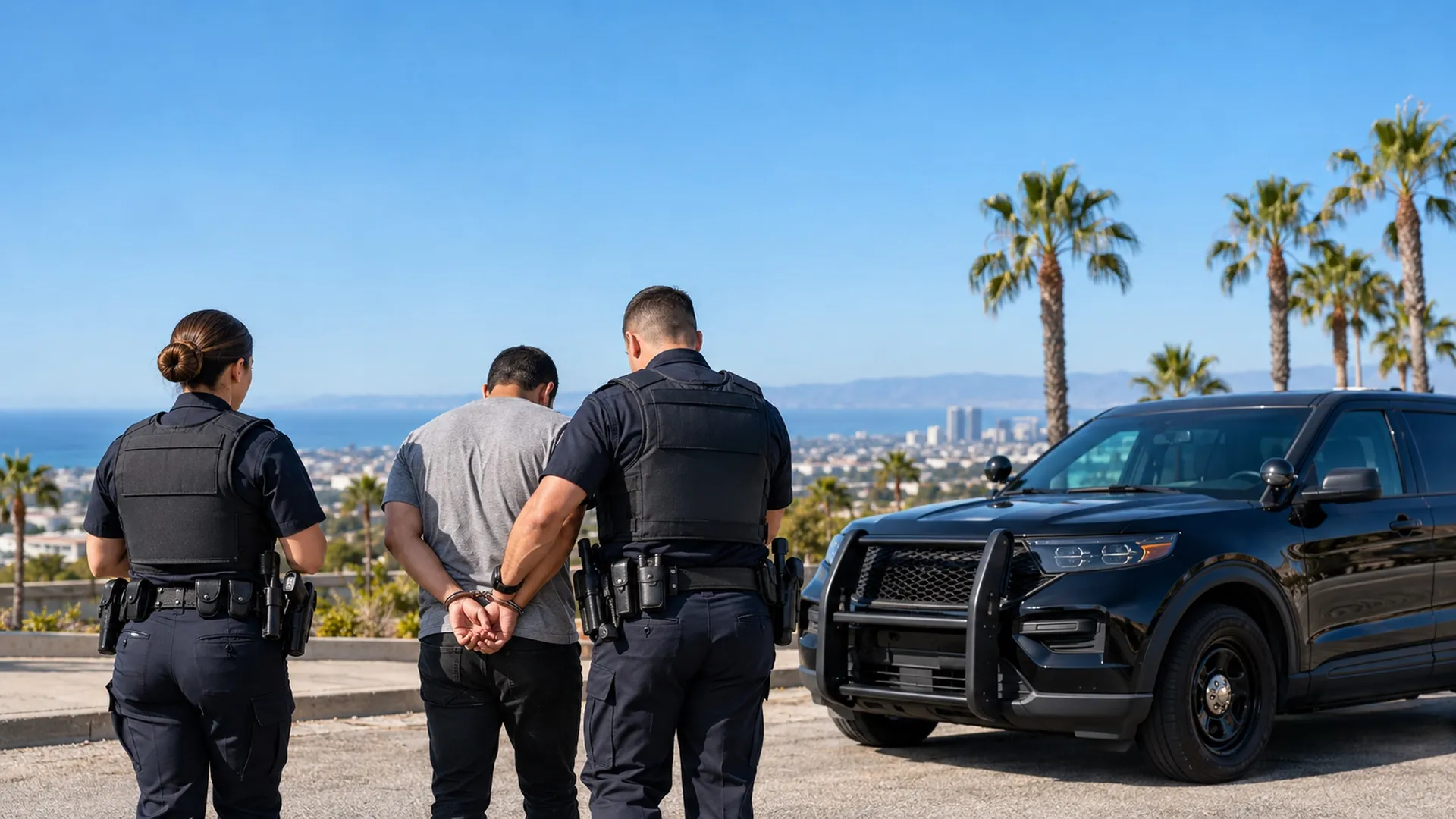

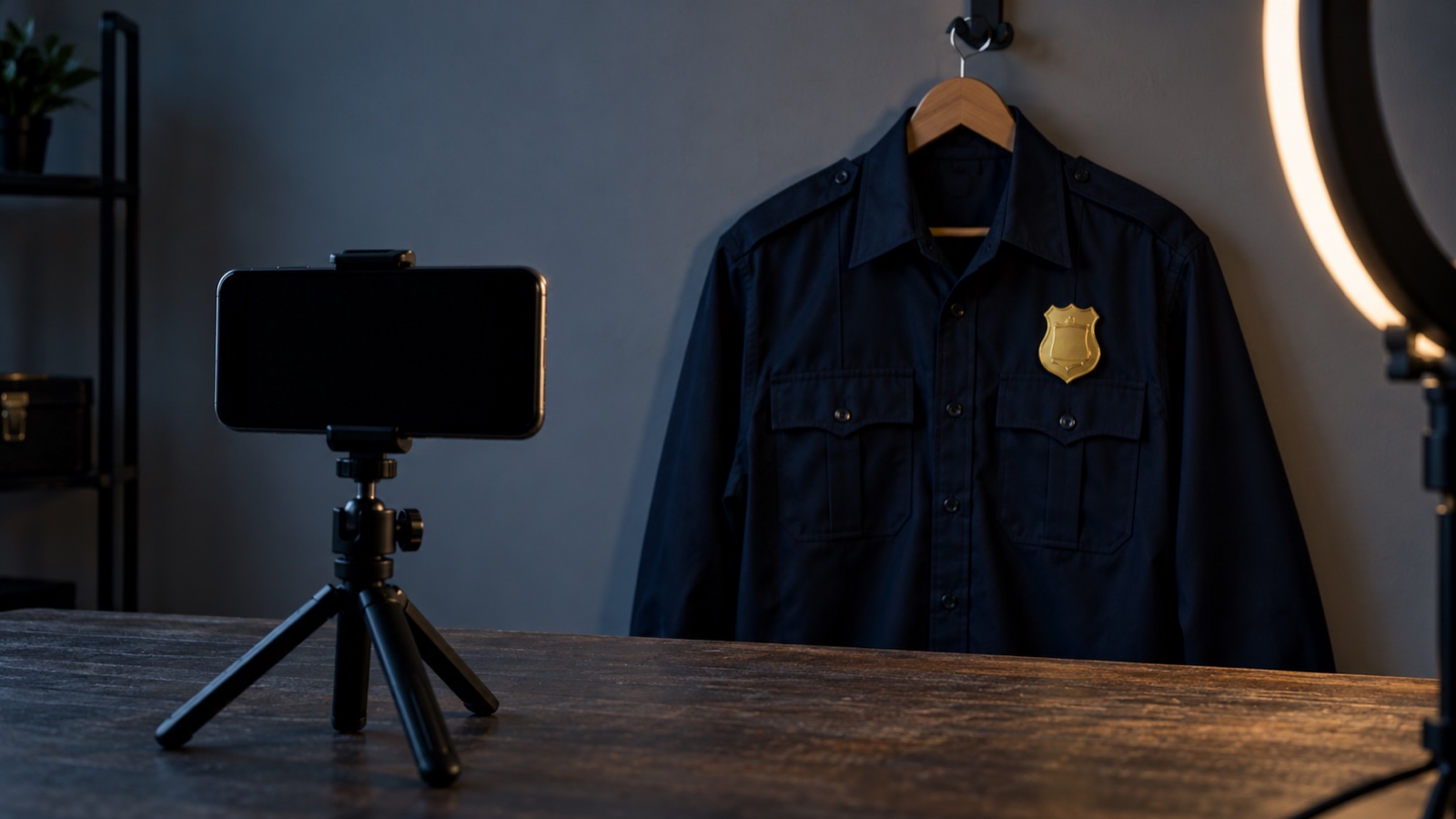
Three months into the channel, 40, 50 thousand followers. Patrol car in the video, rifle, full kit, badge on the chest — and, at the end, a link to buy a course. The hosts of Palavrão Tático have a name for that format: "tactical porn." In the second part of the conversation with police chief Maurício de Thomazi, host of Criminocast, the topic was exactly the other side of the coin: how to make content about policing without using the police as a showcase — and what a California police officer can, and cannot, do on social media.
The channel that sells the look
Before launching the podcast, the hosts said, they studied what already existed online in Portuguese about American policing. They found plenty of courses selling the dream of becoming a cop or joining the military in the United States, plenty of videos shot inside patrol cars, and a large audience drawn in by the look — "the guy wants to see the rifle" — curious, but not necessarily working in the field.
The problem, as they see it, isn't just quality. It's risk. A lot of people, sometimes fresh out of the academy, don't understand the consequences of using the institution's image — uniform, patch, patrol car — for personal profit, or of speaking on behalf of an agency that never authorized it and may not even agree with what's being said. "That guy is signing up for a headache," one of them summed up.
The rule at the agency: nobody speaks for the badge
One of the hosts explained the rule at his agency: an officer cannot speak publicly representing the department, nor appear with any badge or agency identification while doing so. "Even if you say 'I like being American.' You can't." That's why Palavrão Tático always speaks on behalf of the hosts themselves, from their own experience, and never as the spokesperson for any department.
This kind of rule is common. American departments, including the large ones in the Los Angeles area, maintain internal social media policies that generally prohibit using the uniform, patch, patrol car or facilities in personal content without authorization, disclosing information about calls and investigations, and implying that the officer speaks for the department.
What American law says
A police officer is a citizen and has freedom of speech guaranteed by the First Amendment. But as a public employee, that freedom has limits defined by the U.S. Supreme Court:
- Pickering v. Board of Education (1968) — when a public employee speaks as a citizen on a matter of public concern, the courts weigh that right against the agency's interest in operating efficiently and with discipline;
- Garcetti v. Ceballos (2006) — what a public employee says pursuant to official duties is not protected by the First Amendment from disciplinary action.
In California, the Public Safety Officers Procedural Bill of Rights Act (Government Code 3300 et seq.) guarantees officers the right to engage in political activity off duty, but prohibits that activity on duty or in uniform (section 3302). The general line, then, is clear: off duty, out of uniform and not speaking for the agency, the officer has room; with the badge showing, he is speaking for the institution — and answers for it.
Content for people who want to understand, not just to watch
Both Palavrão Tático and Criminocast decided from the start not to go down the sensationalism road. The police chief admitted that, if all they wanted were numbers, they could just fill the guest list with shootout stories. "Would it get ratings? Absolutely." But it would be an audience that's there "for the thrill," not one interested in seeing police work as something to be studied.
The formula he said he built with his partners has two pillars. The first is technical quality — studio, colors, framing designed by a filmmaker on the team. The second is editorial curation, with three criteria: look for what's different, interesting stories with perspectives others haven't had (not guests chosen by follower count), and contribute to the debate, including bringing in people who think differently.
The hosts told the origin story of Palavrão Tático along the same lines. There was no shortage of information about American policing for a Brazilian audience — what was missing was accurate information. What circulated came from Hollywood shows or from influencers who had never set foot in a patrol car. They also noticed another phenomenon: podcasts where veterans tell stories that, it later turns out, happened to someone else. In the United States, fraudulently claiming military decorations to obtain a benefit has been a federal crime since the Stolen Valor Act of 2013; telling someone else's story as your own, even when it isn't a crime, destroys the speaker's credibility.
The audiences of each format
The conversation also touched on audience. The police chief said that Criminocast's audience, judging by the comments, splits between police exam candidates — many of them law students aiming for a career as a delegado (police chief) — and civil and military police officers. The hosts said Palavrão Tático sees two very different audiences: when an episode shows gear, firearms or ammunition, the comments are of one kind; when it's a long, technical conversation, of another. And engaging with commenters, including critics, is part of the job.
Checklist for the officer who wants to create content
Before recording your first video, it's worth checking:
- Read your department's social media and outside activity policy — and, if in doubt, ask in writing;
- Don't use the agency's uniform, patch, badge, patrol car or facilities without formal authorization;
- Make it clear the opinion is yours, not the department's;
- Never expose a call, victim, suspect or ongoing investigation;
- If money is involved (course, sponsorship, product), check the agency'soutside employmentrules.
What the two of them think about it
In the episode, Eliel Teixeira and Edwin Wu talk about why they created Palavrão Tático, the rule against speaking on behalf of the agency, and the difference between technical content and a channel that sells the look. With their guest, they discuss the curation that gives a police podcast its credibility.
Sources and verification
Supreme Court of the United States, Pickering v. Board of Education, 391 U.S. 563 (1968), and Garcetti v. Ceballos, 547 U.S. 410 (2006). California Government Code, sections 3300 to 3313 (Public Safety Officers Procedural Bill of Rights Act), especially section 3302. Stolen Valor Act of 2013 (18 U.S.C. 704). Specific rules vary by department and should be checked in each agency's manual. The rule on public statements described in the text is the one at one of the hosts' agency, as stated in the episode; the curation and audience profile of Criminocast are the guest's.
Who's speaking here: Eliel Teixeira and Edwin Wu are active-duty police officers in the Los Angeles area, California — Brazilian-born, American citizens, with long careers in law enforcement. In this episode, produced in partnership with Criminocast, they once again welcome Maurício de Thomazi, a delegado (police chief) with the São Paulo State Civil Police, professor of criminology and criminal procedure, and host of Criminocast.
Note: what is described here about American policing applies to the rules of California — and, in several respects, to each officer's specific department. Rules change in other U.S. states. What is described about Brazil applies to the Civil Police of São Paulo; each Brazilian police force has its own organic law and internal rules.
This article is a reference edition of episode 50 of Palavrão Tático and is subject to edits and editorial additions. For the full conversation, watch the episode. — Updated on 22/10/2026.