
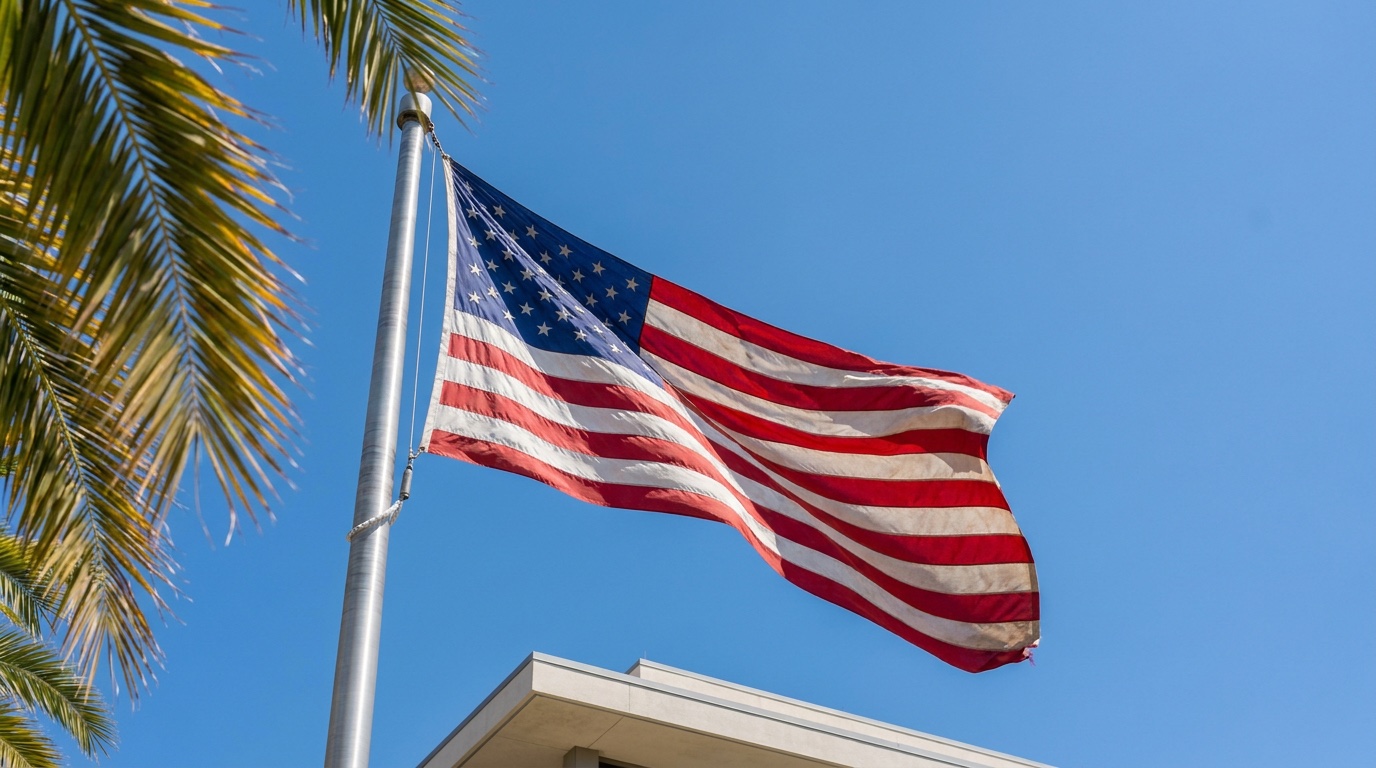
Anyone looking at an American uniform for the first time does a double take: on the right arm, the United States flag appears backwards, with the star field on the wrong side. It's not a sewing error, and it's not a supplier slip-up. It's doctrine.
The right-shoulder rule
Historically, in the American Armed Forces and law enforcement agencies, the flag goes on the right arm. Sew the flag on there the "normal" way — stars on the viewer's left — and the star field ends up facing the service member's back.
Stars forward: the forward movement
The logic goes back to when the flag was carried on a staff, out in front of the troops. With the flag bearer advancing, the stars always face the direction of the march while the red stripes trail behind in the wind. That's forward movement: the flag always moving ahead.
Sewn onto the right shoulder, the only way to reproduce that effect is to reverse the patch. That way, with the service member on the move, the stars point forward — exactly as they would with the flag flying from a staff.
These colors never retreat
A "normal" flag on the right arm would produce the opposite image: stars facing the rear, like someone fleeing the battlefield. And in military symbolism, that's heavy stuff — it cuts straight into troop morale.
"These colors never run. These colors never retreat — they always move forward."
The detail artificial intelligence gets wrong
This conversation came out of a real case inside the show itself: the artwork for a commemorative t-shirt marking the 250th anniversary of the United States, featuring the Betsy Ross flag (the thirteen-colony one), came back from the image generator with the flag on the wrong side. No AI model understands why the patch is reversed — it just copies the most common design it has seen.
So here's the practical rule for anyone producing artwork, patches, patrol car decals or unit t-shirts: always check which side the stars are on. If the piece goes on the right side, the flag is the reversed one. Anyone who's on the job spots it instantly.
Who's talking here: Eliel Teixeira and Edwin Wu are active-duty police officers in the Los Angeles area, California — Brazilian-born, American citizens, with long careers in law enforcement. On Palavrão Tático, they talk cop to cop, for officers and enthusiasts, with no translation into civilian speak.
Heads up: everything described here applies to California rules — and, on several points, to each host's specific department. In other American states (Florida, Texas, New York…) the rules can be quite different.
Watch this part of the episode:
Military Symbolism: Why is the American flag worn reversed on the right shoulder? — starting at 24:45 · Palavrão Tático
This article is a reference edition of episode 42 of Palavrão Tático and is subject to edits and editorial additions. For the full conversation, watch the episode. — Updated on 09/08/2026.