



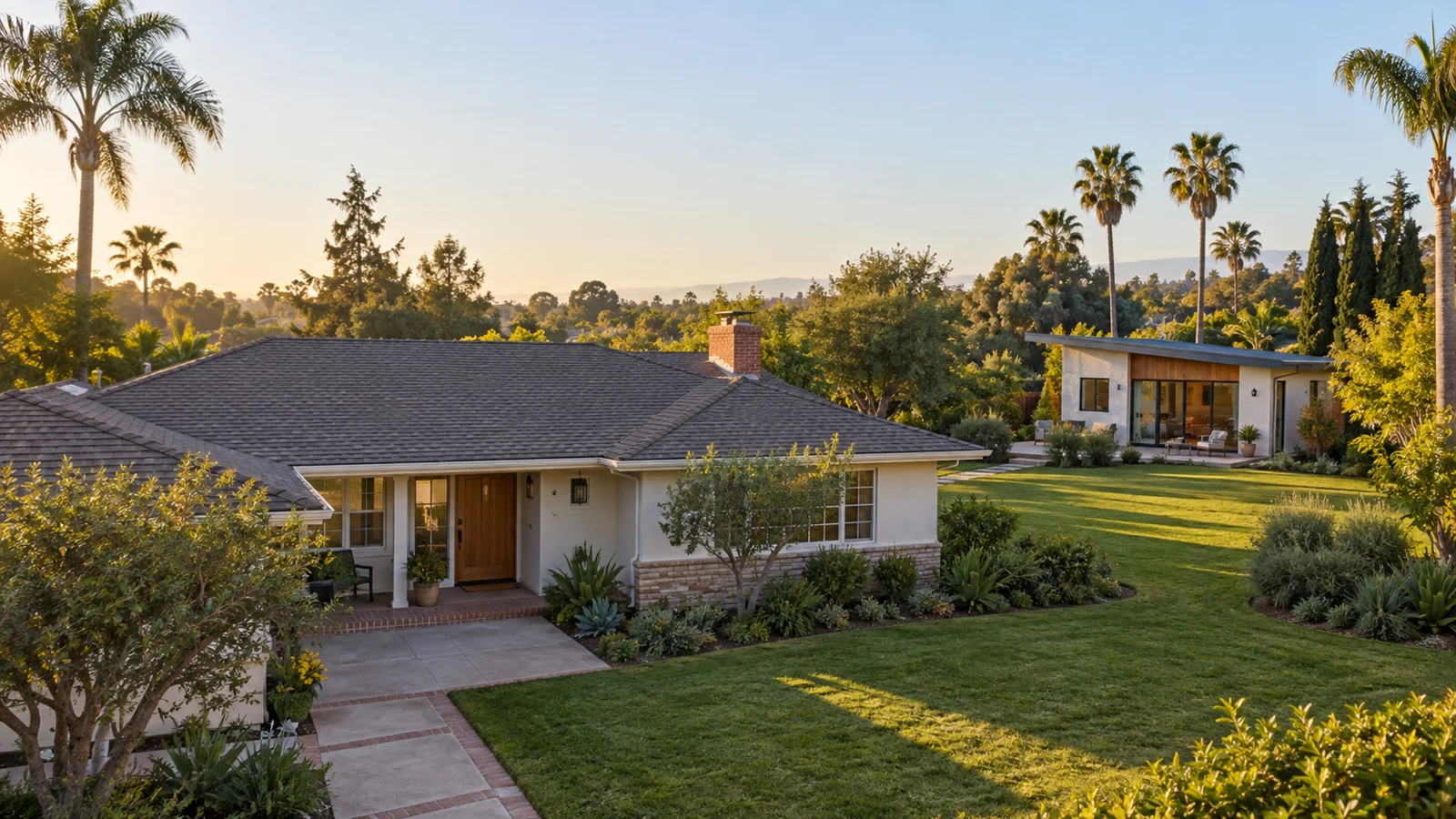
Newcomers to California are struck by the size of the lots and the houses in the suburbs. That, according to builder Rafael Pozas, a guest on the episode, is exactly where the explanation for the ADU (Accessory Dwelling Unit) boom begins — the extra residential unit built on the same lot as a house.
A state designed for big houses
Rafael sums up how California's cities took shape: a state that imagined itself wealthy, made of ranches, with big lots and wide areas set aside for single-family homes (single-family) instead of apartment buildings and complexes (multifamily). Over more than a century, one economic cycle after another — from the gold rush to the movies, to aerospace and to tech — drew people from everywhere.
The result, by his simple math, was little residential land available, plenty of demand and ever higher prices. In much of the state's cities, most of the residential area is still zoned for one house per lot — which, as a rule, prevents more housing from being built where people want to live.
The unpermitted backyard units
Faced with the prices, owners with big backyards did what many Brazilian families would recognize: they built a second house out back, without a permit, to rent out and help pay the mortgage. Rafael cites an estimate that, around 2015, there were about 350,000 units of that kind, unpermitted, in California backyards alone.
The state saw two things in that phenomenon, he says. First, a way to formalize — and tax — something that already existed. Second, a fast solution: large housing developments take years to clear environmental permits and public hearings; a house in the backyard is one owner's decision, approved one at a time.
2017: the law that changed the game
California already had a "second unit" law dating back to the 1980s, but cities applied it with so many restrictions that very little got built. On January 1, 2017 , two laws took effect, SB 1069 and AB 2299, which cut parking requirements, fees and utility connection charges and required cities to approve ADUs that met minimum standards.
Rafael says that at first hardly anyone knew what an ADU was — he ran workshops in 2018 and 2019 for an audience that was still skeptical. Since then, the legislation has been expanded almost every year, always in the direction of loosening the rules. Some milestones:
- 2020: shorter approval deadlines, an end to minimum lot size requirements and caps on impact fees;
- 2022: the SB 9 began allowing single-family lots to be split and more units to be built (the subject of its own article in this series);
- 2024: the AB 976 permanently barred cities from requiring the owner to live on the property to have an ADU, and the AB 1033 opened the possibility of selling the ADU separately where a city adopts the rule;
- 2025: the AB 2533 widened the path to legalizing ADUs built without a permit before 2020;
- 2026: the SB 543 set a 15-business-day deadline for the city to say whether a permit application is complete.
One of the show's realtors asks whether the law's intent was to create rentals. Rafael clarifies that the law doesn't address the use: the only reference to renting is to keep the units from becoming short-term lodging, because the goal is permanent housing.
Each city's housing targets
The engine behind the loosening is a system of targets. Under RHNA (Regional Housing Needs Allocation), the state calculates how many homes each region needs, and each city gets a quota for an eight-year cycle, to be planned in its Housing Element, the housing chapter of its general plan. Every year, cities send the state's Department of Housing (HCD) a progress report.
Rafael says no California city manages to meet the target — some are just less behind than others. And the state started to enforce it: cities that don't follow the housing rules can be sued, lose access to state funding and become subject to rules that make project approval easier.
The shift was visible in practice, he says: city halls that at first wouldn't even answer now have explanatory handbooks ready. One of the realtors mentions Santa Clarita, which traditionally resisted ADUs and, under state pressure, had to give ground.
The builder's tip: look at the city's performance
Rafael's first tip for anyone thinking about investing is to go look up the state's data. HCD publishes a dashboard with the annual progress reports (Annual Progress Reports) and each city's progress against its target. The way he reads it, the cities with the worst numbers are precisely the friendliest to ADUs — because they need to show housing production.
Two cautions are worth adding. Friendly to permitting doesn't by itself mean a good rental market: demand, price and construction cost count too. And state law applies across California, but each city has its own regulations, within the limits the state allows.
Sources and verification
- SB 1069 (Chapter 720, Statutes of 2016) and AB 2299 (2016) — amendments to the second unit law (Government Code, section 65852.2), in effect since January 1, 2017.
- AB 976 (2023), AB 1033 (2023), AB 2533 (2024) and SB 543 (2025) — later amendments to ADU legislation.
- California Department of Housing and Community Development — Annual Progress Reports and RHNA progress dashboard by city.
- California Department of Housing and Community Development (HCD) — Accessory Dwelling Unit Handbook (most recent update) and Government Code, sections 66310 to 66342.
- Transcript of episode 9 of the Cadê Moradia podcast (April 2026), with the show's realtors and builder Rafael Pozas.
This topic comes from the full episode — watch it:
CADÊ BRAZIL
This article is a reference edition of episode 9 of the podcast and is subject to edits and editorial additions. For the full conversation, watch the episode. — Updated on 17/09/2026.