

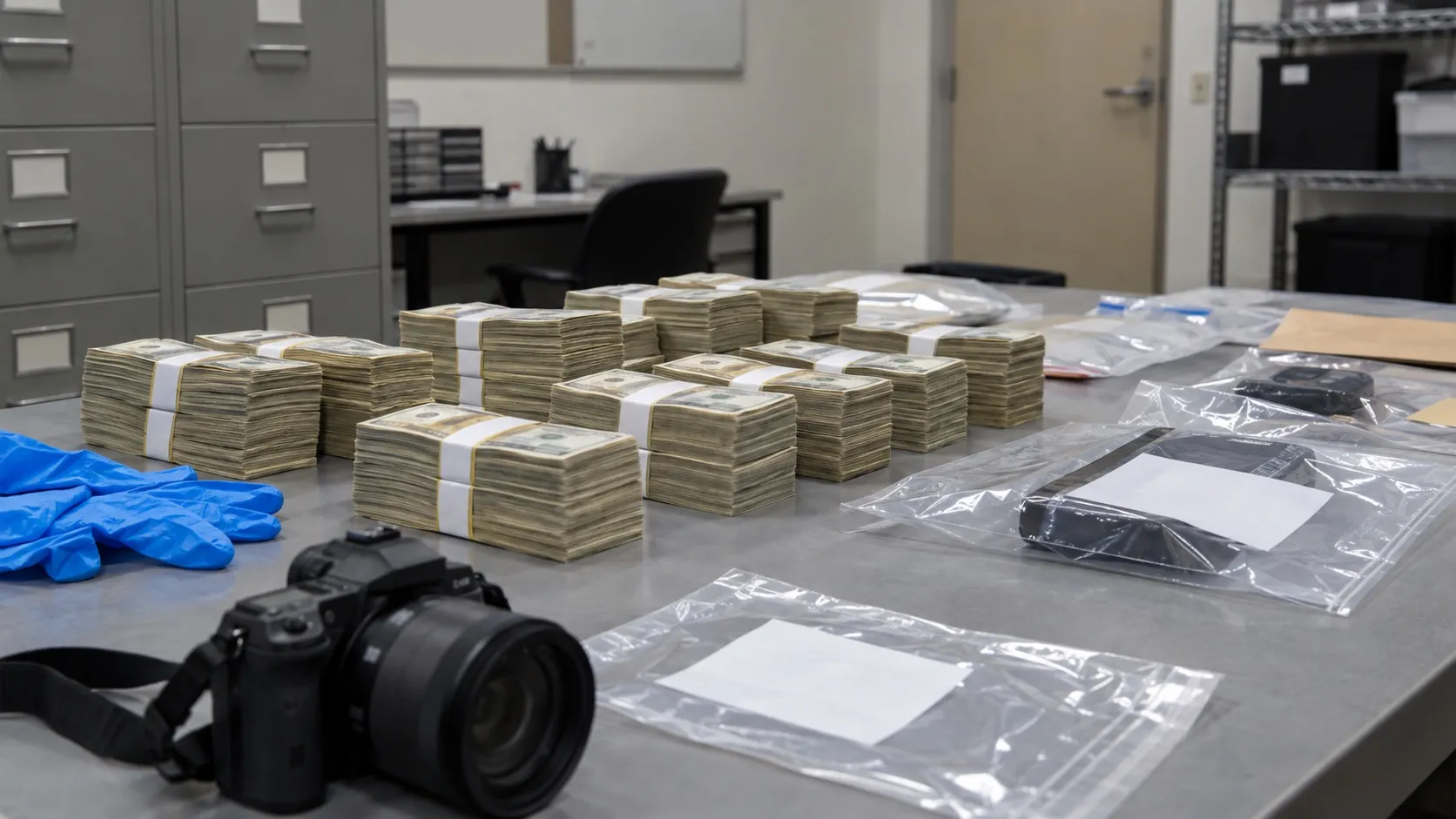
An officer leading a $250,000 cash seizure, back when body cameras didn't exist yet. Nobody would miss $20,000. Would the drug dealer complain that money was missing? Who'd believe him? The scene, told by one of the participants in episode 45 of Palavrão Tático, explains in a few seconds why American police forces dig so deep into the financial life of anyone who wants to carry a badge. Eliel Teixeira, Edwin Wu, and guest Marcelo Bini talk about background investigations, about what they call "bendable morals," and about how criminals — including some who were once officers — explain to themselves what they did.
Why police look at your credit
In Brazil, checking records like Serasa and SPC comes up in some civil-service exams. In the United States, credit history is a central piece of the background investigation. The reason isn't bias against someone who's had financial trouble — it's risk: someone deep in debt who doesn't manage their own money is more vulnerable to bribery and to the temptation of easy cash.
"If you're not financially responsible, they can say: someone might try to bribe you."
California spells this out in the statute itself. Labor Code section 1024.5, added in 2011, bars most employers from using a credit report in hiring — but carves out exceptions for specific positions, including peace officer roles and law-enforcement agency jobs. In other words, the state treats credit as irrelevant for nearly every job except the ones involving authority, access to money, and sensitive information. In the selection process, the state POST commission's guidelines list financial history among the areas investigated, alongside criminal record, employment, drug use, and personal references. What carries weight, the participants say, isn't just being late on payments — it's disproportionate debt and how the person handles it.
No other profession gets filtered like this
One of the participants makes a point that tends to go unnoticed in public debate: few professions undergo as detailed an investigation into a person's life before hiring. Doctors, firefighters, professions considered noble — none of them, in his view, face the same level of social scrutiny. In American policing, the candidate goes through an interview with an investigator, checks with neighbors and former employers, driving history, credit, medical and psychological exams, and, at many agencies, a polygraph.
Even so, they note, two caveats still apply. First: no filter is foolproof — "nothing is 100%." Second: police forces recruit human beings, and the human race is flawed. The participants cite scale for perspective: there are roughly 700,000 police officers in the United States (the rough order of magnitude from federal statistics for state and local agencies). In a pool that size, there will always be someone who slipped through undetected, or who, once hired, later showed a lack of judgment. Their argument is that this proportion is far smaller than in the rest of society.
Why an arrested officer always makes headlines
The participants discuss recent reported cases of officers arrested for common crimes — shoplifting at a department store, involvement in a robbery — and how big those cases get. Their explanation has two sides. It makes news because it's rare. And it makes news because it involves public trust: when an officer commits a crime, the breach isn't just individual, it's institutional. What they won't accept is the next leap — using one case to say "the whole police force is corrupt."
In the American system, a breach of trust also has procedural consequences. An officer with a history of dishonesty can end up on the so-called Brady list: because of the Brady v. Maryland decision (1963) and later precedents, prosecutors are required to disclose to the defense anything that could affect the credibility of prosecution witnesses — and an officer whose word can no longer be used in court, in practice, loses his usefulness for the job.
How the criminal explains it to himself
The most interesting part from an investigative standpoint is about rationalization. The guest says that, when interviewing people who've committed crimes, he sees the same pattern every time: they don't see themselves as criminals. "I did it because my grandmother was sick." "I was going to pay it back." "I was only going to take a little bit." And, since it worked once, it keeps going — "it's a snowball."
An experienced interviewer uses this to his advantage. The guest explains he doesn't need the person to admit they did wrong; he needs them to admit what they did. Offering an acceptable justification ("I understand, that makes sense") is often the path to getting the facts admitted.
Criminology has described this mechanism for decades. In 1957, sociologists Gresham Sykes and David Matza published the theory of techniques of neutralization: denial of responsibility, denial of injury ("nobody got hurt"), denial of the victim, condemning the condemners, and appealing to higher loyalties. Shortly before that, criminologist Donald Cressey, studying embezzlement, formulated what became known as the fraud triangle: pressure (a debt, a need), opportunity (money within reach, unchecked), and rationalization (the story a person tells themselves). The background investigation works precisely on the first two points; the interview is what tries to uncover the third.
Bendable morals and a lack of common sense
The participants land on a useful distinction. Some people have flexible, "bendable" morals — people prone to that kind of conduct, which the selection process tries to identify. And some people have a clean record, perfect credit, have never committed a crime, but lack common sense — the ability to notice that something might not look like a crime at first glance but is morally wrong. In English, they note, that's the expression "common sense" — "and common sense isn't so common." It's from this category, right after in the episode, that the story comes of an insurance-fraud proposal made by someone from inside the police force itself.
Sources and verification
California Labor Code, section 1024.5 (AB 22, 2011), on restrictions on employers' use of credit reports and exceptions for police positions. California POST, background-investigation guidelines for police candidate selection. U.S. Supreme Court, Brady v. Maryland, 373 U.S. 83 (1963). Sykes, G. and Matza, D., "Techniques of Neutralization: A Theory of Delinquency," American Sociological Review (1957). Cressey, D., "Other People's Money" (1953). Bureau of Justice Statistics, staffing statistics for state and local police agencies. The accounts of the cash seizure, interviews with offenders, and cases discussed come from the episode's participants.
Who's speaking here: Eliel Teixeira and Edwin Wu are active-duty police officers in the Los Angeles, California area — Brazilian-born, American citizens, with long careers in law enforcement. In this episode, they host Marcelo Bini, who worked as a police officer in Texas.
Note: everything described here applies to California rules — and, on several points, to each officer's specific department. In other U.S. states (Texas, Florida, New York…) the rules can be quite different.
Watch this part of the episode:
The background investigation: credit and morality under scrutiny — starting at 1:13:50 · Palavrão Tático
This article is a reference edition of episode 45 of Palavrão Tático and is subject to edits and editorial additions. For the full conversation, watch the episode. — Updated on 16/09/2026.