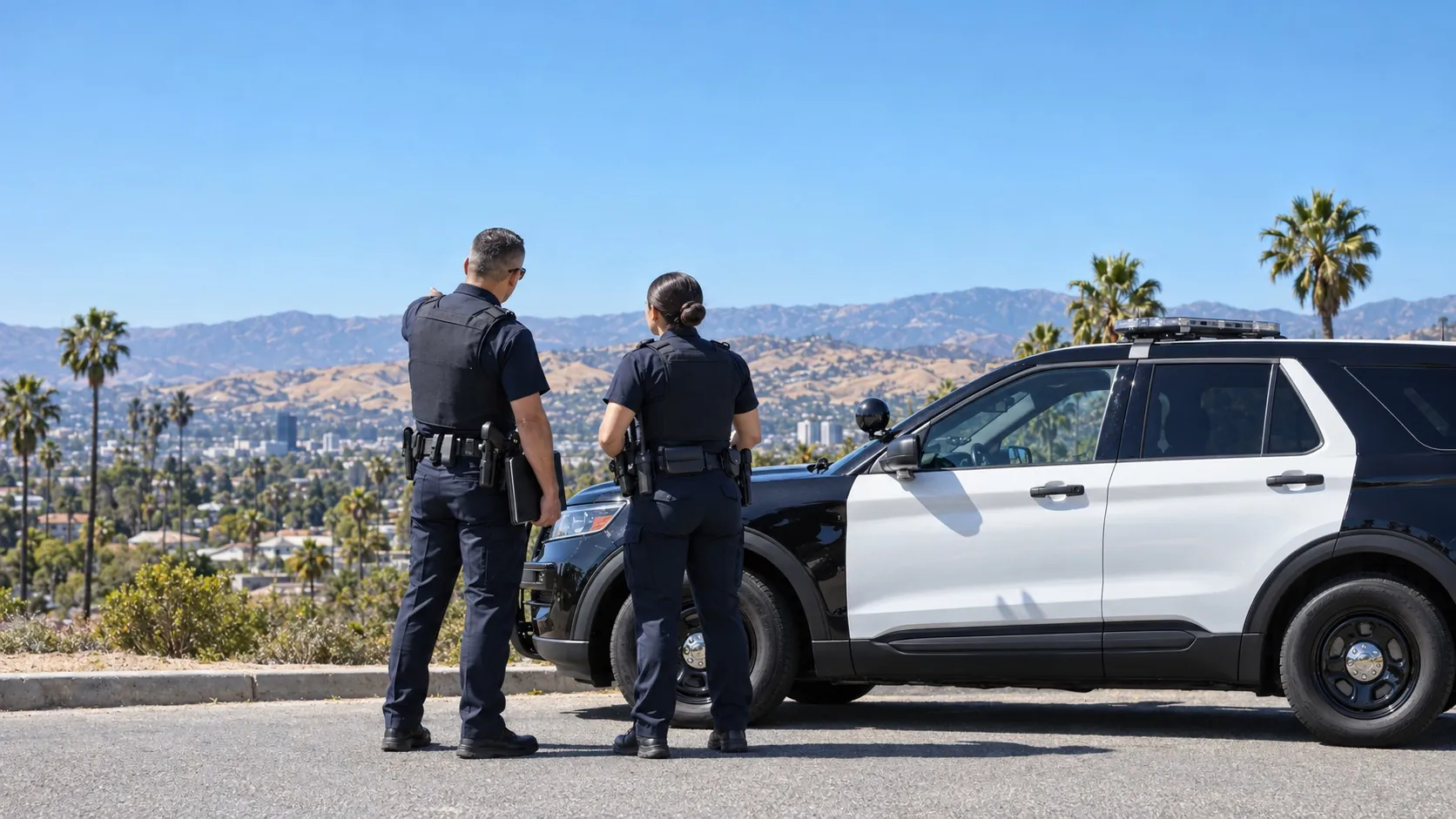


It was the question left hanging at the end of the previous episode, and it opened the fourth part of the conversation: why, in Brazil, does the entire review of an arrest in the act (flagrante) run through a single person, the police chief (delegado), when everywhere else the officer who made the arrest is the one who answers for it? To Eliel Teixeira and Edwin Wu, who built their entire careers in California policing, the Brazilian design looks like a detour. Maurício de Thomazi, a delegado with the São Paulo Civil Police, a criminal procedure professor and host of Criminocast, answered the way he answers his own students: starting with the Constitution.
In Brazil, there are only two ways to be arrested
The starting point is Article 5, item LXI, of the 1988 Constitution: no one may be arrested except in the act of committing a crime or by written, reasoned order of a competent judicial authority (with the exception of military transgressions and strictly military crimes). Apart from a judge's warrant, the only door is the flagrante, and what counts as one is written in Article 302 of the Code of Criminal Procedure (CPP). A person is caught in the act who:
- is committing the criminal offense;
- has just committed it;
- is pursued shortly afterward by the authorities, the victim or anyone else, in circumstances that suggest they are the perpetrator;
- is found shortly afterward with instruments, weapons, objects or papers that suggest they are the perpetrator.
The guest's example was that of any patrol officer: the officer sees a man pointing a gun at someone's face, understands it as a robbery in progress, steps in and detains the suspect. The question is: who says, legally, that this was a flagrante? In the United States, the officer himself. In Brazil, the delegado.
The officer is the "conductor"; the delegado makes it official
Under the Brazilian design, the officer who makes the arrest is the conductor (condutor). He takes the suspect and the witnesses to the station and, in the guest's words, presents the situation: "Chief, we saw this, we think it's a flagrante, please analyze whether we are correct." Article 304 of the CPP orders the authority to hear the conductor, the witnesses and the suspect and, if he finds it is a case of flagrante, to draw up the arrest report (auto de prisão em flagrante). From that point on, the decision is his. "Now it's mine," the delegado sums up.
It is not just a rubber stamp. The delegado can decline to ratify the arrest, order the incident to be recorded and send the case to investigation without arresting anyone. For crimes with a maximum sentence of up to 4 years, he can himself set bail (Article 322 of the CPP). And the arrest must be reported immediately to the judge, the Public Prosecutor's Office and the suspect's family, with the report sent to the judge within 24 hours (Article 306). Law 12,830/2013 defines these duties of the delegado as "legal in nature, essential and exclusive to the State," and the post is reserved for law graduates.
In California: the officer swears, the duty judge checks
On the American side, the hosts described the path they know from the street. The sworn officer arrests without a warrant when he has probable cause that the person committed a crime, under California Penal Code 836. He is the one who writes the report and signs the probable cause declaration that goes to the on-duty judge. The U.S. Supreme Court requires that, in a warrantless arrest, a judge make this check within 48 hours (County of Riverside v. McLaughlin, 1991), and Penal Code 825 requires the arrestee to be brought before a magistrate within the same period, not counting weekends and holidays.
There is also a filter before that. Penal Code 849(b)(1) allows the arrestee to be released without being taken to a judge when it is concluded that there is not enough basis for a formal charge; in that case, under 849(c), the arrest is treated as a mere detention. In practice, the person who usually makes that call is the supervisor, according to each department's policy. That is what the hosts pointed out: the arrest can be reversed, but the officer remains exposed to answering for it. The one who charges is the prosecutor, and the one who examines legality is the judge, with no delegado in between.
The Sixth Amendment: why the delegado model would not survive in an American court
The hosts' central argument is constitutional. The Sixth Amendment guarantees the accused, in every criminal prosecution, the right to be confronted with the witnesses against him (the Confrontation Clause). Since Crawford v. Washington (2004), the Supreme Court has held that testimonial statements from someone who will not testify at trial, without the defense having had a chance to cross-examine, cannot be used against the defendant.
Hence the exercise they ran in the studio: if an American "delegado" formalized the arrest without having seen anything, the defense would ask at trial whether he was there, whether he saw the client's behavior, and would hear "no" to everything. He only knows what he heard from third parties. For the defense, the arrest would be dismantled. That is why, in the United States, the person on the witness stand is the officer who saw, heard and decided, with the five senses he used on the street.
California has an exception that proves the rule: since Proposition 115 (1990), at the preliminary hearing, which only decides whether there is enough evidence for the case to proceed, an officer with five years of experience or specific POST training may relate what other people said (Penal Code 872(b)). At trial, the confrontation rule applies in full again.
At the custody hearing, the one in the defendant's seat is the delegado
The guest has a saying: every time he signs off on an arrest on his shift, he is "sitting in the defendant's chair" next to the suspect. At the custody hearing (audiência de custódia), the closest Brazilian equivalent to the first appearance before a judge that Americans call the arraignment, three things are assessed, and the law confirms the list (Article 310 of the CPP, as amended by Law 13,964/2019, and CNJ Resolution 213/2015):
- the legality of the arrest: judge, prosecutor and defender check whether the story presented fit one of the four items of Article 302. If it did not, the arrest is set aside, and the one who erred was the delegado, who may answer to the Internal Affairs office (Corregedoria);
- the suspect's rights: whether they had the right to remain silent, whether the family was notified, whether they were assaulted;
- the need for detention: whether it is converted to pretrial detention, or provisional release is granted, with or without bail, with or without an ankle monitor.
The hearing must take place within 24 hours, a rule established by the Supreme Federal Court (STF) in ADPF 347 (2015) and incorporated into the CPP by the anti-crime package. In California, the third question, whether the suspect stays or goes and on what bail, is also asked at the first appearance; since In re Humphrey (2021), the California Supreme Court requires the judge to consider ability to pay before keeping someone locked up solely for being unable to afford bail.
The result, for the delegado on duty, is a legal risk of "100%," in his words: he "signs up" for every case that comes in. When the hosts asked whether he agrees with this, the answer came with the curse word that gives the podcast its name, and that is left for those who watch.
The first constitutional filter
The hosts' doubt is about the design, not the professional: if the officer had the training and legal education to decide, wouldn't it be a more direct system, with fewer people involved and less spread-out responsibility? In the American logic, whoever saw it is whoever answers for it. In the Brazilian model, someone who was not there takes responsibility for something he did not witness, without knowing whether the officer and the suspect told the truth.
The answer from those who designed the system, according to the guest, is that the delegado is also a legality filter, "almost a mini judge": he asks about the witness, checks whether the suspect was told of their rights, undoes the arrest when it does not fit and orders the handcuffed person released before anyone has a right suspended unnecessarily. He points out that the delegado is not the hierarchical superior of the military police officer who brings the suspect in: he has simply been placed in a legal position where he decides a great deal.
The hosts point out that the American system also has layers: the supervisor makes the first assessment and can release (the 849), the prosecutor oversees police work, especially on constitutional issues, and the judge makes the third check. The difference lies in when the filter comes in: in the United States, by the time the suspect reaches the station, the suspension of the right has already happened and the officer answers for it.
The Fourth Amendment, which prohibits unreasonable searches and seizures, shows the weight Americans give to this moment. For the Supreme Court, a street stop, an arrest and even the use of deadly force are forms of seizure (Tennessee v. Garner, 1985). That is why, as they put it, the seriousness of an arrest is placed in the officer's head from the academy onward.
"You have to be good at paperwork"
In the middle of the discussion, a point appeared on which the two systems agree. The great lesson, the guest says, is the one taught at the academy: the officer needs to make a thoughtful decision and be able to sustain it in the report. If he brought the suspect in, why? If he did not, why? If the next day the reason turns out not to be enough but is well explained, the work was well done. It applies to the officer and to the delegado.
In California, report writing is a mandatory subject of basic POST training (Learning Domain 18, Investigative Report Writing), and the report is the basis on which the prosecutor decides whether to charge. Today there is a second witness: the hosts say a good part of the evaluation of their work is done by the body camera, which the prosecutor watches. For them, this weakens the argument that an intermediary figure is needed to "translate" what the officer saw.
Why Brazil chose this model
The guest himself warns that the final explanation is his own, not written anywhere: it is the one he gives his students. Arrest in the act is the "exception to the exception" in a system where the rule is to arrest only by court order, a moment so "radioactive" that the legislator found it convenient to have a legal figure prepared, dedicated on duty solely to this assessment, before the judge.
And that, he says, has history. Brazil is a country "deeply traumatized by arbitrary arrests," and the 1988 Constitution was written right after 21 years of military rule (1964–1985), a period in which Institutional Act No. 5, of 1968, even suspended habeas corpus for political crimes. In his view, the legislator's choices carry this historicity: they are the product of each country's history.
What the two of them think about it
Eliel Teixeira and Edwin Wu call Maurício de Thomazi's explanation one of the best, if not the best, they have ever heard on the subject, without giving up the lens of people who work in California, where responsibility for the arrest belongs to the officer from the first minute. What each would do if they had to work in the Brazilian model, and what that has to do with productivity on the street, is in the episode and in the next article of this series.
Sources and verification
Brazilian Federal Constitution of 1988, Art. 5, items LXI to LXV, and Art. 144, § 4. Code of Criminal Procedure, Arts. 302, 304, 306, 310 (as amended by Law 13,964/2019) and 322. Law 12,830/2013 (criminal investigation conducted by the police chief). Supreme Federal Court, ADPF 347 (2015). National Council of Justice, Resolution 213/2015 (custody hearings). Institutional Act No. 5 (1968), Art. 10. Constitution of the United States, Fourth and Sixth Amendments. U.S. Supreme Court: Tennessee v. Garner (1985), County of Riverside v. McLaughlin (1991), Crawford v. Washington (2004). California Penal Code §§ 825, 836, 849(b)–(c) and 872(b) (Proposition 115, 1990). California Supreme Court, In re Humphrey (2021). California Commission on Peace Officer Standards and Training (POST), Learning Domain 18. The "defendant's chair" line, the "100%" risk and the historical explanation of the model are the guest's opinions.
Who is speaking here: Eliel Teixeira and Edwin Wu are active police officers in the Los Angeles area, California — Brazilian-born, American citizens, with long careers in law enforcement. In this episode, produced in partnership with Criminocast, they close the four-part conversation with Maurício de Thomazi, a delegado with the Civil Police of the State of São Paulo, professor of criminology and criminal procedure, and host of Criminocast.
Note: what is described here about American policing applies to the rules of California — and, on several points, to each one's specific department. In other U.S. states the rules differ. What is described about Brazil applies to the Civil Police of São Paulo; each Brazilian police force has its own organic law and internal rules.
Watch this part of the episode:
Arrest in the act and judicial orders in Brazil — starting at 1:07 · Palavrão Tático
This article is a reference edition of episode 52 of Palavrão Tático and is subject to edits and editorial additions. For the full conversation, watch the episode. — Updated on 19/11/2026.