



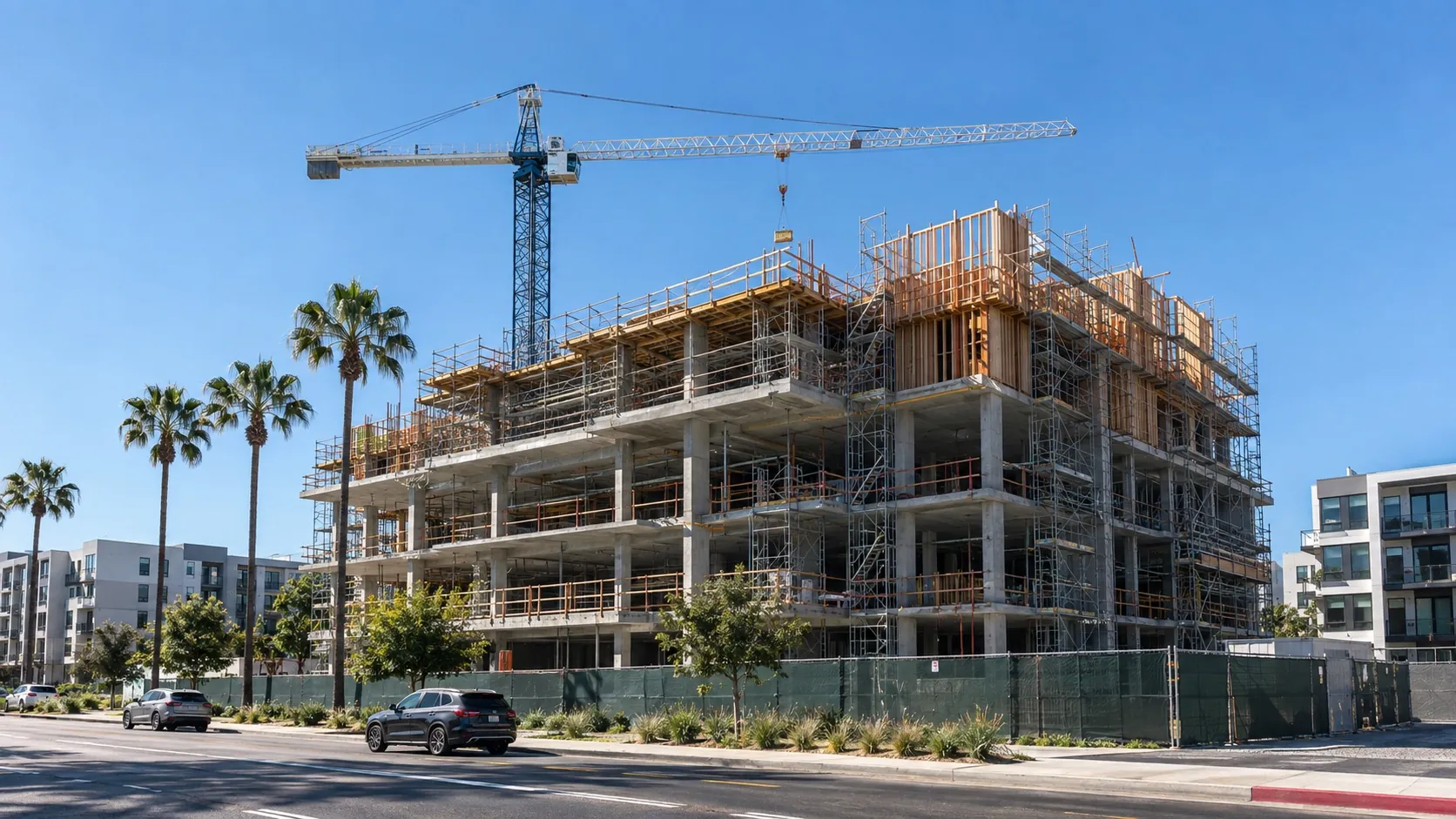
At some point in the episode the conversation moves from financing to the root of the problem: why homes cost so much in Southern California. The agents' answer is about supply — not enough gets built for what the region needs.
"We have a goal of building a hundred thousand new homes a year, at least in Los Angeles County, and only a fraction of that actually gets built." — from the episode
The figures cited on the show — a goal in the hundred-thousand range, with actual output in the low thousands — are the agents' on-air estimate, not an official number read off a source in real time. But the direction matches what public data has shown for years: the state housing targets assigned to the Los Angeles region run far above the units actually permitted and completed each year.
The time between applying and being allowed to build
The most illuminating part of this segment is about timing. The agents describe cases of developers whose project takes years between filing for approval and getting the permit. And what happens in that gap is what drives up the cost of everything:
- material and labor costs change;
- interest rates change, and with them the cost of financing the construction;
- the target sale price changes — sometimes the project needs to be redesigned to make the numbers work.
It's a self-feeding cycle: delay drives up cost, higher cost shrinks the number of viable projects, fewer projects mean less supply, and less supply keeps prices high.
This isn't just the agents' impression. California has passed a string of laws in recent years aimed precisely at shortening that path — streamlined approval for certain residential projects and limits on cities' power to block developments that comply with zoning rules. The debate over how effective those laws have been in practice remains open.
A concrete example: Torrance
As an example of what's in the pipeline, the episode cites a residential project in Torrance, near the Del Amo Fashion Center, with more than 200 apartment units and delivery expected in summer 2027. The agents use the case to point out an important cultural difference for a Brazilian audience: you don't buy off-plan here the way you do in Brazil. Developers here typically only set prices and start selling once construction is well underway, precisely because of cost uncertainty.
ADUs: more units, same neighborhood
The final part of the segment covers ADUs (Accessory Dwelling Units) — the extra units built on the same lot, behind the main house, above the garage, or by converting it. California has significantly relaxed the rules around this kind of construction precisely to boost supply without relying on large developments.
The episode raises an honest caveat: a residential neighborhood was designed — sewer, water, power grid, streets — for a certain number of homes. Adding units without touching that base puts pressure on infrastructure. And then there's parking: in a region where, as they put it on the show, "without a car you can't go anywhere," a new unit with no parking spot means another car on the street.
The counterpoint also comes up: public transit in the region has been expanding, with line extension projects underway — just on a decade-long timeline, not a yearly one. And there's the cultural barrier, acknowledged in the conversation: people who've lived here a while have gotten used to the car.
What this means for buyers
- Scarcity keeps prices up. Until construction catches up with demand, a sharp, broad price drop remains unlikely to expect — and no one, on the show or off it, can predict the market.
- New construction plays by different rules. Timelines, price adjustments, and purchase conditions work differently than for resale homes.
- An ADU is opportunity and responsibility. Before counting on one, check with the city what's allowed on that specific lot.
Sources and verification
- California Department of Housing and Community Development — Regional Housing Needs Allocation (RHNA) and annual housing progress reports (APR) from cities and counties.
- Southern California Association of Governments — distribution of housing targets across the Los Angeles region.
- California state legislation on streamlining approval for residential projects and on ADUs (Government Code, Accessory Dwelling Units sections).
- The cited goal of a hundred thousand units a year, the Torrance project with more than 200 units and expected 2027 delivery: the agents' assessment on the episode (March 2026) — market figures mentioned in conversation, not official data checked live on air.
- Transcript of episode 6 of the Cadê Moradia podcast.
Watch this part of the episode:
The Los Angeles housing shortage (approximate excerpt) — starting at 21:18 · CADÊ BRAZIL
This article is a reference edition of episode 6 of the podcast and is subject to edits and editorial additions. For the full conversation, watch the episode. — Updated on 18/09/2026.