



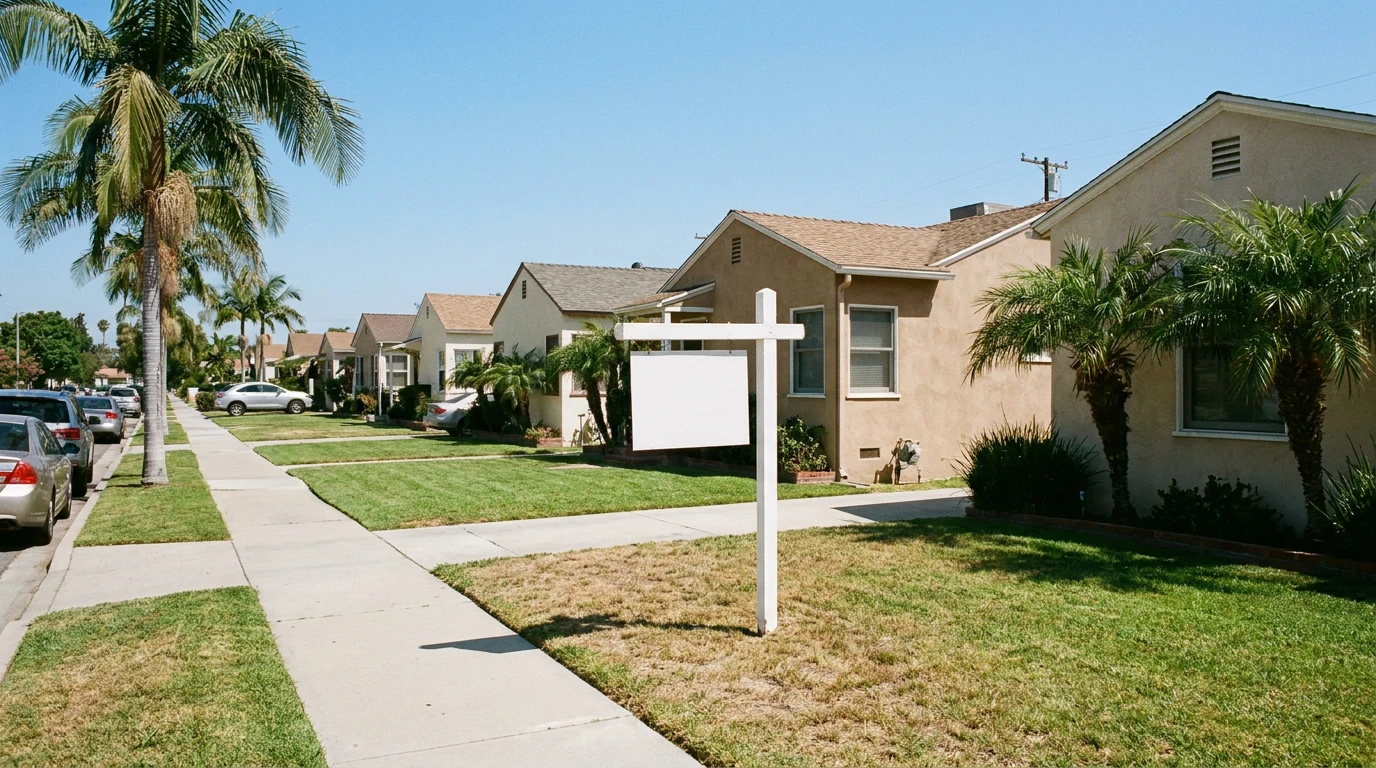
Anyone who looked for a house in Hawthorne five years ago and started looking again now found a different city — in price. The question every Brazilian buyer asks is the same one: why did it get so expensive, and in such a short time?
Two explanations come up in the episode. Dina points to the drop in interest rates during the pandemic, which multiplied the number of buyers able to close a deal. Jason points to the arrival of investors and short-term rentals, pulling houses out of the pool available to people buying a place to live. Both readings describe real parts of the same process — and there is a third one, structural, that usually gets left out and may be the most decisive. Let's take all three.
1. Cheap money: more buyers competing for the same house
During the pandemic, the 30-year mortgage rate in the United States fell to the lowest level ever recorded in the series, reaching around 2.6% a year in early 2021 — something without precedent. Then, in the Federal Reserve's tightening cycle, it climbed hard again, going past 7% in 2023.
The effect of a rate that low isn't to make the house cheaper: it's to increase how much each family can finance with the same monthly payment. If the payment that fits your budget starts buying a larger loan, you move up into the competition for more expensive homes — and everyone does that at the same time. With a lot of people able to pay more for the same stock of houses, prices go up.
"When there's a lot of demand and little supply, the price goes up. And that, unfortunately, is what we're going through." — Dina Silveira, on the episode
That's why the market's most repeated line almost never comes true: there is no moment when low rates and low prices happen together. When rates fall, demand rises and takes prices with it. When rates rise, prices may cool off, but the payment gets more expensive. Waiting for both at once is waiting for something the mechanics of the market rarely produce.
2. The lock-in effect: nobody with a 3% rate is selling
There's a consequence of that low-rate period that explains much of today's scarcity, and it almost never makes it into the conversation. Millions of families locked in loans at 2% and 3% a year. Selling the house today means, for them, giving up that rate and taking on a new mortgage at twice the cost.
The result is that a lot of people who would naturally move — to a bigger house, a smaller one, or another neighborhood — simply don't list. It's what the American market calls the lock-in effect: yesterday's low rate holds down today's inventory of homes for sale. Fewer listings, more competition for the few that show up.
For anyone searching in Hawthorne right now, that's the most concrete reason you find few options and heavy competition on each one — even more than the asking price itself.
3. Investors and short-term rentals: real, but sized correctly
The second reading from the episode — investors and short-term rentals taking houses off the market — is real and its effect is concentrated. When a house becomes a hospitality operation, it leaves the pool available for housing, and where that concentrates (tourist areas, close to the beach) the pressure on prices and rents shows up visibly.
That is exactly why several California cities began restricting or banning the practice, with the stated goal of returning homes to residential use. Hawthorne did not ban it — it requires a permit, fees and compliance with the rules, a subject covered in its own article in this publication.
It's worth sizing this honestly, though: short-term rentals are a relevant factor in specific neighborhoods, not the sole cause of an entire city's price surge. Treating it as the only explanation leads to a mistaken expectation — that restricting the practice, on its own, would take prices back to what they were.
4. The structural factor: California built too little for decades
Behind the three factors above there is one that came before all of them: California produced far less housing than it needed, for many years. Restrictive zoning rules, long approval processes and local resistance to new development limited construction precisely where demand grew the most — the coastal strip, the South Bay included.
That means when a demand shock arrives — like the one from cheap money — it meets a supply that can't react. In markets where building is fast, a jump in demand gets absorbed by new houses. Where construction is stalled, that same jump turns into price.
Cities like Hawthorne end up absorbing that pressure by being the viable alternative for everyone pushed out of Manhattan Beach, Hermosa and Redondo. The city got expensive, in large part, because its neighbors got expensive first.
What this changes for anyone searching right now
Don't wait for the perfect scenario. It usually doesn't exist — the two variables move in opposite directions. The sensible decision is about your financial moment, not about timing the bottom of the market.
High rates have an upside. Periods of elevated rates push part of the competition away, cut down bidding wars above asking price and give you room to negotiate. A loan can be refinanced later; the price you paid for the house cannot.
Few options doesn't mean a stalled market. Low inventory is a consequence of the lock-in effect, not of weak demand. Where supply is thin, the good house disappears fast — pre-approved paperwork and a quick decision are worth more than waiting for something better to show up.
This article explains market dynamics and does not constitute investment advice. Rates and terms change; confirm current numbers with a lending professional before deciding.
Sources and verification
- Freddie Mac — Primary Mortgage Market Survey: historical series of the average 30-year mortgage rate, with the record low registered in early 2021 and the climb above 7% in 2023.
- Federal Reserve — rate-hiking cycle started in 2022 and its effect on the cost of mortgage credit.
- Literature on the lock-in effect (or mortgage rate lock-in): homeowners holding on to properties with contracted rates below current ones, and the impact on supply.
- California's public and legislative debate on the housing shortfall, zoning and approval of new development.
- Short-term rental rules: always check with the specific city's government — they vary and they change over time.
Watch this part of the episode:
Housing market: why prices went up and the Airbnb effect — starting at 1:45 · CADÊ BRAZIL
This article is a reference edition of episode 16 of the podcast and is subject to edits and editorial additions. For the full conversation, watch the episode. — Updated on 09/08/2026.