

In the Cadê Brazil episode that launches the "Quem tá em LA?" ("Who's in LA?") segment, a simple question turns into a history lesson. Comedian Zé Modesto recalls that, flying in from Brazil, he heard a flight attendant ask whether he was going "to LA" — and didn't realize she meant Los Angeles. From there the conversation moves to the city's full name, and Miguel Albanês, pastor at PIBBLA and a university professor, explains where it comes from.
The name nobody uses
Few residents know it, but Los Angeles was born with a long Spanish name. The traditional form, repeated in the episode, is "El Pueblo de Nuestra Señora la Reina de los Ángeles" — the town of Our Lady, the Queen of the Angels. Historians still debate the exact wording of the founding name, and some versions add "de Porciúncula," a reference to the river and to a chapel linked to Saint Francis of Assisi. Today the city's official name is simply City of Los Angeles — and, day to day, "LA." "Americans don't say Los Angeles, it's LA," says Jason Lanzarini.
The founding, in 1781
Los Angeles was founded on September 4, 1781, under the Spanish Crown, by a group of 44 settlers — the pobladores, eleven families — who came from the north of what is now Mexico. The pastor notes that he and other Brazilians often visit the spot where the city began, El Pueblo de Los Angeles, downtown, with Olvera Street. That is where you'll find the Avila Adobe, from 1818, considered the oldest house still standing in the city.
The missions and El Camino Real
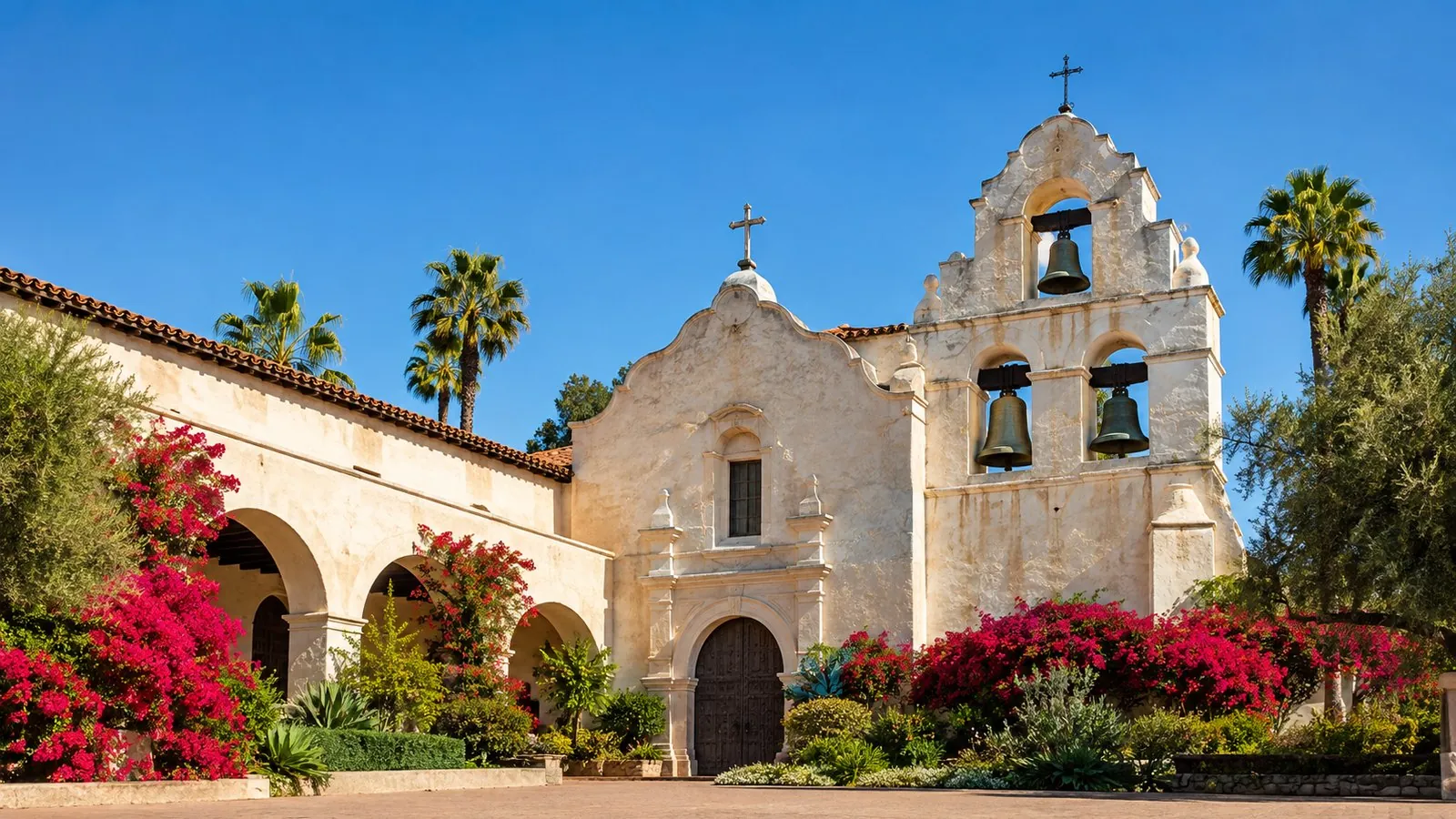
Many California cities carry a saint's name because of the missions — complexes of church, school and workshops run by Franciscan friars, where Indigenous people were catechized and taught Spanish and trades, a system criticized today for forced labor and the deaths of Indigenous people. The pastor compares them with the missions, or reductions, that existed in Brazil and Paraguay, portrayed in the film "The Mission," starring Robert De Niro.
- The first was San Diego de Alcalá, in 1769; the last, in Sonoma, in 1823. In all, 21 missions.
- The idea was for them to sit about one day's travel apart, so a traveler could leave one in the morning and sleep at the next.
- Los Angeles was not a mission, but San Gabriel, from 1771, is in the area. San Juan Capistrano and Santa Barbara, mentioned in the episode, are also mission towns.
- The road connecting them became known as El Camino Real. Along Highway 101, iron bells on posts mark the route — they were installed starting in the early 20th century and are now maintained by the state transportation department. "Next time you drive the 101, look for the bells," the pastor says.
Spain, Mexico, the United States
In the mission era, the region was part of New Spain. With Mexico's independence in 1821, California became Mexican. In the Mexican-American War, from 1846 to 1848, the Americans took the territory; under the peace treaty, the Treaty of Guadalupe Hidalgo, the United States paid Mexico 15 million dollars for the huge area ceded — which explains the episode's joke about "bought" versus "took." Florida, also Spanish, passed to the United States through a treaty with Spain in 1819. That is where you'll find St. Augustine, founded by the Spanish in 1565 and considered the oldest continuously inhabited city of European origin in the continental United States.
Spanish California had two parts: Alta California, which became the American state, and Baja California, the peninsula that remained Mexican. Hence the Spanish name: the city was already 67 years old when it became American.
The republic that stayed on the flag
The California flag features a bear and the words "California Republic." It comes from the Bear Flag Revolt of June 1846, when American settlers declared an independent republic in Sonoma. It didn't last: about three weeks later, with the war already under way, American forces took control. Texas had a similar, longer story — it was an independent republic for almost ten years, from 1836 to 1845, before joining the United States. "Live and learn," Zé Modesto concludes.
A metropolis of many cities
The conversation ends in the present: Jason points out that Greater Los Angeles is the largest metropolitan area in the country by extension, spread out horizontally because of earthquakes, with one city running into the next — Los Angeles County alone has 88. And the comedian sums up the confusion of a newly arrived Brazilian: "I thought I was going to Canada," he says about Ontario, the Greater Los Angeles city where the podcast is recorded.
Sources and verification
- City of Los Angeles and El Pueblo de Los Angeles Historical Monument — the city's founding (1781), the pobladores and the Avila Adobe.
- California Missions Foundation and California State Parks — the 21 missions (1769-1823).
- California Department of Transportation (Caltrans) — the El Camino Real bells.
- Treaty of Guadalupe Hidalgo (1848); Adams-Onís Treaty (1819).
- California State Library — Bear Flag Revolt (1846) and the California flag; Texas State Library and Archives — Republic of Texas (1836-1845).
- National Park Service — St. Augustine (1565).
Who's talking: the Cadê Brazil podcast is hosted by Jason Lanzarini, who since 2014 has organized the Facebook groups of the Brazilian Community in California. In this episode, which launches the "Quem tá em LA?" segment, he welcomes comedian João Netto, known as Zé Modesto, alongside Cezar Brelaz, owner of Pampas Grill, and pastor Miguel Albanês, of the First Brazilian Baptist Church of Los Angeles (PIBBLA).
General information for the Brazilian Community in California — not legal or financial advice.
Watch this part of the episode:
Trivia: Do you know the FULL name of Los Angeles? — starting at 30:39 · CADÊ BRAZIL