



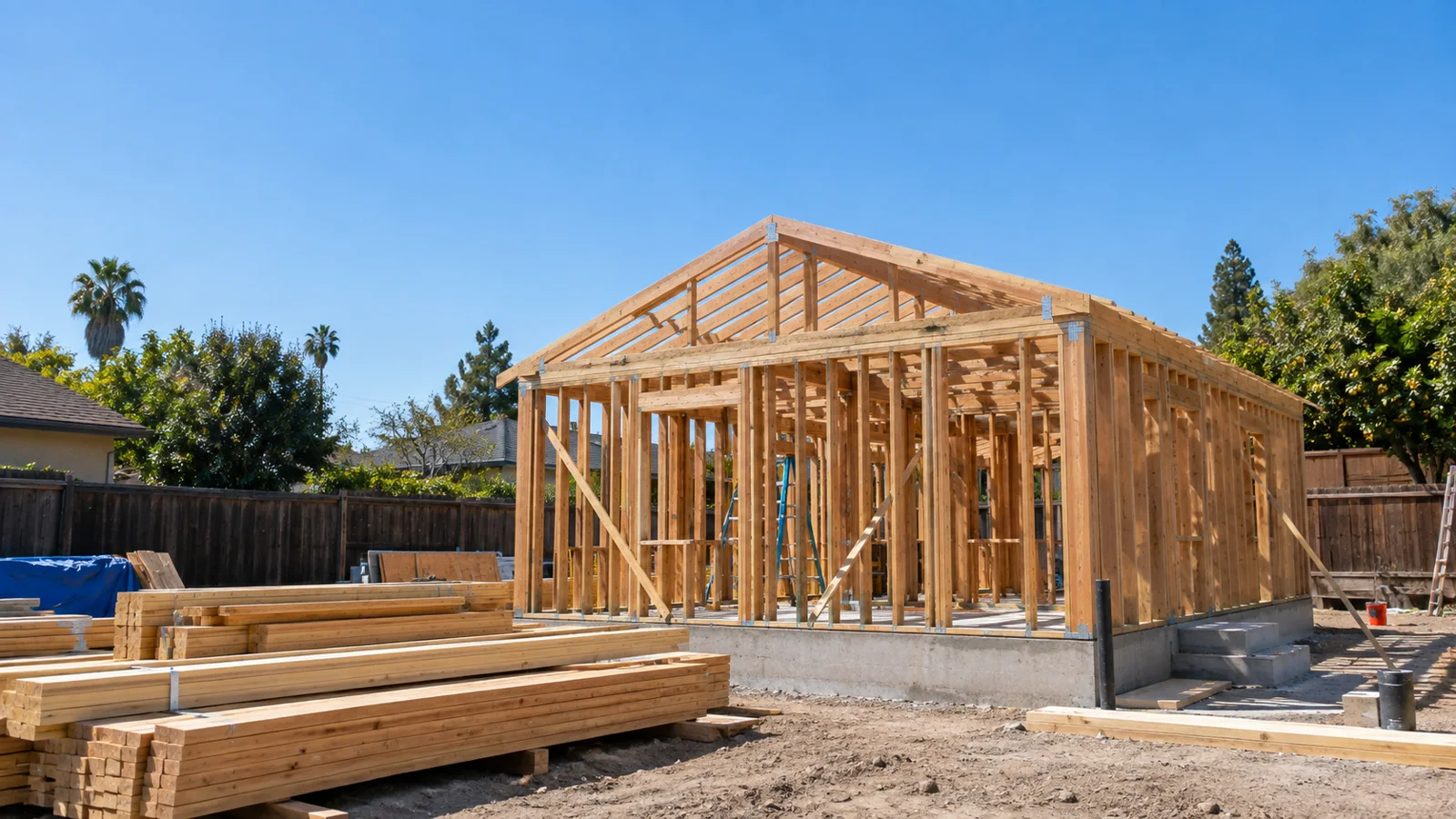
In the episode, one of the realtors asks the question that, according to builder Rafael Pozas, normally comes first: what does it cost to build an ADU? Rafael jokes that he was surprised it took so long — and answers that it isn't a simple question.
The price per square foot — and what it hides
The number most quoted in the business is the cost per square foot. By Rafael's benchmark, a licensed contractor, with a track record of building ADUs, charges between $200 and $300 per square foot, varying with the finishes. A 500-square-foot ADU (about 46 m²), by that math, would run between $100,000 and $150,000.
The problem, he explains, is that an ADU "doesn't float in mid-air": it sits on a lot. Everything it takes for the unit to exist — running power, water, gas and sewer to the back of the lot, preparing the ground, building access — lands in the final bill, but doesn't show up in the per-square-foot price of the construction. That's why some units reach $500 per square foot.
What makes a lot expensive
- Slope: investors send Rafael sloped lots thinking "it's going to look amazing." If the ADU sits below street level, the sewage won't flow by gravity and calls for a sewage pump; the lot may need retaining walls on the sides. That's cost you don't get back in rent.
- A lot that's too big: it looks like an advantage, but the larger the area used, the greater the spending on the improvements around it (site improvements) — walkways, drainage, long utility runs — which generate no return.
- Utility connections: the distance to the existing lines, the capacity of the house's electrical panel and the utility company's fees can all change the budget.
The flatter and simpler the lot, the cheaper the square foot.
Why a smaller unit costs more per square foot
One of the realtors is puzzled: wouldn't the smaller one be cheaper? In total, yes. But per square foot, no. The most expensive rooms in a house are the kitchen and the bathroom, full of systems and components. In a small unit, that fixed cost is divided across few square feet; in a bigger one, it dilutes.
The choice, then, depends on the purpose. Near a university, where space is fought over, a modern studio can cost more per square foot and less in total — and rent well. In an area of families and schools, a larger two-bedroom unit serves that audience better.
The Junior ADU, created inside the house, is usually the most affordable option, because it takes advantage of space that is already habitable, with insulation and windows. In exchange, Rafael notes, it adds less to the property's value, since it takes a bedroom out of the house.
Finishes: to rent out or for the family
If the ADU is for income, the recommendation is durable, low-maintenance material — not sophisticated. This isn't a remodel to flip, he points out: there will be a tenant, wear and a broken tile. If it's for the family, it makes sense to invest in finishes and custom cabinetry. Both decisions change the final price.
Who to hire
Rafael points out a trap: someone who knows how to do a remodel doesn't necessarily know how to build an ADU. An ADU is a new house on the same lot, with its own utility connections, foundation and inspections. A contractor without experience tends to discover problems mid-job and make up for them with change orders (change orders), driving the project's price up.
He also warns about the order of hiring. It's common to pay $10,000 to $15,000 for architectural plans, get them approved by the city and only then discover, when bids come in, that the work costs far more than expected. That's why he recommends a feasibility study with the builder before finalizing the design.
In California, work costing more than $1,000 (labor and materials) requires a contractor licensed by the Contractors State License Board (CSLB), which can be checked on the agency's website.
Approval: simpler than a house, but not fast
One of the realtors asks whether it's true that cities make ADU approval easy. Rafael answers that it isn't quite like that. People arriving from Brazil imagine everything in the United States moves quickly, but local government has its own interests and its own slowness — and, he says, the situation got worse after the pandemic, with fewer staff and rising demand.
State law tries to tighten the deadlines: the city has 60 days to approve or deny a complete ADU permit application and, since 2026, 15 business days to say whether the application is complete. But corrections, plan revisions and resubmittals make the real calendar longer.
Six to eight months of construction
Rafael works with an estimate of six to eight months of construction — and prefers to promise more and deliver early. The main reason: in California, every stage of the work depends on a city inspection. You finish the wood structure (framing), for example, and the inspector's next available slot is at the end of the week. Three or four days lost here and there add up.
The calendar counts too. Work starting in December has a greater chance of running late, because January and February are when the rain comes in Southern California — exactly when the foundation is poured.
A budgeting checklist
- Ask for a complete bid, including utility connections, site preparation, permit fees and utility charges.
- Verify the contractor's license with the CSLB, and their ADU track record.
- Do the feasibility study before the architectural plans .
- Add up the time with no income: months of permitting and construction cost money too.
- Set aside a margin for surprises with the foundation and the utility connections.
The figures cited are the guest's benchmarks at the time of recording (April 2026) and vary by city, lot and project. Get detailed bids before deciding.
Sources and verification
- Government Code, section 66317 — 60-day deadline to decide on an ADU permit; SB 543 (2025) — 15-business-day deadline for a completeness review, starting in 2026.
- Contractors State License Board (CSLB) — license requirement for work over $1,000 and public license lookup.
- California Department of Housing and Community Development (HCD) — Accessory Dwelling Unit Handbook (most recent update) and Government Code, sections 66310 to 66342.
- Transcript of episode 9 of the Cadê Moradia podcast (April 2026), with the show's realtors and builder Rafael Pozas.
This topic comes from the full episode — watch it:
CADÊ BRAZIL
This article is a reference edition of episode 9 of the podcast and is subject to edits and editorial additions. For the full conversation, watch the episode. — Updated on 17/09/2026.