

Training a police officer in California is a heavy investment — and the numbers surprise even people in the field. From the day someone applies to graduation day at the academy, the state spends an average of $150,000 per candidate. Add in salary and benefits for the first year on the job and the package tops $250,000 — today, with the raises, the bill is closing in on $300,000.
The road to the badge
The path is broken into stages: a two-month pre-academy (physical conditioning and leveling — the department has already invested so much in the candidate that it wants them to pass), the six-month academy, one month of post-academy and, right after that, the field training period as an OIT (officer in training) — when the rookie cannot do a single thing alone: every call, every contact has a legally responsible officer supervising.
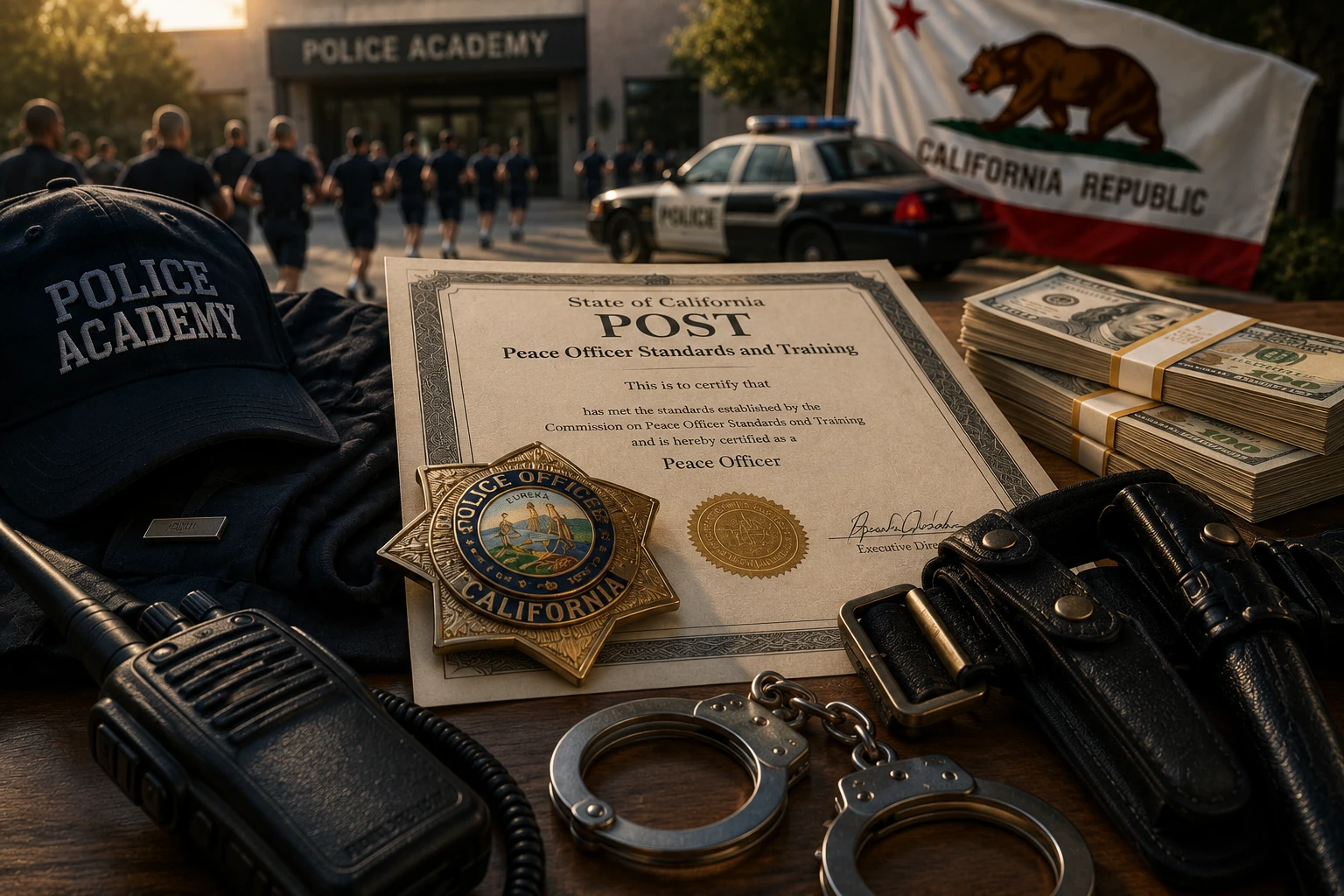
The academy certificate by itself does not make anyone a police officer. You have to work 12 months full time at an agency — the probationary period — to earn the state certification, issued by POST (the California commission that sets the standards for police selection and training).
The curriculum: everything the job needs, nothing beyond it
The six months at the academy cover the learning domains — criminal justice system, criminal law, crimes against persons and property, sex crimes and crimes against children, narcotics, search and seizure, use of force, domestic violence, vehicle operations, traffic, custody, first aid, unusual occurrences and on down the list. It is the subject matter of police work specifically, concentrated.
"Law school is useless for police work"
The line is blunt and it is said without hedging: for police work in the United States, a law degree is not required and is not missed. The introduction to the criminal justice system at the academy is a block of about 12 hours — enough to understand who the prosecutor is, what the public defender does, how a report turns into charges. Legal interpretation is not the officer's job: that is what the district attorney's office is for, and it backs up the people on the street directly (and constantly). Anyone who wants to study law out of personal interest, great — but nobody needs to bankroll years of college to put on the uniform in California.
The paper worth $300,000
Once certified, an officer can knock on the door of any agency in the state — and gets welcomed with open arms: hiring someone already certified saves the entire up-front investment. The reputation of that piece of paper crosses state lines: in Texas, an officer certified in California needs only a two-week conversion (basically the local laws) to go to work. The rest — tactics, conditioning, experience — already came built in.
Who's talking here: Eliel Teixeira and Edwin Wu are working police officers in the Los Angeles area, California — born in Brazil, American citizens, with long careers in law enforcement. On Palavrão Tático they talk cop to cop, for officers and enthusiasts, without translating any of it into civilian language.
Heads up: everything described here follows the rules of California — and, on several points, the specific department each of them works for. In other American states (Florida, Texas, New York…) the rules can be quite different.
Watch this part of the episode:
The $250,000 figure: what the public invests in every officer — starting at 15:05 · Palavrão Tático
This article is a reference edition of episode 40 of Palavrão Tático and is subject to edits and editorial additions. For the full conversation, watch the episode. — Updated on 06/08/2026.