



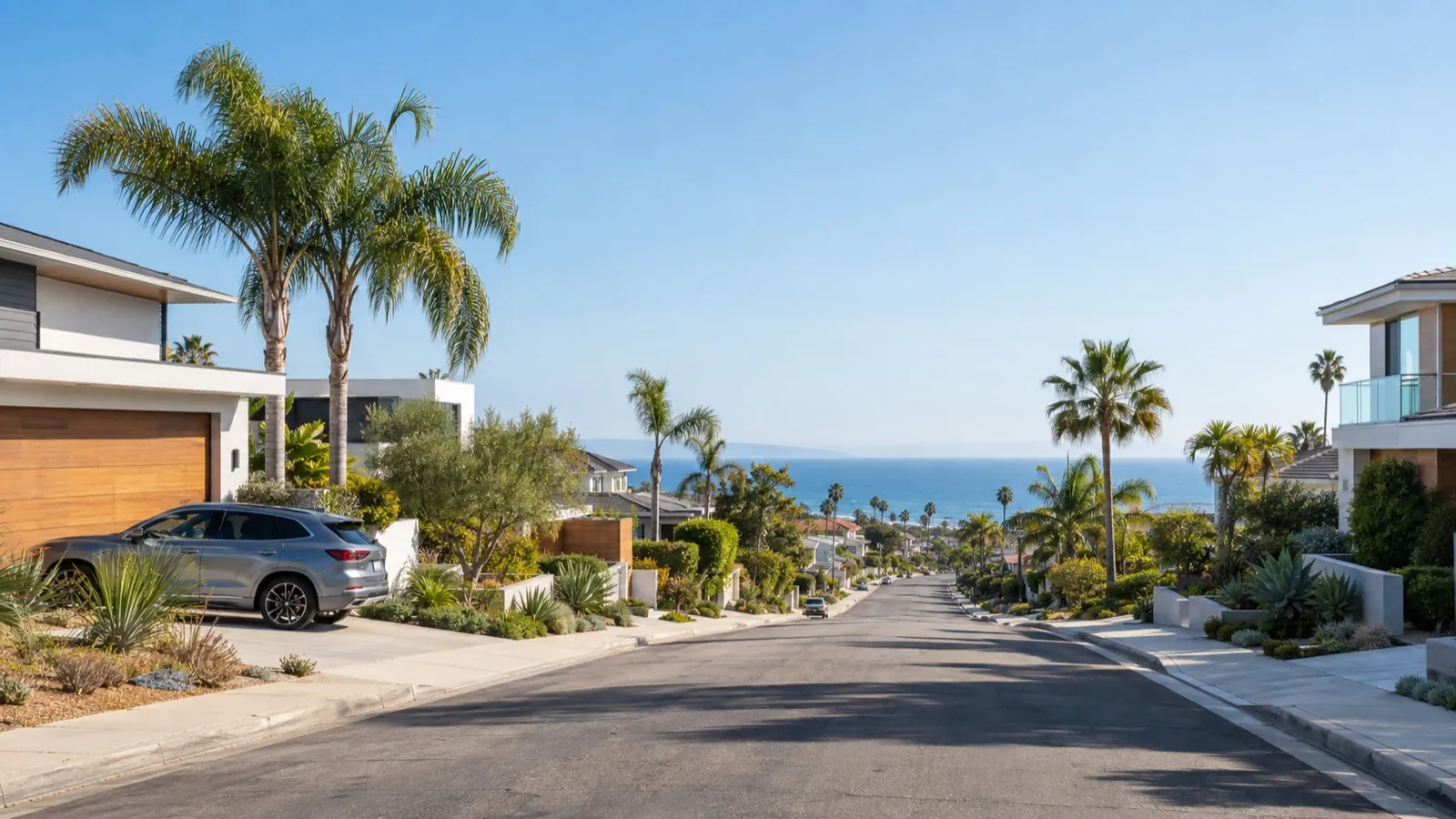
Hollywood Riviera holds a curious position on the South Bay price map. It sits right next to Palos Verdes, one of the most expensive areas in California, and a few miles from Manhattan Beach, another luxury benchmark. In the episode, Dina Silveira describes the neighborhood as "the sweet spot in the middle": neither one's price nor the other's. But that doesn't mean cheap.
"It's a bit pricey, because it's close to the beach. There's no way around it." — Jason Lanzarini, in the episode
The benchmark numbers from the recording
In the recording, made in May 2026, Dina presented figures from the previous three months. The average price of homes sold was around $2.75 million, driven by a wide spread — there were sales close to $1 million and others above $5 million. In the same period, according to her, 30 properties were available and 9 were sold.
The listings shown in the episode help make sense of the price ranges. There were townhouse-style units (three stories, with ocean views) near $1.5 million; small two-bedroom houses on the side closest to the beach around $1.7 million; remodeled three-bedroom houses on the Torrance side above $2 million; and large, modern houses near the sand approaching $4 million.
Those listings were a snapshot of that week, and most are no longer available. Their value is showing what each price range could buy, not serving as a price table.
How to read "30 available, 9 sold"
Inventory numbers alone can mislead, and it's worth knowing the metric American agents use to interpret them: months of supply (MOS). The math is active listings divided by one month of sales. As a general reference, below 4 to 6 months the market tends to favor sellers; above that, buyers gain negotiating power.
In small neighborhoods like Hollywood Riviera, the metric swings a lot from one quarter to the next, because a few more or fewer sales change the result. What Dina sees in practice, and what matters when making an offer, is something else: well-located, correctly priced homes keep getting multiple offers, even with the broader market less heated than in the low-interest-rate years.
"When there's scarcity, there's nowhere to run. There are a lot of people just waiting for the opportunity to buy." — Dina Silveira, in the episode
That's why anyone searching should ask their agent for the neighborhood's current numbers — sales, price per square foot, average days on market and months of supply — instead of starting from an old average.
The "Redondo" side and the "Torrance" side: what the same money buys
Hollywood Riviera lies entirely within Torrance, but some homes have a Redondo Beach mailing address (the mix-up is explained in the neighborhood guide published in this newspaper). In the market, that split shows up in price. The stretch with a Redondo address is closer to the sand and carries the prestige of the neighboring city's name, which has a higher average value.
By Dina's math, at the neighborhood's average price:
- On the side with a Redondo Beach address, you tend to buy a smaller, less modern house, a 5- to 15-minute walk from the beach.
- On the side with a Torrance address, the same money usually buys a bigger, more updated house with more land — which also leaves room for an addition or an ADU.
"I'm not crazy about living right next to the beach, because the other area is still very close. I like space, privacy. I'd probably choose the Torrance part — but I'd be torn." — Dina Silveira, in the episode
Jason adds the other side of the equation: people who live a bit farther inland are still just minutes from the beach and pay much less than they would on the Redondo Beach waterfront.
The "good, but not perfect" house is the most contested
The neighborhood is old, and that creates its own dynamic. Dina points out that remodels age: a house renovated 20 years ago no longer looks contemporary to today's buyer. In practice, there will always be homes needing updates.
Her advice for buyers without the budget for a move-in-ready, "premium"-priced house is to look at livable homes in good condition, but without magazine-level finishes — and update them over time. The catch, she warns, is competition: that's exactly the kind of house most people want, because it avoids the price of a fresh remodel.
Two precautions before going down that road:
- Separate cosmetic from structural. An old kitchen can be replaced; foundation, termite or moisture problems can cost more than the price difference. The inspection is what tells one from the other — the subject of a separate article in this newspaper.
- Get estimates before you offer. Construction costs in California are high, and permits take time. The price of the house plus the remodel has to fit the plan, not just the first.
What about appreciation?
Asked whether the neighborhood may have hit its ceiling, Dina answers that, in her reading, scarcity supports prices: there is demand for a desirable neighborhood and little supply. It's a market assessment from someone who follows the area, not a guarantee. Home prices also fall, as California has seen in other cycles, and the decision to buy should rest on the family's use and budget, not on a bet on appreciation.
This article describes the market at the time of recording and is not investment advice. Prices, inventory and interest rates change quickly; confirm current numbers with a licensed real estate agent before deciding.
Sources and verification
- Neighborhood metrics presented by Dina Silveira in the episode (three months prior to May 2026): average sale price around $2.75 million; 30 properties available and 9 sold in the period.
- Listings shown in the episode (May 2026), cited here only as price ranges and without identifying addresses.
- Months of supply concept: standard market metric used by the National Association of REALTORS® and the California Association of REALTORS®.
- Mailing address difference (ZIP 90277, Redondo Beach) within Torrance city limits: neighborhood profiles published by South Bay agents.
- Transcript and chapters of episode 13 of the Cadê Moradia podcast (May 2026), with Dina Silveira and Jason Lanzarini.
Watch this part of the episode:
Market values: how much does it cost to live here? — starting at 7:15 · CADÊ BRAZIL
This article is a reference edition of episode 13 of the podcast and is subject to edits and editorial additions. For the full conversation, watch the episode. — Updated on 16/09/2026.