



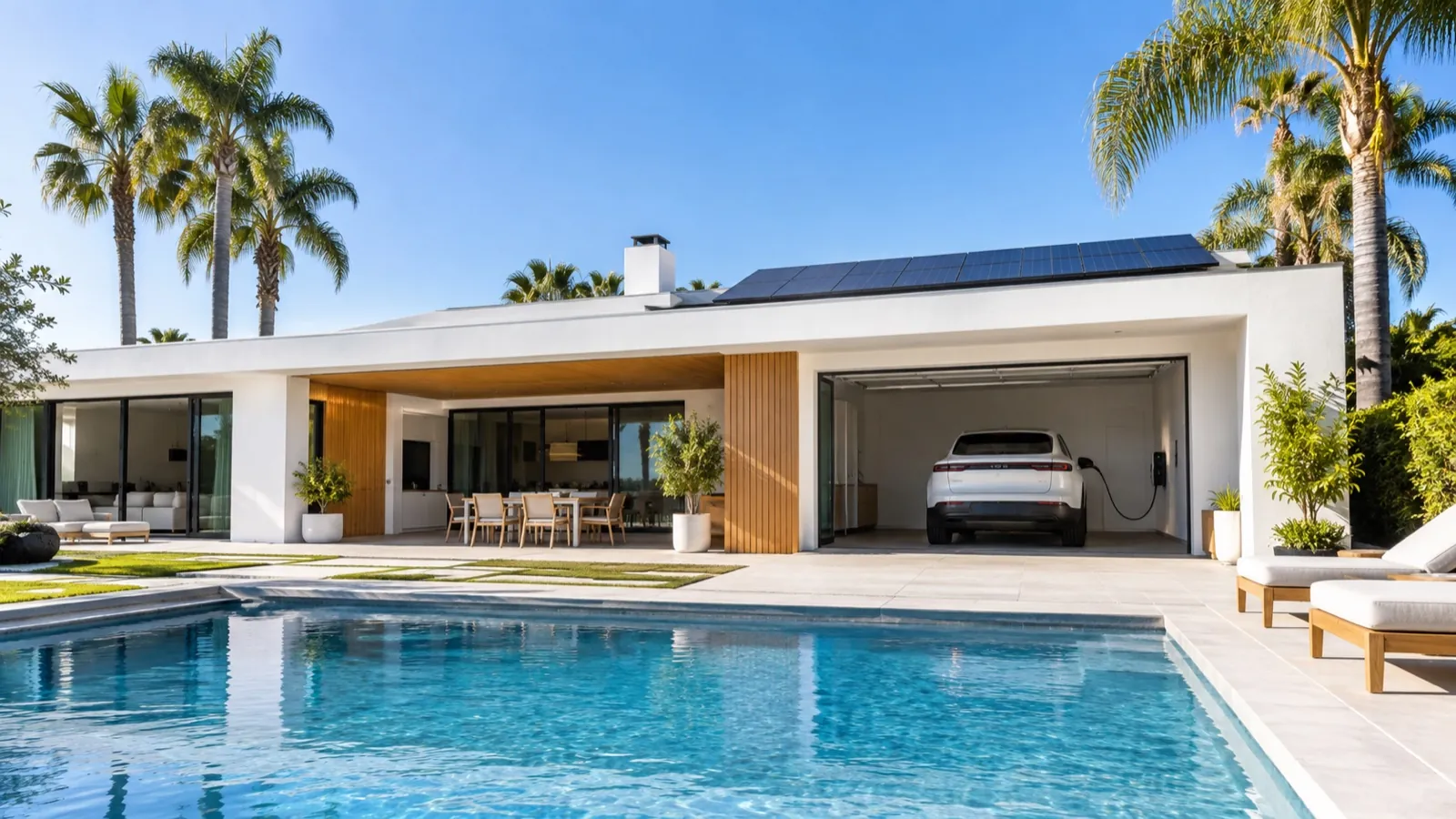
The first question people considering solar usually ask is "how many panels does a three-bedroom house need?". In the episode, Dina Silveira asks exactly that, and guest Tharsio Theodoreli takes the premise apart.
"The size of the house doesn't matter. What matters is people's habits. I have clients with 20 panels and it's more than enough, and clients with 30, 35, and it's not enough." — Tharsio Theodoreli, in the episode
The consumption bad guys
Tharsio calls the equipment that weighs most on the bill the "usual bad guys." There are four groups:
- Electric car. Today it's the biggest addition to a home's consumption. An electric car uses on average something around 0.3 kilowatt-hours per mile. Someone who drives 12,000 miles a year (about 19,000 km) adds roughly 3,600 kWh a year to the home bill, which, with modern residential panels in Southern California, can mean five to seven more panels (an illustrative estimate that varies with equipment and roof).
- Any electric heater. Space heaters, heated floors, electric water heaters, ovens. Anything that turns electricity into heat through resistance uses a lot.
- Air conditioning, especially in the hottest regions and in poorly insulated houses.
- Pool pumps, especially old single-speed ones, which can use a few thousand kWh a year. Variable-speed pumps reduce that consumption significantly, according to the U.S. Department of Energy.
The mansion case: 70 panels and the bill didn't hit zero
To illustrate, Tharsio tells the story of a client in Beverly Hills, an actor whose name he keeps private. The house had three pumps running 24 hours a day, for the pool and aquariums, plus electric heaters.
"We installed 70 panels and it wasn't enough. His bill was 3,000 dollars; now he pays 800 a month." — Tharsio Theodoreli, in the episode
A reduction of about 70%, limited by the physical space available for more panels. The example shows both sides of the math: solar cuts a lot, but it can't offset out-of-scale consumption on its own. In these cases, replacing or adjusting equipment (variable-speed pumps, a heat pump instead of electric resistance) can deliver as much as adding panels.
How to get the right number for your home
The method serious installers use follows the same logic, with no magic formula:
- 1. Get your real consumption. Pull 12 months of kWh usage history from your electric bill (on the utility's website, such as Southern California Edison, you can download it). A single month misleads, because summer and winter are very different.
- 2. Add the family's plans. An electric car on the way, a pool, swapping a gas stove for induction, new air conditioning: the system lasts more than 25 years and needs to keep up with those changes.
- 3. Consider the roof. Orientation, pitch and shade from trees and neighboring buildings change each panel's output.
- 4. Decide on a battery. Under California's current net metering rule, surplus energy exported to the grid is worth little, and batteries now weigh on system sizing, the subject of a separate article in this newspaper.
The starting point is the same one Tharsio defends in the episode: the calculation starts from consumption, not square footage. Be wary of a quote that arrives with a number of panels without having asked for your electric bills.
New homes: the code minimum isn't your need
Anyone buying a newly built home in California already gets panels on the roof, as required by Title 24. But that system usually has 7 to 11 panels, according to Tharsio, and is sized for standard consumption. With an electric car in the garage or a pool in the backyard, the electric bill may stay high, and an expansion needs to be part of the purchase plan.
Who speaks in the episode: Tharsio Theodoreli, a Brazilian who has lived in the United States for more than 20 years and founder of Solar Freedom USA, a solar design and installation company in the Los Angeles area, where he has worked since 2018. The assessments attributed to him reflect the experience of someone working in the industry.
The numbers in this article are illustrative estimates and don't replace a design based on your real consumption by a licensed installer.
Sources and verification
- U.S. Department of Energy (energy.gov / fueleconomy.gov) — average electric vehicle consumption in kWh per mile and efficiency of variable-speed pool pumps.
- Production estimate: residential systems in Southern California generate, as an order of magnitude, 1,500 kWh per year per installed kilowatt (values vary with orientation, pitch and shading; NREL's PVWatts tool).
- California Energy Commission — Title 24, Part 6: minimum sizing of solar systems on new homes.
- Transcript and chapters of episode 14 of the Cadê Moradia podcast (May 2026), with Dina Silveira and guest Tharsio Theodoreli (Solar Freedom USA).
Watch this part of the episode:
How many panels does a house really need? (Consumption habits) — starting at 5:52 · CADÊ BRAZIL
This article is a reference edition of episode 14 of the podcast and is subject to edits and editorial additions. For the full conversation, watch the episode. — Updated on 16/09/2026.