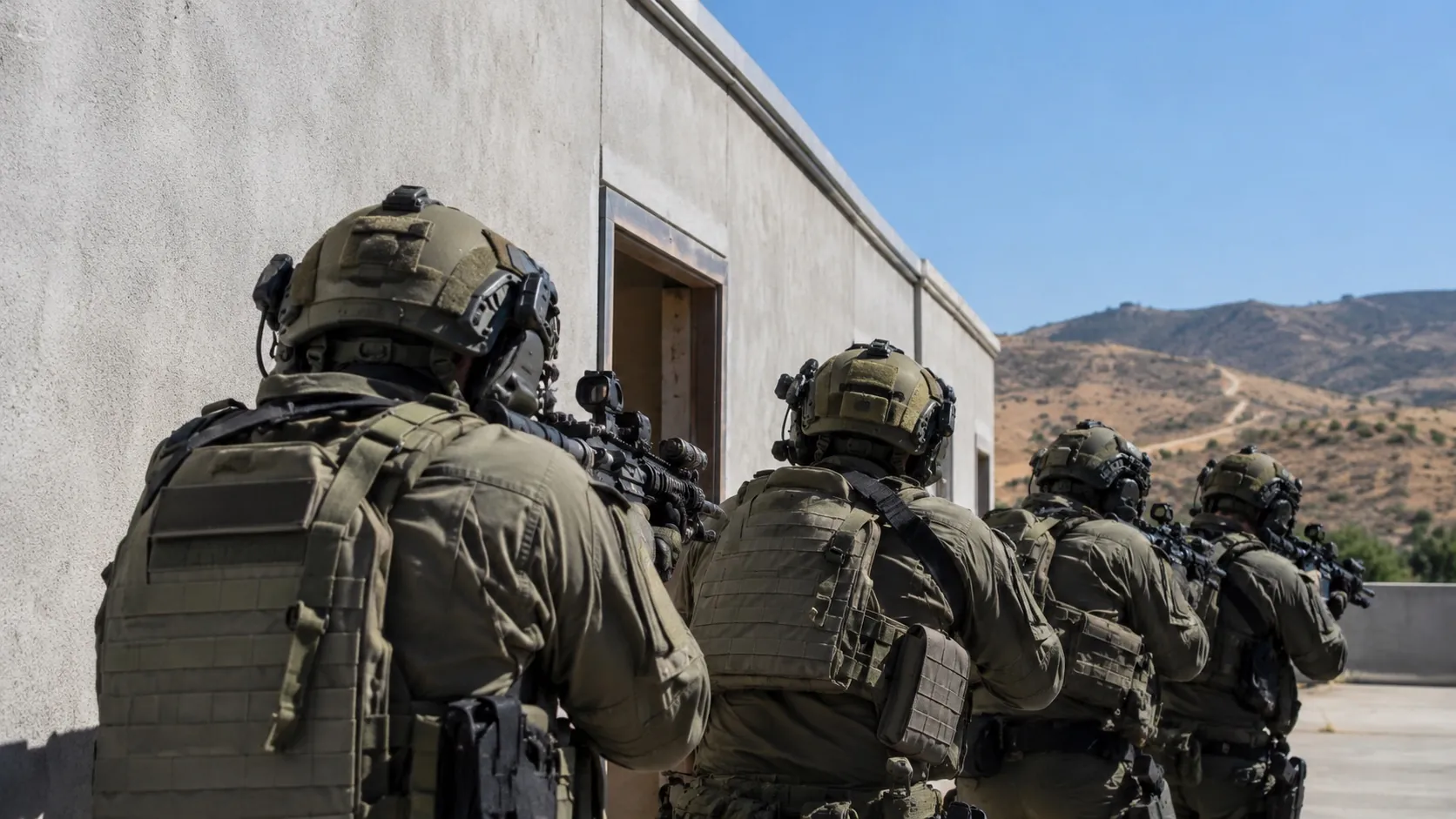


"When I joined the police, I used to say: I'm trying to be a good cop. What would that even mean?" The question comes from Paulo Brandão, a police officer in Brazil's Federal District with 27 years on the job, a guest on episode 47 of Palavrão Tático alongside his partner Felipe Teixeira. The answer he spent years looking for became one of the most talked-about moments of the conversation with Eliel Teixeira and Edwin Wu — and a piece of advice that works for any cop, whether in California, in Brasília or anywhere else.
The search: shoot well, take courses, be technical
First, he thought being a good cop meant being a good shot. He bought a reloading press — back when that was a lot harder to do in Brazil —, loaded his own ammo and trained. Then he figured it meant being technical: he started paying for courses out of his own pocket, chasing every training that came along, until he lost count. The department also sent him to courses at top-tier units, in Brazil and abroad, and he makes a point of giving it credit for that.
None of it, though, filled the void. "It only clicks after a long time."
The answer: be resistant to frustration
"To be a good cop, you have to be resilient. You have to be resistant to frustration." He explains what that means in practice. That call you walk away from feeling like you won, chest out because you made a difference, is the same one that can keep you away from home for a week, with your family rightfully upset. It's the same one where, even having done everything by the book, you'll get questioned by the prosecutors about the force you used, accused by the suspect, blamed by his family, exposed by the press. "The thing I was most fired up about was the one I took the most heat for."
The way out he found is almost domestic: a night's sleep, breakfast, a shower — and a fresh start. From the moment he understood that, he says, his life got "100%" better. The hosts joke that he could already write a self-help book for people coming into the job — and add that it's one of the best pieces of advice they've ever heard. It's not waiting for the boss to say "good job," or for anyone to clap: it's doing what had to be done.
Nothing on the street is personal
One of the hosts shares the advice he always gave the new officers he trained after the academy: never take anything personally. The person who runs, who tries to fight you, who cusses you out, who talks about your mother — they don't know you. That's the behavior of someone on the other side of the law, not an attack on you. The problem, he explains, is that a lot of cops take it to heart. And then they fall into the trap: someone is filming on their phone, provoking precisely so the officer loses his cool, and gets the video they wanted.
The best cop, by his definition, is the one who can stay calm and normal in the face of an insult — and who, at the same time, can go from zero to a hundred in a second if the situation calls for force. Both things live together: calm isn't weakness, it's control.
The idea has deep roots in American training. The Verbal Judo method, created by former police officer and professor George Thompson and published as a book in 1993, has been used for decades in police academies and teaches exactly that: let the insult slide, don't react from ego and keep your focus on the goal of the contact.
Accept it and it hurts less
Tactical courses — and military service — teach the same thing by a different route. The participants recall the moments when the instructor puts the student in a no-win situation and waits to see the reaction. The lesson: some situations aren't going to change, and complaining, crying or asking to quit won't fix anything. What's left is to accept it and keep moving. "Accept it and it hurts less." Psychology has a name for this kind of preparation — stress inoculation, controlled exposure to pressure so a person learns to function under it.
"It's not worth it"
The same host describes the question he asks himself when someone tries to provoke him: is this life or death? Am I going to lose an arm, a leg, my eyesight? No. But if I do something wrong, can I lose my pension and go to jail? I can. So it's not worth it.
In California, the math is very concrete. Under the state's public employee pension law (PEPRA), a public employee convicted of a felony committed in the course of their duties forfeits the retirement benefits earned from the date of the crime onward. And since SB 2, from 2021, POST can revoke an officer's certification for serious misconduct — which takes them out of the profession statewide, not just out of their department.
A support system Brazilian cops don't have
The hosts acknowledge a difference that works in the American officer's favor. After a shooting in the United States, it's common for the officer to be taken off the street, go through evaluation and psychological follow-up, and only return once cleared — the psychological services section of the IACP, the International Association of Chiefs of Police, publishes guidelines for that support. Brazilian cops, they say, rarely get that kind of support, and even so they rank among the best in the world for what they face with the resources they're given. "It runs in the blood," one of them sums up.
What the two of them think about it
In the episode, Eliel Teixeira and Edwin Wu talk about the advice they'd give to people just starting out, drawing on their experience training new officers in Los Angeles. Paulo Brandão's full account — in the voice of someone who took 27 years to reach that conclusion — is in the episode.
Sources and verification
George J. Thompson and Jerry B. Jenkins, Verbal Judo: The Gentle Art of Persuasion (1993). Donald Meichenbaum, Stress Inoculation Training (1985). California Public Employees' Pension Reform Act (PEPRA), Government Code § 7522.72 (forfeiture of benefits for job-related felony). California Senate Bill 2 (2021), decertification of peace officers by POST. International Association of Chiefs of Police (IACP), Police Psychological Services Section — guidelines for officer support after an officer-involved shooting. Paulo Brandão's career path and the advice to new officers are accounts from the episode's participants.
Who's talking here: Eliel Teixeira and Edwin Wu are active-duty police officers in the Los Angeles area, California — Brazilian-born, American citizens, with long careers in law enforcement. In this episode, they host Paulo Brandão, a police officer in Brazil's Federal District for 27 years, and Felipe Teixeira, a police officer in the Federal District for 16 years, who came to Los Angeles for SWAT School.
Heads up: everything described here applies to the rules in California — and, in many respects, to each officer's specific department. Rules change in other U.S. states; in Brazil, each police force has its own organic law and internal regulations.
Watch this part of the episode:
starting at 24:35 · Palavrão Tático
This article is a reference edition of episode 47 of Palavrão Tático and is subject to edits and editorial additions. For the full conversation, watch the episode. — Updated on 02/10/2026.