



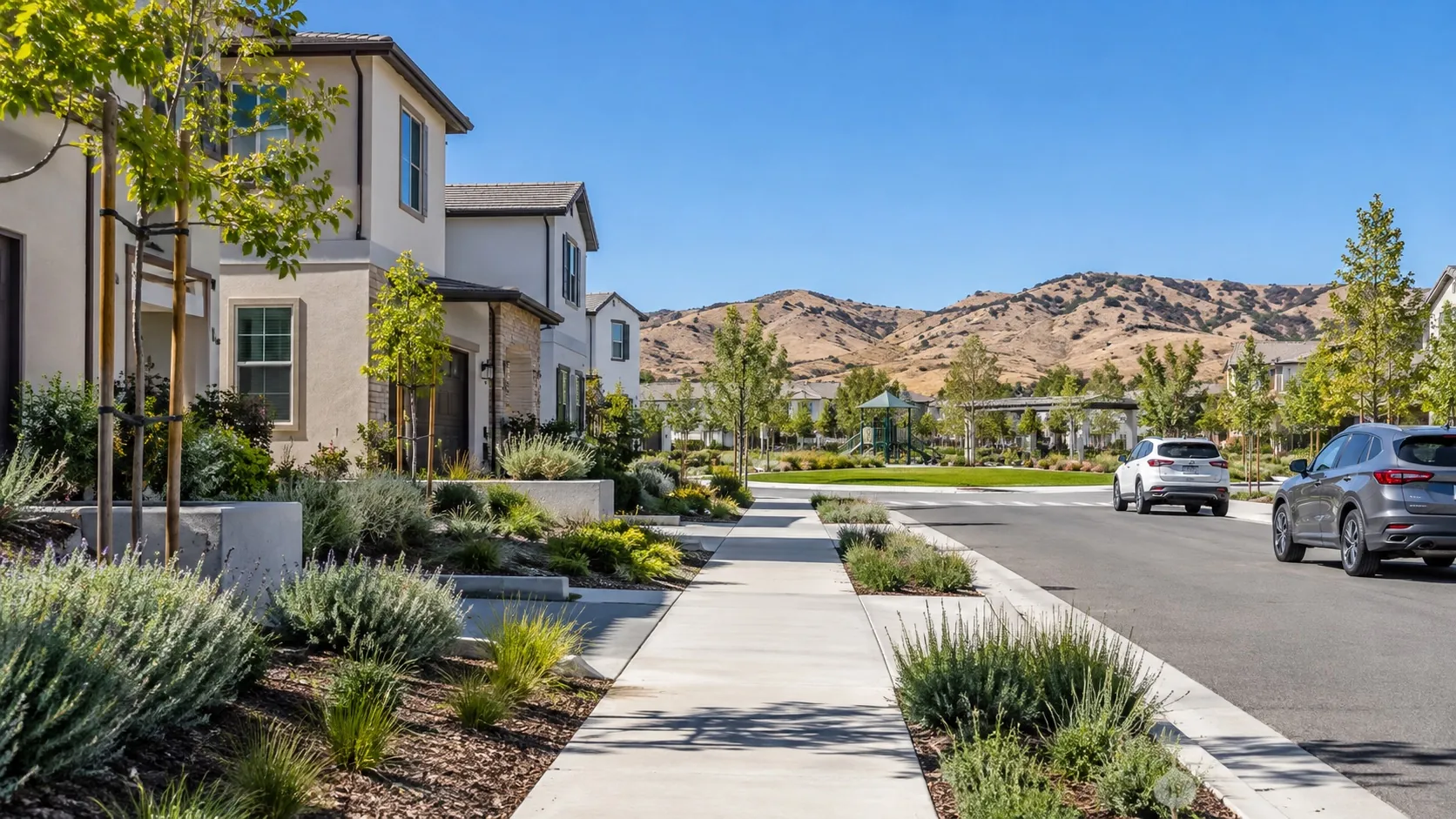
When the conversation in the episode turns to cities, the agent who covers the area north of Los Angeles brings up something new happening in Santa Clarita: neighborhoods being built around a concept that's still the exception in Southern California — being able to handle daily life on foot.
"These are areas they want to be walkable: you live there and can walk to the store, to the playground, to the school." — from the episode
Why "walkable" became a selling point
The Los Angeles metro area grew up around the car. A neighborhood where you can walk to the supermarket, let a kid bike to school, and reach a park without getting on the freeway is, here, a rare find — and, according to the episode, one with very strong demand.
The agent's point is about everyday quality of life: the feeling of "I'm home and I can handle what I need" changes a family's routine. And there's a market effect behind it — homes in areas with retail, schools, and parks nearby tend to have steadier demand, because they appeal to a wider range of buyers.
The unwritten rule: the west side costs more
The most useful part of this segment for anyone house-hunting in the area is about price geography. The agent describes the local pattern: the further west, the pricier; and west of the 5 freeway, pricier still. Santa Clarita sits between two freeways — the 14 on one side and the 5 on the other — and that position shapes much of how neighborhoods are read in the city.
On the show, the agents note the pattern repeats elsewhere in the region even where there's no ocean nearby, and admit honestly that its roots are historical and cultural — that's simply how the settlement happened and how the market has priced ever since. It's a useful reading tip for listings: two similar homes with different prices might be telling a story about location, not about the quality of the house.
What the city offers
- Family profile — the city is known for attracting families with school-age kids.
- Outdoor living — parks and trails are part of the routine; biking groups and park exercise groups come up in the episode as a social entry point for newcomers.
- Newer homes — a good chunk of the inventory is recent construction, with open-concept floor plans.
- Distance — the trade-off: it's outside the core of Los Angeles, and the daily commute needs to be factored in.
How the city came together
Santa Clarita was formed by neighboring communities — Newhall, Saugus, Canyon Country, and Valencia — that incorporated into a single city in 1987. That's what the agent sums up in the conversation: instead of five or six mayors, one. That origin explains why the neighborhoods still have very distinct identities from one another.
Before settling on a neighborhood in Santa Clarita
- Confirm the school district for the exact address — in the area, elementary and high school are served by different districts.
- Check for a Mello-Roos in the neighborhood: newer-construction areas often carry this extra property tax charge.
- Time the commute at the actual hour you'd be doing it, not mid-afternoon.
- Check the heat: in summer, the city runs noticeably hotter than the coastal strip.
Sources and verification
- City of Santa Clarita — incorporated in 1987, formed from the valley's communities.
- California Department of Transportation — routing of the I-5 and SR-14 freeways through the Santa Clarita Valley.
- Description of the walkable neighborhoods, the demand for them, and the east/west price pattern: assessment by the area's agent on the episode (March 2026).
- Transcript of episode 6 of the Cadê Moradia podcast.
Watch this part of the episode:
Santa Clarita: walkable neighborhoods and the price gap (approximate excerpt) — starting at 30:40 · CADÊ BRAZIL
This article is a reference edition of episode 6 of the podcast and is subject to edits and editorial additions. For the full conversation, watch the episode. — Updated on 18/09/2026.