



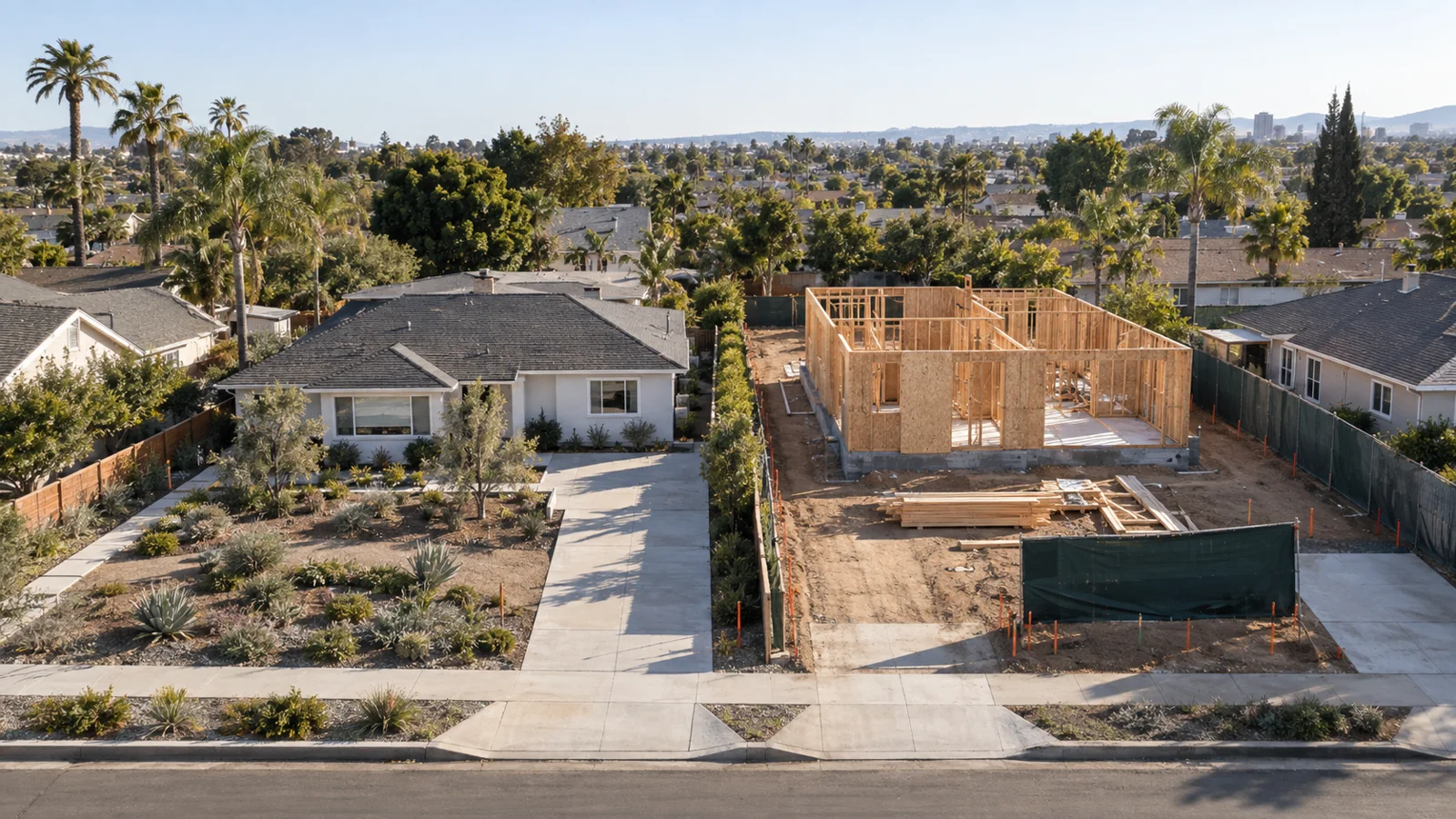
When the first modern ADU law took effect, the rule was clear: the extra unit belonged to the same property. You couldn't sell it separately. Over time, builder Rafael Pozas says in the episode, the legislation kept loosening, to the point where today you can split the lot. The law that allows it is Senate Bill 9, known as SB 9, in effect since January 1, 2022.
A new address is not a new lot
The question the show's realtors raise is one of the most common. In California, every piece of land has a tax identification number at the county level, the parcel number (APN), something like the property's registration. Rafael explains the difference:
- Traditional ADU: two addresses on the same parcel number. The unit gets its own address (something like "Unit A") and mailbox, but the land is still one lot, with one owner.
- Lot split under SB 9 (urban lot split): creates a second parcel number. There are two lots, which can have different owners and be sold separately.
One of the realtors points out that, with a single parcel number, the electricity and water connections are often shared between the house and the ADU. With the split, each lot becomes an independent property, and the connections have to follow that separation.
There is a third path, which is not SB 9: the AB 1033, in effect since 2024, allows an ADU to be sold separately as a condominium, without splitting the lot — but only in cities that adopt the option.
What SB 9 allows
The law has two parts, which can be used separately or together, on lots in single-family residential zones:
- Two units per lot: the city must approve, administratively (with no public hearing), the construction of up to two primary houses on the same lot.
- Lot split: the city must approve splitting a lot in two, provided each new lot has at least 1,200 square feet (about 111 m²) and the split is reasonably balanced — neither lot can end up with less than 40% of the original area.
Combining the two gets you to the number Rafael cites: up to four units where there used to be one house. He describes the math like this: you split the land and put a house and an ADU on each side — or you keep the units on a single parcel number, without splitting.
An important precision belongs here. When the owner uses at the same time the split and the two units per lot, the law allows the city to cap the total at two units per lot and it is not required to approve additional ADUs on those lots. In other words, the maximum SB 9 guarantees is four units in total; the exact combination (two houses per lot, or a house plus an ADU) depends on each city's regulations.
With a split, the primary houses don't have the ADU's size cap, Rafael notes. Even so, the city cannot impose rules that prevent units of at least 800 square feet, and the required side and rear setbacks cannot exceed 4 feet.
The conditions that catch investors out
SB 9 was designed for the owner, not the speculator. Rafael notes that the goal was to keep developers from moving in en masse, though demand is strong enough that the investment happens anyway. The law's main brakes are:
- Three years living there: whoever requests the lot split has to sign a declaration that they intend to live in one of the units as their primary residence for at least three years from approval.
- One split only: the same owner (or someone acting in concert with them) cannot have done an SB 9 split on a neighboring lot, and a lot created by an SB 9 split cannot be split again by that route.
- Tenant protections: excluded are properties that would require demolishing rent-controlled or low-income housing, and properties occupied by a tenant in the last three years, in certain situations.
- Excluded areas: historic districts and landmarked properties, and, as a rule, hazard areas — such as very high fire hazard severity zones, floodplains and earthquake fault zones — unless the project meets specific requirements.
- No short-term rentals: units created under the law cannot be rented for periods of 30 days or less.
Before you count on those four units
- Check your city's SB 9 regulations: permitted combinations, design standards and fees.
- Check whether the lot is in an excluded area (historic, fire, flood, earthquake fault).
- Run the feasibility study: area, shape, setbacks, each lot's street access, water and sewer connections.
- Plan the occupancy: the three-year declaration is a personal commitment.
- Budget the infrastructure cost: separating connections and opening access can weigh as much as the construction itself.
This text is for informational purposes and does not replace legal or technical advice. SB 9 is applied differently from city to city; confirm the local rules before buying or designing.
Sources and verification
- SB 9 (2021), Government Code, sections 65852.21 (two units per lot) and 66411.7 (urban lot split): minimum lot of 1,200 square feet, minimum 40% proportion, units of at least 800 square feet, maximum 4-foot setbacks, three-year occupancy declaration, exclusions and the ban on rentals of 30 days or less.
- Association of Bay Area Governments — owner-occupancy declaration templates for SB 9.
- AB 1033 (2023) — separate sale of an ADU as a condominium where the city adopts the rule.
- Transcript of episode 9 of the Cadê Moradia podcast (April 2026), with the show's realtors and builder Rafael Pozas.
This topic comes from the full episode — watch it:
CADÊ BRAZIL
This article is a reference edition of episode 9 of the podcast and is subject to edits and editorial additions. For the full conversation, watch the episode. — Updated on 17/09/2026.