



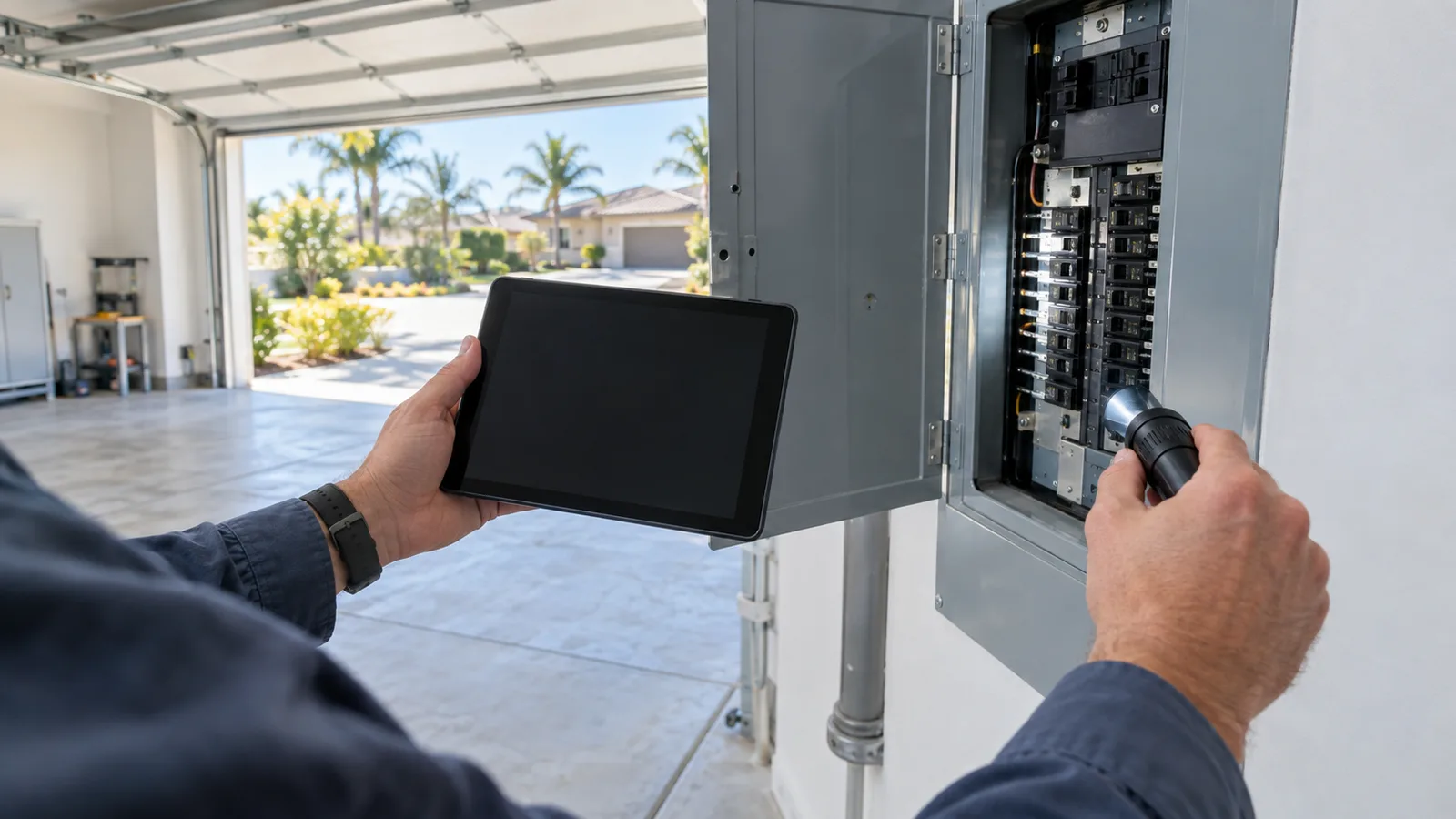
For decades, renewing homeowners insurance in California was a formality: the bill arrived, you paid it, and that was that. In the episode, the show's realtors point to a recent shift — insurers have started sending an inspector to the house, with photos and a report, before they will issue or renew a policy.
The requirement lands in an already tight market. In recent years, major insurers have stopped writing new policies or declined to renew part of their book in the state, citing the cost of wildfires, repairs and construction inflation, and many homeowners ended up on the California FAIR Plan, the insurer of last resort. In that climate, the company taking on the risk wants to know exactly what it is covering.
The most common format is the so-called four-point inspection (or 4-point). Aguiar, the home inspector featured in the episode, walks through each one.
1. Roof
The insurer wants to know the condition of the roof, its approximate age, whether there are signs of leaks, recent repairs and fire risk. Aguiar uses a drone to photograph the roof and goes into the attic (the space under the roof) to look for water stains.
He tells of a house he inspected at the request of the daughters of an elderly resident: the roof looked, in his words, like "a thatched hut" and, in his assessment, was a serious fire hazard. With that roof, the policy would not be renewed.
In general, roofs near the end of their service life — many insurers use a benchmark of 20 years or more for certain materials — are the ones most likely to trigger a replacement demand.
2. Electrical panel: the brands that don't pass
The second item is the breaker box. Aguiar explains that there are older panel brands whose breakers may fail to trip during an overload or short circuit — exactly the job they are supposed to do. He compares it to the electric shower head in Brazil: when the load goes past the limit, the breaker trips and prevents a fire. In these panels, that may not happen.
The brands most often flagged by inspectors and insurers are:
- Zinsco (also sold as Sylvania-Zinsco), common in homes built in the 1960s and 1970s;
- Federal Pacific Electric (FPE), especially the Stab-Lok line;
- Bulldog Pushmatic, very old panels with push-button breakers;
- some models of Challenger with a known recall.
Aguiar says the inspector has to name the brand in the report — even knowing it can get in the way of a sale — because the insurer will refuse the policy until the panel is replaced. He tells of a client in San Diego who had to replace her box; after the swap, new photos were all it took for the renewal to go through.
3. Plumbing: galvanized, copper, PEX — and the cover-up
In the plumbing, the item that usually fails is galvanized iron, a material used in older homes. Over time it corrodes from the inside, cuts the water pressure and can leak. More recent plumbing uses copper (rigid or flexible) or PEX, the flexible plastic tubing.
The trouble is that you can't always see it. Aguiar tells two stories that show both sides of the risk:
- The fake galvanized. On a thick exterior pipe, dirty, painted gray and threaded, everything pointed to galvanized iron — and that is what he wrote down. The insurer froze the renewal, the owner complained, and Aguiar went back to the property, scraped the paint and found it was painted PVC. He corrected the report with close-up photos.
- The copper cover-up. At a house in the Riverside area, the exposed plumbing out front and in the garage was copper, and what reached the seller's agent was that the whole house was copper. Scraping the supply lines under the sinks, Aguiar found galvanized in every bathroom.
The show's realtors point out that a real estate agent does not inspect and is not licensed to certify building materials: the agent passes along what the owner reports. That is why the independent confirmation comes from the inspector.
4. Air conditioning and heating
The fourth item is the HVAC system: age, brand, model and condition. Aguiar considers this the least decisive item for insurers, but he has a warning for buyers about units still running on the refrigerant R-22. Under U.S. Environmental Protection Agency (EPA) rules, new equipment stopped being manufactured with R-22 in 2010, and production and import of the refrigerant ended on January 1, 2020. A 30-year-old unit may still be running fine, but when it breaks, the repair tends to be expensive or impossible — and replacing the system goes on the tab.
What to do, in practice
- Buyer: before you remove the inspection contingency, get an insurance quote using the findings in the report. A panel, roof or plumbing the insurer won't accept becomes an immediate cost — and a negotiating point.
- Ask for close-up photos of the pipe material and the panel label in the report. When in doubt, the inspector can scrape a section, as Aguiar did.
- Owner: if your insurer asks for an inspection, you already know what will be looked at. Fixing it before the visit saves you a round of rejection.
- Don't hide it or dress it up. Replacing only the exposed plumbing doesn't change what is inside the wall — and the problem shows up at the first serious inspection.
This text is for informational purposes. Acceptance criteria vary from insurer to insurer and change often; confirm the requirements with your insurance agent before making a decision.
Sources and verification
- Four-point inspection (roof, electrical, plumbing and HVAC): criteria described by Southern California inspection companies and industry guides (Rocket Mortgage, HomeTeam).
- California Department of Insurance and California FAIR Plan Association — the state of the homeowners insurance market in California and the FAIR Plan's role as insurer of last resort.
- U.S. Environmental Protection Agency — phase-out schedule for HCFC-22 (R-22): end of manufacturing of new equipment in 2010 and of production and import on January 1, 2020.
- Zinsco, Federal Pacific Electric (Stab-Lok) and Bulldog Pushmatic panels: brands flagged by inspectors and insurers as a risk in four-point reports.
- Transcript and chapters of episode 8 of the Cadê Moradia podcast (April 2026), with inspector Aguiar and the show's realtors.
Watch this part of the episode:
The four main items insurers require in California. — starting at 21:03 · CADÊ BRAZIL
This article is a reference edition of episode 8 of the podcast and is subject to edits and editorial additions. For the full conversation, watch the episode. — Updated on 17/09/2026.