The conversation started with a Brazilian case. Paulo Brandão and Felipe Teixeira, police officers from Brazil's Federal District who were in Los Angeles for SWAT School, were telling Eliel Teixeira and Edwin Wu, on episode 48 of Palavrão Tático, how an incident involving two state police forces and several agencies turned into a "horror show" for lack of command and control. The answer from the American side came fast: "Our 9/11." The United States, one of the hosts pointed out, also learned this "the hard way" — and the lesson came from a place few people associate with public safety: California's wildfires.
9/11 as a turning point
For anyone who studies the subject, the 2001 tragedy wasn't only the attack. It was also how the response was coordinated. "People who lived through it, people who study it, they say: there's no way those guys got so much wrong in the response," one of the hosts summed up. Police officers and firefighters showed up from every direction, with no communication between them, not knowing who was in charge, with no control over who was going in and who was coming out.
The official report of the National Commission on Terrorist Attacks Upon the United States, published in 2004, documents exactly that picture in New York: the Fire Department and the Police Department set up separate command posts, their radios didn't talk to each other, information from the police helicopter about the condition of the towers never reached the fire chiefs in the lobby, and many off-duty personnel self-dispatched to the scene without anyone knowing who was inside. Not for lack of courage — for lack of a system that told each of them where they fit.
What came out of the chaos: DHS, FEMA and NIMS
The first effect was institutional. The Homeland Security Act of November 2002 created the Department of Homeland Security (DHS), which began operating in 2003 by bringing together 22 federal agencies — among them FEMA, the federal emergency management agency created in 1979, which took on a much bigger role. The hosts explained why: with thousands of independent agencies, each with its own jurisdiction, and control concentrated at the state level — "just like Brazil, Military Police and Civil Police, all at the state level" — there was no standard for a coordinated response.
The second effect was doctrinal. In February 2003, a presidential directive (HSPD-5) ordered the creation of a single national incident management system. In March 2004 came NIMS (National Incident Management System), which adopted ICS as its mandatory command structure. Since then, agencies that want federal emergency preparedness funding have had to adopt NIMS — which spread ICS to virtually every police department, fire department and emergency service in the country.
Why California already had the answer
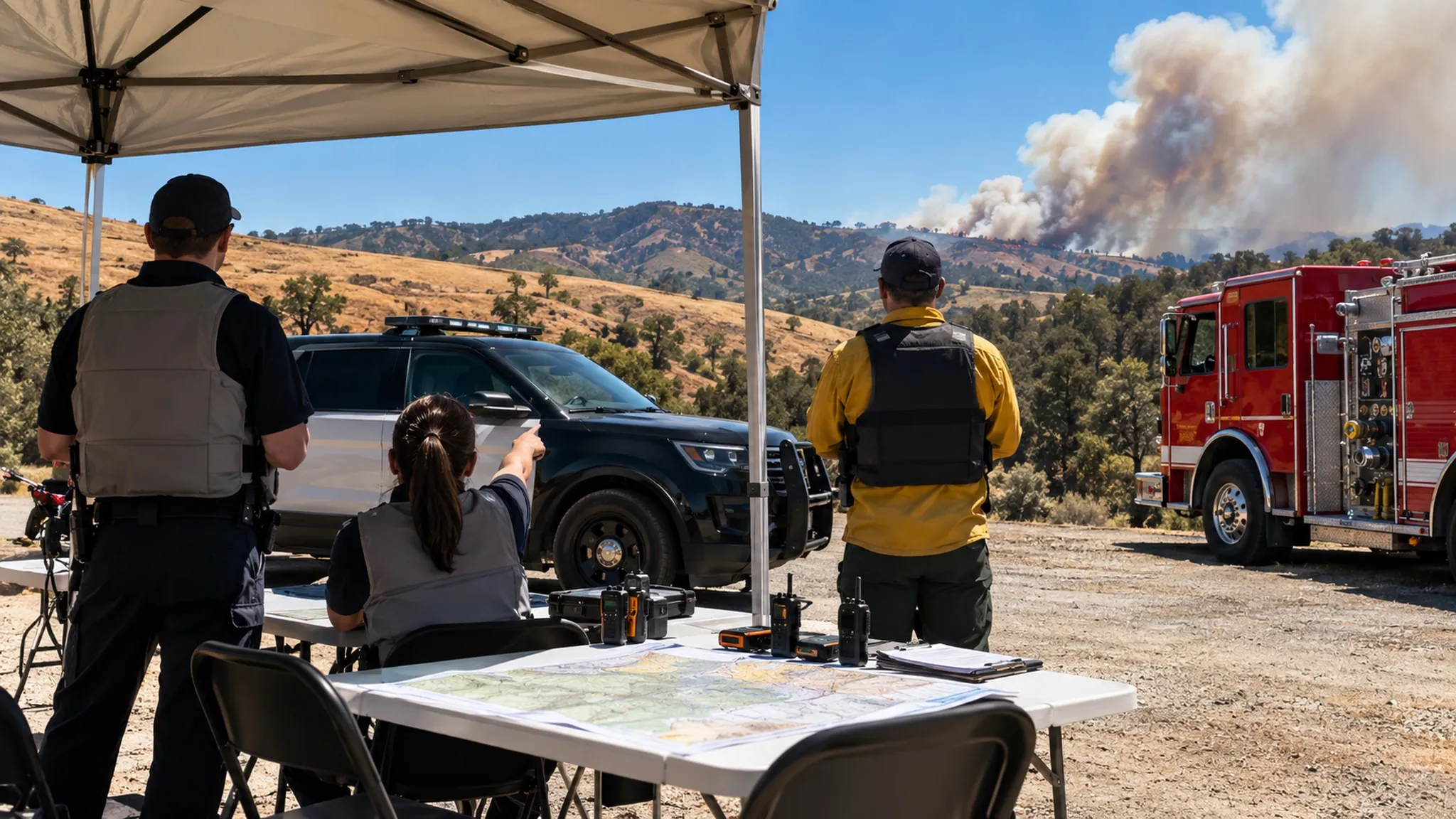
When the federal government went looking for a model, it looked to the state that was already making it work. "California, because of the wildfires, already had a definition of an incident area since the '70s," one of the hosts recalled. The system's official history confirms it: in 1970, in just 13 days, fires in Southern California killed 16 people, destroyed more than 700 structures and burned more than 500,000 acres. The after-action analysis concluded that the problem hadn't been a lack of resources, but a lack of coordination among the agencies that came to help.
That gave rise to the FIRESCOPE program (Firefighting Resources of California Organized for Potential Emergencies), funded by Congress starting in 1972, which brought together the U.S. Forest Service, Cal Fire and local fire departments. The result was ICS, built on principles that any American police officer learns today in the basic courses:
- Common terminology — no agency-specific codes on the radio;
- Modular organization — the structure expands or contracts with the size of the incident;
- Single chain of command — and, when several jurisdictions are involved, unified command, in which the chiefs make decisions together under one plan;
- Span of control — each supervisor ideally oversees five people or units (from three to seven);
- Incident action plan — objectives set for each operational period, in writing on larger incidents;
- Resource management — whoever arrives checks in, gets logged and is given an assignment.
From ICS to Brazil's SCI
In Brazil, the model goes by SCI (Sistema de Comando de Incidentes) or SCO (Sistema de Comando em Operações), and it has been adopted by fire departments, Civil Defense and some police forces. One of the hosts said he went to São Paulo with the São Paulo Military Police to work on certifying the system, bringing the same material taught to managers in the United States — and that, according to him, São Paulo was the first agency to receive full certification. "Today I think we're already at a better level. I wouldn't say it's perfect, but it's a much higher level."
What this means for the street cop in California
In California, emergency coordination has its own layer: SEMS (Standardized Emergency Management System), created by state law after the 1991 Oakland Hills fire and written into the Government Code (section 8607). Local governments must use SEMS to qualify for state reimbursement of response costs — and SEMS is built on ICS.
On the street, that translates into a few rules an officer carries into any incident that grows:
- the first one on scene takes command until formally relieved — transfer of command is done with a briefing, not a wave;
- the command post is set, announced on the radio and doesn't move without notice;
- whoever comes to help checks in with command before acting — no unit picking its own perimeter;
- FEMA's basic courses (IS-100, IS-200 and IS-700) are a common requirement in departments, and those who run larger incidents take the advanced modules.
It's the kind of structure that only looks like bureaucracy until the day it's missing. And that's why, in the conversation, the subject came back to Brazil: the Federal District officers used two recent cases — the manhunt for Lázaro Barbosa in 2021 and the escape from the Mossoró federal prison in 2024 — as examples of incidents where several forces worked without a clear unified command.
What the two of them think about it
On the episode, Eliel Teixeira and Edwin Wu talk about the American experience with ICS — from the chaos of 2001 to the certification taken to São Paulo — and about why it matters to have the system defined before the call comes in. The full conversation with Paulo Brandão and Felipe Teixeira, including the Brazilian examples, is on the episode.
Sources and verification
National Commission on Terrorist Attacks Upon the United States, The 9/11 Commission Report (2004), chapter 9 (emergency response in New York). Homeland Security Act of 2002 (Public Law 107-296). Homeland Security Presidential Directive 5 (HSPD-5), 02/28/2003. FEMA, National Incident Management System (2004; 3rd edition, 2017). FEMA/Emergency Management Institute, history of ICS in the IS-100 course (the 1970 fires and the FIRESCOPE program). California Governor's Office of Emergency Services, SEMS — California Government Code § 8607. Bureau of Justice Statistics, Census of State and Local Law Enforcement Agencies (2018). The São Paulo certification and the assessments of the Brazilian cases are accounts from the episode's participants.
Who's talking here: Eliel Teixeira and Edwin Wu are active-duty police officers in the Los Angeles area, California — Brazilian-born, American citizens, with long careers in law enforcement. On this episode, they host Paulo Brandão, a police officer in Brazil's Federal District for 27 years, and Felipe Teixeira, a police officer in the Federal District for 16 years, who came to Los Angeles for SWAT School.
Note: everything described here applies to California rules — and, in several points, to each officer's specific department. Rules change in other U.S. states; in Brazil, each police force has its own organic law and internal regulations.
This article is a reference edition of episode 48 of Palavrão Tático and is subject to edits and editorial additions. For the full conversation, watch the episode. — Updated on 08/10/2026.