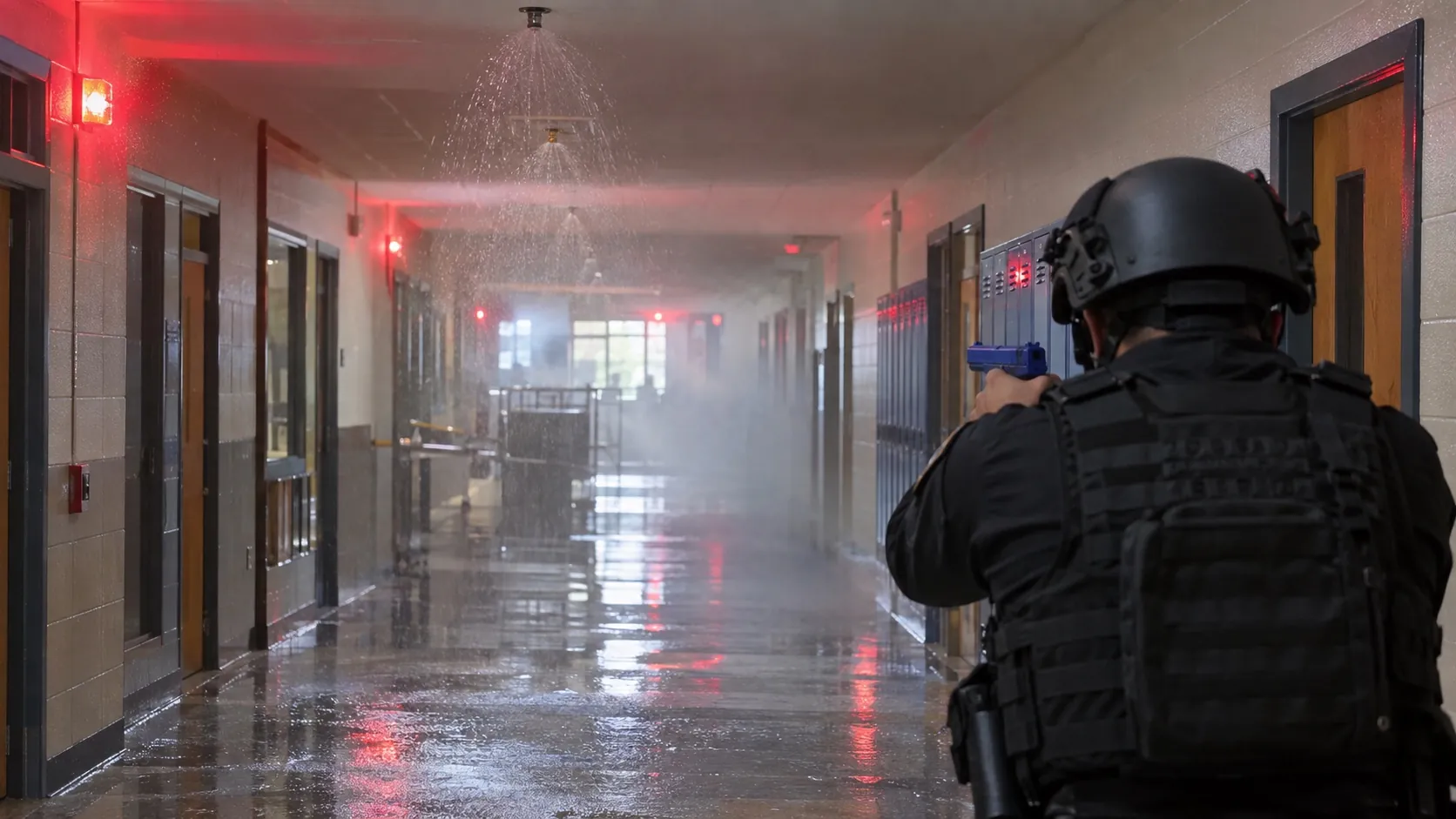
Just about every officer has been through a "dry" active shooter drill: lit hallway, working radio, familiar partners, an instructor announcing that the exercise has begun. The problem, as episode 45 of Palavrão Tático sums it up, is that no real call looks anything like that. At the first shot inside a school, the fire alarm goes off, the strobes start flashing, the sprinklers may soak everything, the radio doesn't work, and the partner beside you may be someone you've never seen before, in flip-flops and carrying a rifle. Eliel Teixeira, Edwin Wu and guest Marcelo Bini, an active shooter response instructor, talk about what changes when training starts reproducing that chaos — and about the habits that bad training carries out onto the street.
Why the brain has to be pulled out of its comfort zone
The guest describes his own method with an image: on classroom day he's "the nice guy in a suit"; the next day the simulation starts and he "puts on the other hat," the yelling one. The point, he says, isn't to turn the course into a hazing ritual — it's to take the officer out of the comfort zone, because that's what's waiting for him.
The science behind this is well documented. Under extreme stress, the body alters perception. In research with officers involved in shootings, police psychologist Alexis Artwohl reported, in an article published in the FBI Law Enforcement Bulletin (2002), that 84% experienced diminished sound and 79% had tunnel vision during the event; many also reported acting "on autopilot" and distortions in their sense of time. Training with no stressors at all means training an officer who won't exist on the day of the call.
The "Korean theory": when rank decides for you
One of the habits the guest works against in his simulations is dependence on the senior officer. If an officer always trains behind someone with more time on the job, waiting for that person to lead, what happens when that colleague goes down? In the simulation, he says, the tendency is to stay with the wounded officer and not push forward — exactly what can't happen while the shooter keeps firing. "Sometimes you have to win on your own."
The nickname refers to a subject Palavrão Tático has covered in another episode: rigid hierarchy as an accident factor, as studied in commercial aviation. In active shooter response, that has a practical consequence: the first officer on scene may be off duty or from another agency, with no familiar partner. The guest recalls that when he entered a school during a real attack, the colleague next to him was someone he had never seen before — "in flip-flops, with a rifle." What gave him confidence was knowing the other man had trained the same way.
Children, moulage and the officer who didn't see the shooter
To bring the simulation closer to reality, the course described in the episode uses actors, wound moulage, children when possible — and, when not, the sound of children. "It gets to us, so it gets to them." The guest describes one specific exercise: he would hide behind a classroom door with a weapon, the officer would come in, sweep the room and not see him. With video recording, you can show afterwards exactly where the officer's eyes failed.
The next step, he says, is technological. The guest mentions a team from ALERRT — the rapid response training center at Texas State University, adopted by the FBI in 2013 as the national standard for active shooter response training — bringing eye-tracking glasses to Brazil, which record where an officer looks as he enters a room. It's the kind of data that turns a feeling ("I think I looked there") into an objective correction.
Training scars: the mistake you train becomes the mistake you repeat
Training scars are habits acquired through repetition in training, right or wrong, that the brain reproduces automatically under stress. The classic example in American academies is the officer who, in weapon-retention drills, hands the gun back to the "attacker" to run the technique again — and risks making the same gesture in a real fight. The lesson is that repetition doesn't tell right from wrong: it only automates.
That's why the guest values criticism, wherever it comes from. He recounts that he used to approach cars a certain way until a younger officer asked why he exposed himself like that. "I had never thought about it." He changed. Accepting correction from a rookie is, in practice, the antidote to the "Korean theory."
Alarm, sprinkler, strobe and a dead radio
In the final part of the episode, the conversation returns to the physical environment of a school under attack. The three list what almost nobody trains for:
- Fire alarm and strobe lights. Gunfire and smoke can trigger the fire system. The continuous noise covers voices and shots and makes it harder to locate the shooter. At Columbine, in 1999, alarms and sprinklers going off during the attack are a well-known part of the record.
- Sprinklers. Heavy water coming down from the ceiling, slick floors, gear and clothing soaked and heavy.
- A radio that doesn't work. Concrete and metal structures block the signal. In "dry" training, the officer calls for backup on the radio and everything flows; in real life, communication may have to happen through hand signals and touch.
- Smoke and low visibility, which change how every hallway reads.
One of the hosts plays, in the studio, video of a full department exercise with around 500 officers, run in a building with many rooms, with strobes, smoke and alarms going. Even without audio, the footage makes the difference from conventional training obvious.
Simunition and the fatal funnel
The last element is pain. Marking ammunition — known by the brand name Simunition and the nickname "Sims" — fires paint projectiles from converted weapons, and it hurts. That changes the behavior of whoever is training: after taking a marking round, an officer tends to freeze in the fatal funnel, the doorway, the most exposed point of any room entry. That freeze is exactly what training has to expose and correct before the real call.
The guest recounts that officers from Cipe, in Espírito Santo, used marking ammunition in the training they did in Los Angeles — and "took a ton of hits." The hosts' reaction sums up the philosophy of the segment: knowing that is "a wonderful thing," because immediate feedback teaches what no lecture can.
Sources and verification
Artwohl, A. "Perceptual and Memory Distortion During Officer-Involved Shootings," FBI Law Enforcement Bulletin, October 2002. ALERRT (Advanced Law Enforcement Rapid Response Training), Texas State University — adopted by the FBI in 2013 as the national standard for active shooter response training. Public reports on the Columbine High School attack (1999). Simunition is a registered trademark of marking training ammunition. The accounts of course methodology, simulations, eye-tracking glasses and department-wide exercises come from the episode's participants; the use of marking ammunition by the Cipe officers was reported on the show and has not been independently verified.
Who's speaking here: Eliel Teixeira and Edwin Wu are active-duty police officers in the Los Angeles, California area — Brazilian-born, American citizens, with long careers in law enforcement. In this episode they host Marcelo Bini, who worked as a police officer in Texas and is an active shooter response instructor.
Heads up: everything described here applies to California rules — and, on several points, to each person's specific department. Training protocols vary between departments and states.
Watch this part of the episode:
Realistic training for critical incidents — starting at 27:15 · Palavrão Tático
This article is a reference edition of episode 45 of Palavrão Tático and is subject to edits and editorial additions. For the full conversation, watch the episode. — Updated on 16/09/2026.